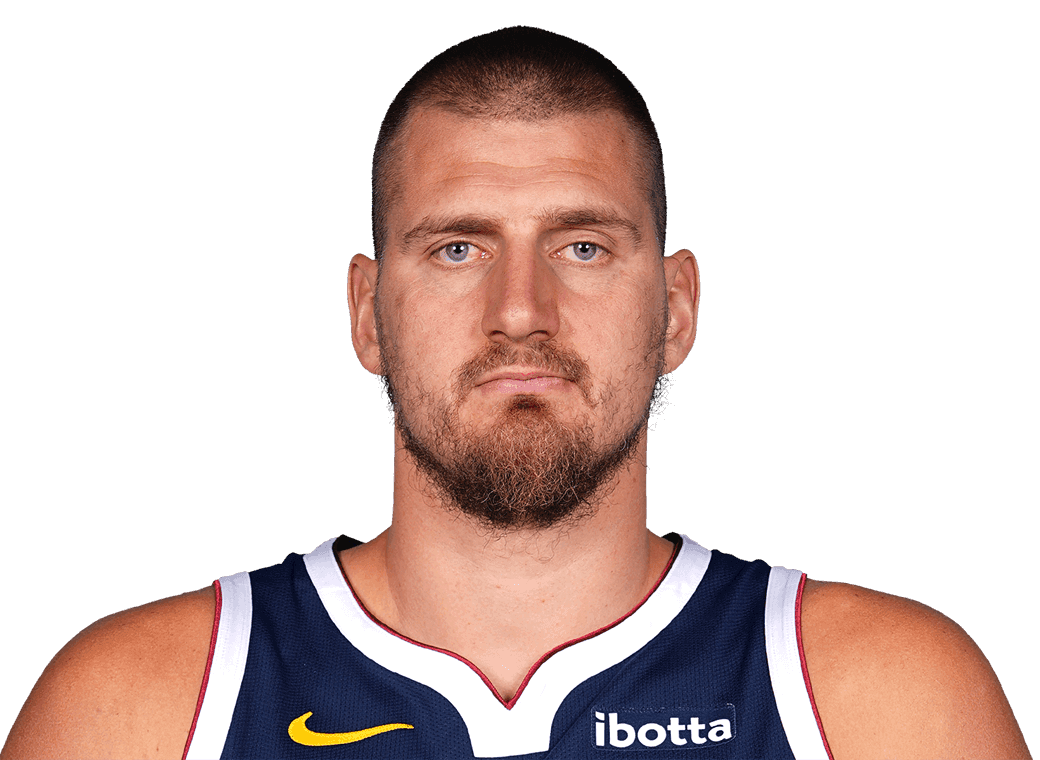
How Nikola Jokic Changed What an NBA Big Man Can Be
Three MVPs. One championship. Zero athleticism advantages. A statistical deep dive into how Jokic redefined the center position through passing vision, efficiency, and basketball IQ.
Diosh Lequiron
··12 min read·
M
Share
This page contains affiliate links. We may earn a commission if you purchase through these links, at no extra cost to you. As an Amazon Associate I earn from qualifying purchases.
Nikola Jokić is the single strongest argument that basketball intelligence, not athleticism, is the sport's most important attribute — and his numbers demand context because without it they sound fabricated. Through 2025-26 his career averages read 25.2 points, 11.4 rebounds, and 8.9 assists; no center in NBA history has come within three assists per game of that. The efficiency is the infrastructure: a 63.1% career true shooting percentage, a 2.9 assist-to-turnover ratio better than most point guards, and a 31.2 PER — the highest in league history, above Jordan's 27.9. He does this with bottom-15% sprint speed, an unremarkable vertical, and no elite wingspan, yet has won three MVPs, a championship, and a Finals MVP. The 2023 title run — 30.2 points, 14.0 rebounds, 7.2 assists per game, first player ever to lead a postseason in all three — incinerated the "can't win in the playoffs" knock. He just sees the game further ahead than anyone.
The Statistical Unicorn
Jokic's numbers demand context because without it they sound fabricated. Through the 2025-26 season, his career averages read: 25.2 points, 11.4 rebounds, and 8.9 assists per game. No center in NBA history has come within three assists per game of that number. The assists are the headline, but the efficiency is the infrastructure:
Career True Shooting %: 63.1% (top 10 all-time among high-volume scorers)
Career assist-to-turnover ratio: 2.9 (better than most point guards)
Career PER: 31.2 (highest in NBA history, above Jordan's 27.9)
Career BPM: +10.1 (highest in NBA history)
Jokic's Player Efficiency Rating of 31.2 is the highest in NBA history. Not among centers. Not among active players. Among every player who has ever played the sport. He has held the single-season PER record three times.
Women's Nikola Jokic Navy Denver Nuggets Behind The Back Name & Number V-Neck T-Shirt
These numbers describe a player who is simultaneously one of the best scorers, one of the best passers, and one of the most efficient players in basketball history — while playing the center position, which is traditionally the least ball-dominant role on the floor.
The Passing: Point-Center Is an Understatement
Describing Jokic as a "passing big man" is like describing Steph Curry as a "shooting guard." It's technically accurate and fundamentally incomplete.
Youth Nike Nikola Jokic Navy Denver Nuggets Swingman Jersey - Icon Edition
Jokic doesn't just pass well for a center. He passes well compared to anyone who has ever played the sport. His court vision operates on a different processing layer than other players — he sees passing lanes that haven't opened yet, throws to spots where teammates are going to be, and uses the threat of his own scoring to create windows that no defender can anticipate.
The mechanical variety alone is staggering:
Men's Mitchell & Ness Nikola Jokic White Denver Nuggets 2016/17 Throwback Swingman Jersey
No-look passes from the post that hit cutters in stride
Full-court outlet passes that start fast breaks before the defense has turned around
One-handed flicks around defenders that arrive with perfect pace and placement
Bounce passes through traffic that split two defenders and hit the roll man's shooting pocket
Denver's offensive system is built on Jokic as the primary playmaker — a center who functions as the point guard, the post scorer, the high-post facilitator, and the transition quarterback, often within the same possession. The Nuggets run their offense through the center the way the 2018 Warriors ran theirs through Curry. Jokic doesn't just participate in the offense. He is the offense.
The Anti-Athlete Argument
Here's what makes Jokic's dominance genuinely confounding: he possesses none of the physical attributes traditionally associated with NBA greatness.
Unisex Nike Nikola Jokic White Denver Nuggets Swingman Jersey - Association Edition
He is not fast. His sprint speed ranks in the bottom 15% of NBA centers. He is not explosive. His vertical leap is unremarkable. He does not have an elite wingspan for his height. He's listed at 6'11" and 284 pounds, and he moves like a man who is 6'11" and 284 pounds. There is no physical attribute where Jokic would rank in the top half of NBA centers, let alone the top half of all NBA players.
And yet he has won three MVP awards, an NBA championship, and a Finals MVP. He has produced the highest PER in league history. He has led the league in assists as a center — something that hadn't happened since Wilt Chamberlain decided to try it in 1968.
"Jokic is the single best argument that basketball intelligence is the most important attribute in the sport. If a guy with below-average athleticism can be the best player in the world, what does that tell you about how much we overvalue athleticism in player evaluation?" — Zach Lowe, ESPN
Men's Nikola Jokic Navy Denver Nuggets Full-Court Press Name & Number T-Shirt
The Scoring Toolbox
Jokic's scoring defies the limitations his body seems to impose. He can't jump over you, so he shoots over you with an impossibly soft touch from mid-range — his 54% shooting from 10-16 feet is the highest among high-volume shooters in the NBA. He can't blow past you, so he uses footwork and counter moves in the post that require defenders to guess correctly three times in a row to get a stop.
His signature move — the sombor shuffle, a sweeping hook shot from the mid-post that he developed growing up in Sombor, Serbia — is essentially unguardable because it combines a fadeaway with a hook. Defenders can't block it without fouling because the ball is released behind Jokic's head, and they can't contest it because the fadeaway creates space the hook didn't need.
Nikola Jokic Denver Nuggets Framed 14" x 20" Player Caricature Art
The three-point shot has quietly become a real weapon: 35.4% for his career, but 38.7% over the last two seasons on increased volume. Teams that drop their center in pick-and-roll coverage against Jokic now pay a price at the three-point line — a development that's forced yet another defensive reckoning.
The Championship Proof
For years, the knock on Jokic was that his style couldn't win in the playoffs. Too slow. Too dependent on a system. Too passive in crunch time. The 2023 championship run didn't just answer those questions — it incinerated them.
Zeke Nnaji Youth Fanatics Navy Denver Nuggets Fast Break Custom Replica Jersey - Icon Edition
Jokic averaged 30.2 points, 14.0 rebounds, and 7.2 assists through the entire 2023 postseason, sweeping the Lakers and beating the Heat in five games. He became the first player in NBA history to lead all players in points, rebounds, and assists in a single postseason. The Finals weren't competitive — and Jokic's dominance was the primary reason.
His Game 5 clincher — 28 points, 16 rebounds, 4 assists, with the Nuggets never trailing — was the most serene championship performance in recent memory. No fist pumps. No trash talk. Just methodical, surgical efficiency from a player who treats basketball like a chess match where he can see five moves ahead.
Jamal Murray Youth Fanatics Navy Denver Nuggets Fast Break Custom Replica Jersey - Icon Edition
What He Changed
The Jokic Effect isn't just about one player's dominance. It's about what his success has proven to every front office, scout, and development program in basketball: athleticism is a tool, not a prerequisite. Basketball IQ, passing vision, touch, and footwork can substitute for — and in Jokic's case, exceed — pure physical talent.
Young centers around the world are now being taught to pass before they're taught to dunk. Post footwork is back in development programs after a decade of neglect. And somewhere in a small Serbian town, the next Jokic is probably practicing sombor shuffles in an empty gym, proving that the most dominant player in the world doesn't need to be the most athletic. He just needs to be the smartest.
Enjoying this analysis?
Get more breakdowns like this delivered to your inbox.
Boozer and Peterson opened as 2027 NBA Rookie of the Year co-favorites over No. 1 pick AJ Dybantsa. We break down role, usage and the real case for each.
AJ Dybantsa is the presumptive face of the Wizards' rebuild — brought in as the No. 1 overall pick even though Washington already has six NBA wings on the roster. A look at the record-breaking BYU season, the Darryn Peterson decision, and why talent still beats a crowded depth chart.
Dylan Harper arrived as the No. 2 pick and finished his rookie year as an All-Rookie First Team guard starting in the NBA Finals. A film-room look at the Filipino-American lead guard powering San Antonio's next era alongside Victor Wembanyama.