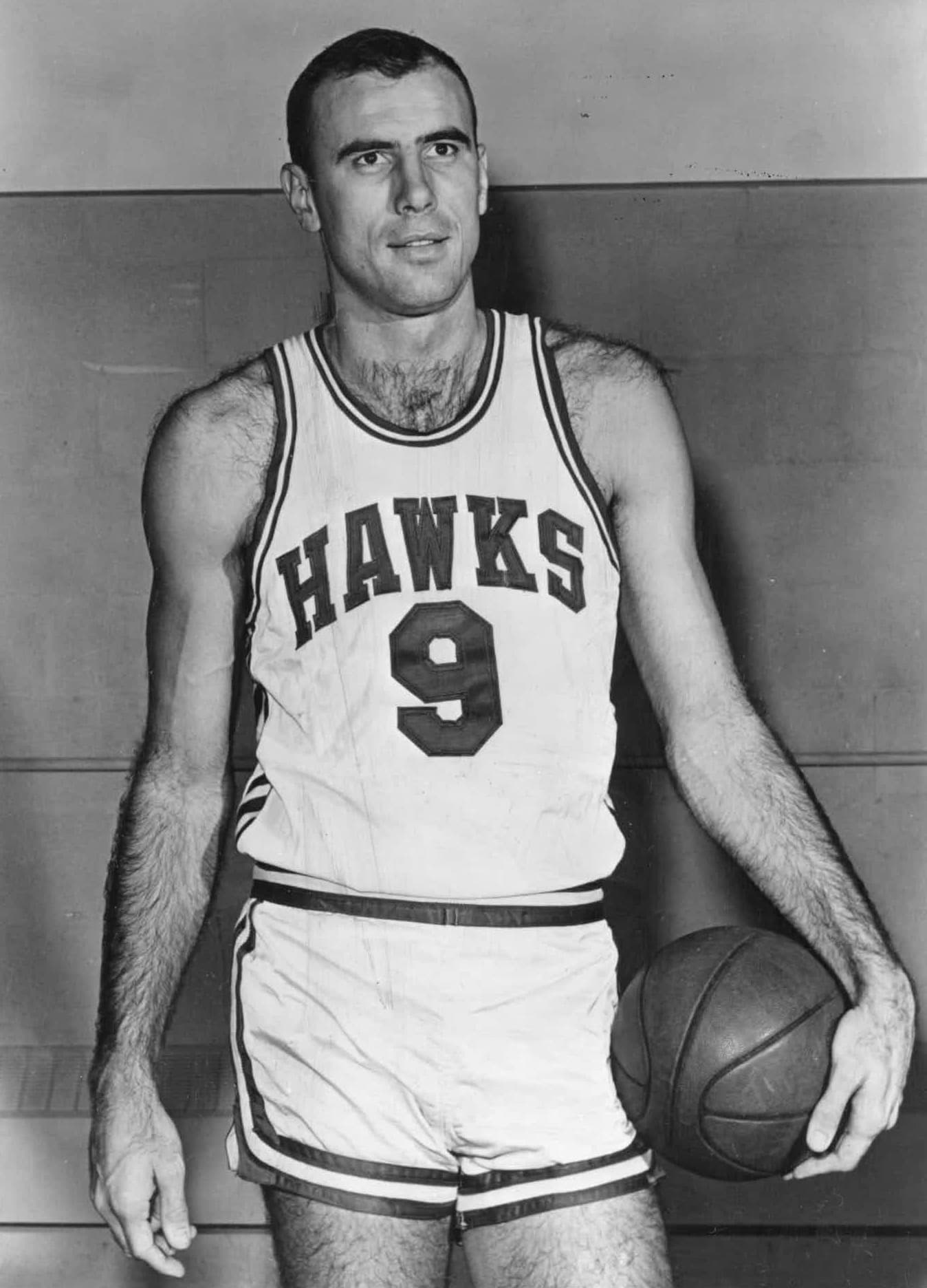
The Atlanta Hawks retired Bob Pettit's #9 because of everything that number represents — including the only NBA title in the history of a franchise that has played since 1946 in three cities. On April 12, 1958, at Kiel Auditorium in St. Louis, Pettit scored 50 points in Game 6 to beat the defending-champion Boston Celtics 110-109 and deliver the city its first and only basketball title. Pettit's story began with rejection: cut from his Baton Rouge High School team as a freshman, he built a basket in his backyard and worked relentlessly. The Milwaukee Hawks selected him second overall in the 1954 NBA Draft; by his second season he had won both the NBA MVP and the scoring title. He was an eleven-time All-Star, a two-time MVP, the first player to score 20,000 career points, and a 1971 Hall of Fame inductee. #9 will remain retired as long as the franchise plays.
The Player Who Was Cut in High School
Bob Pettit's story begins with rejection. As a freshman at Baton Rouge High School in Louisiana, he tried out for the basketball team and was cut. The coach did not believe he had the physical tools or the coordination to contribute. Pettit went home, installed a basket in his backyard, and spent the next several years working with a dedication that coaches now describe when they explain what elite work ethic actually looks like in practice.
By the time he reached LSU, he was one of the premier players in the Southeastern Conference. By the time the Milwaukee Hawks selected him second overall in the 1954 NBA Draft, he was considered a foundational piece for a franchise that desperately needed one. And by the time the franchise relocated to St. Louis, Pettit had already established himself as one of the most dangerous power forwards the game had seen.
In his second NBA season, Pettit won both the NBA MVP and the scoring title — a double achievement that established him as the standard for the position and announced to the league that St. Louis had a player who could carry a franchise.
The 1958 Finals
The St. Louis Hawks had reached the NBA Finals the year before and lost in seven games to the same Boston Celtics team. It was a 1957 series decided at the margins — a missed shot at the buzzer, a franchise away from history. The lessons absorbed in that defeat shaped everything the Hawks did in the 1957-58 season.
Bob Pettit and Cliff Hagan formed one of the premier frontcourt duos in the early NBA. Their combination of size, scoring, and basketball intelligence gave opposing defenses a problem with no clean solution: stop Pettit and Hagan exploited the resulting openings, stop Hagan and Pettit dismantled the defense on his own terms.
In the 1958 Finals, the Celtics were further compromised when Bill Russell — the defensive anchor — injured his ankle in Game 3 and was unable to operate at full capacity for the remainder of the series.
Game 6: 50 Points
The Hawks led the series three games to two heading into Game 6 in St. Louis. One win from a championship. Bob Pettit made sure there would not be a Game 7.
Fifty points. On the most important night of the franchise's history, against the best defensive organization in basketball, in front of his home crowd. Pettit scored 19 of the Hawks' final 21 points in the fourth quarter — a stretch of sustained individual brilliance in a pressure situation that defines what the greatest players deliver when the stakes are highest.
His teammates watched the final minutes from the bench with the expression of men who understood they were witnessing something outside the ordinary category of great performance. This was different.
Final score: St. Louis Hawks 110, Boston Celtics 109. NBA Champions. One city's first and only basketball title.
The Career Beneath the Moment
- Two-time NBA MVP (1956, 1959)
- Eleven All-Star selections (every season he played)
- NBA scoring champion (1956, 1957)
- Career 26.4 points per game
- First player in NBA history to score 20,000 career points
- 1971 Naismith Memorial Basketball Hall of Fame inductee
Why #9 Belongs in the Rafters
The Atlanta Hawks retired Bob Pettit's #9 because of everything that number represents: the years of work that began in a backyard after a freshman cut, the professionalism that produced back-to-back MVPs, the championship that remains the singular achievement in franchise history, and the 50-point performance that delivered it. The number 9 is retired. And it will remain retired as long as the franchise plays basketball.
Enjoying this analysis?
Get more breakdowns like this delivered to your inbox.