This page contains affiliate links. We may earn a commission if you purchase through these links, at no extra cost to you. As an Amazon Associate I earn from qualifying purchases.
On January 5, 1988, Pete Maravich collapsed on a church basketball court in Pasadena, California, and died at forty years old. He had played pickup basketball that morning feeling great, telling a friend he had never felt better in his life. Doctors later discovered what should have been impossible: Maravich had been born without a left coronary artery. By all medical understanding, he should not have survived childhood, let alone a fourteen-year professional basketball career. But then, Pete Maravich had always done what was not supposed to be possible.
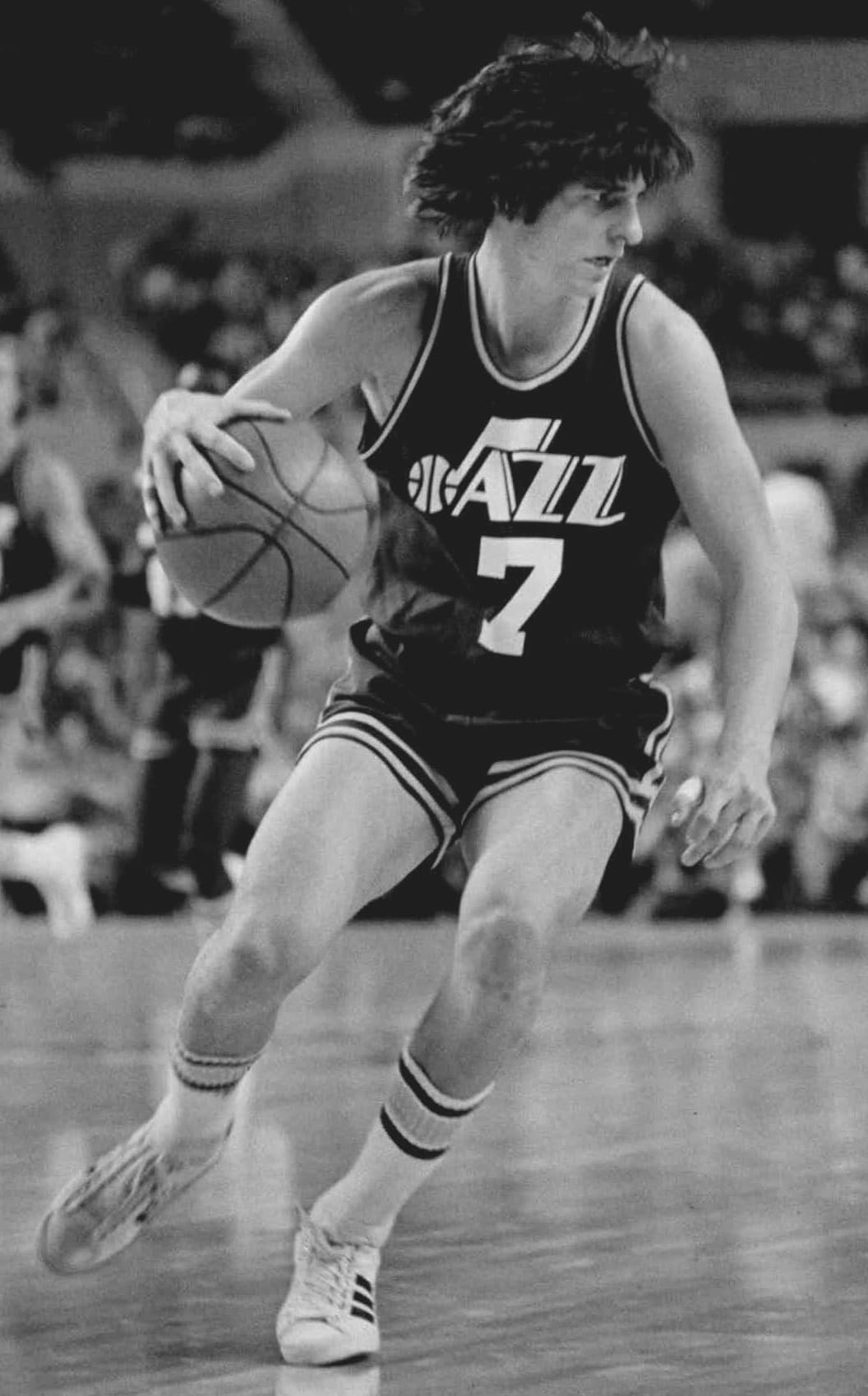
When the New Orleans Pelicans retired the number 7 in 2002, they were honoring a man who had never worn their colors — a ghost of a franchise that left town more than two decades earlier. The New Orleans Jazz played in the Crescent City from 1974 to 1979. In those five seasons, Maravich became the defining basketball figure in Louisiana history. The number still belongs to the city. It always will.
The Boy Who Dribbled Everywhere
Peter Press Maravich was born in Aliquippa, Pennsylvania, in 1947, the son of Press Maravich, a basketball lifer who coached at every level of the game. By age seven, Pete was dribbling in movie theaters, dribbling on the way to school, dribbling himself to sleep at night. Press understood what he had on his hands and spent every spare hour making his son the most technically complete scorer the game had ever produced.
LSU hired Press Maravich as head coach in 1966, and Pete enrolled as a freshman the following year. NCAA rules then did not count freshman statistics toward career totals, so Maravich's three varsity seasons stand as the most prolific scoring run in college basketball history: 3,667 points at 44.2 points per game. There was no three-point line. There were shorter shot clocks, physical defense, and no player in the building capable of guarding him. He floated, he faked, he threw no-look passes to teammates who were not expecting them. The 44.2 came from pure craft — the product of a childhood spent doing nothing else.

44.2 Points Per Game — Without the Three-Point Line
The 1970 NBA Draft produced Maravich third overall to the Atlanta Hawks, behind Bob Lanier and Rudy Tomjanovich. He signed for $1.9 million over five years — at the time the largest contract in league history — before playing a single professional minute. The pressure was immediate and the backlash was sharp. Teammates resented the contract. Coaches struggled to fit him into systems built for players less singular than he was. Atlanta never found the right formula, and five productive but unfulfilling seasons followed.
He averaged over 19 points per game in each of his first four NBA seasons, but the Hawks were never a contender, and the offense never felt built for what Maravich was capable of. He was the best player on a mediocre team in a city that had not yet made him its own. That city was coming. Its name was New Orleans.
Pistol Pete Comes to New Orleans
In 1974, the NBA awarded an expansion franchise to New Orleans, and Maravich was traded to the Jazz before the team played its first game. He was twenty-six years old. For the first time, a franchise had been built — at least in aspiration — around his way of playing basketball. The city embraced him without reservation.
New Orleans understood performance. It understood spectacle and joy and doing things with a little more flair than strictly necessary. Maravich played with floppy socks and floppy hair and the attitude of a man who believed basketball was the most fun a human being could legally have. He threw behind-the-back passes off the dribble. He pulled up from ranges that would now register as threes. He made the crowd feel like collaborators in something rare.

The 1977-78 season was his masterpiece: 31.1 points per game, the NBA scoring title, and a Jazz team that went 39-43 but finally felt like itself. He made six All-Star Games during his career. When the Jazz left for Utah in 1979, Maravich's New Orleans chapter was over — but the city's relationship with that chapter never ended. Some performances cannot be followed. They can only be remembered.
The Style That Invented the Future
Watch footage of Maravich from the early 1970s and you are not watching the past. You are watching a rough draft of the game played today. The hesitation dribble he used to create separation. The mid-range pull-up from the elbow. The skip pass that collapsed half-court defenses. The ability to draw contact and finish through it. His shot selection — attacking the rim when the lane was open, kicking to the open man when the help arrived — maps cleanly onto modern offensive principles. He arrived at the right answers forty years before the analytics validated them.
The players who came after him absorbed what he left behind. Magic Johnson built the no-look pass into his signature. Jason Williams took his between-the-legs creativity mainstream in the late 1990s. Kyrie Irving has cited Maravich's ball-handling directly. Kobe Bryant studied him. Steph Curry, whose pull-up game and feel for space echo Maravich's most clearly, has acknowledged the lineage. The debt the modern game owes Pistol Pete is enormous and quietly present in almost every highlight package in circulation.

Why the Pelicans Retired #7
The Pelicans arrived in New Orleans in 2002, relocating from Charlotte. They inherited an arena, a fan base, and a city's basketball memory that ran directly to Pete Maravich. The decision to retire number 7 was not just a tribute — it was a declaration about continuity. The Pelicans understood that basketball in New Orleans did not begin with their relocation. It began when a kid from Aliquippa with floppy hair stepped onto a court in the Crescent City and showed everyone what the game could look like.
No Pelican will ever wear number 7. That number belongs to the player who dribbled in the dark before anyone was watching, who scored 44.2 points a game without a three-point line, who made an expansion franchise in the Deep South feel like the center of the basketball universe for five unforgettable seasons. It belongs to one of the most gifted players the game has ever seen — gone at forty, still without a true successor five decades later.

The retired number hanging in the rafters is not nostalgia. It is a calibration — a reminder of what basketball creativity looks like when it exists without a ceiling. Every Pelican who laces up under that banner plays in a long shadow. So does every guard in the league who has ever tried to do something the game had not yet imagined. Pistol Pete invented the permission. New Orleans keeps the number to remind the world.
Enjoying this analysis?
Get more breakdowns like this delivered to your inbox.