This page contains affiliate links. We may earn a commission if you purchase through these links, at no extra cost to you. As an Amazon Associate I earn from qualifying purchases.
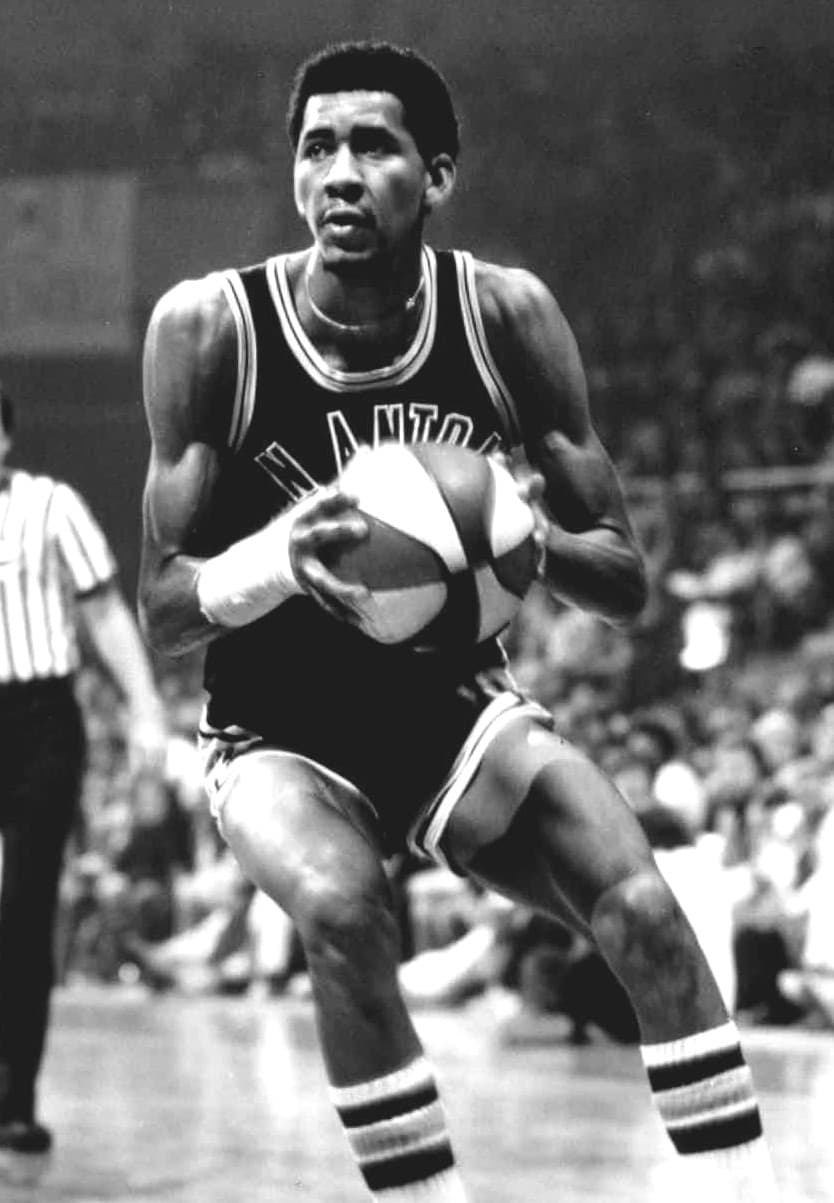
The finger roll. It is the most elegant shot in basketball history, and George Gervin owned it. He did not invent it — the mechanics existed before him — but he elevated it from a specialty move to a signature weapon, deploying it against defenders who knew it was coming and still could not stop it. The Iceman made the finger roll a statement: this is the shot I will use to score my points, and you will not stop me.
Gervin won four scoring titles in five seasons from 1978 to 1982, a concentration of offensive dominance that no player has matched in the modern era. He averaged better than 26 points per game seven times. He played with a cool, unhurried grace that made elite scoring look effortless — hence the nickname that followed him from the ABA through his entire NBA career. The Iceman never seemed to break a sweat. He just kept scoring.

From the ABA to San Antonio's First Star
Gervin's path to the Spurs ran through the American Basketball Association, where he played for the Virginia Squires and then the San Antonio Spurs when the franchise was still in the ABA. When the NBA-ABA merger happened in 1976, the Spurs and their star scorer came along, and Gervin immediately established himself as one of the most dangerous offensive players in the unified league.

His ABA years were more than just a professional apprenticeship — they were where he developed the complete offensive game that would define his NBA career. By the time he arrived in the NBA, Gervin was a polished scorer with a full arsenal: the finger roll in the lane, the mid-range jumper, the ability to get to the free throw line at will. He was twenty-four years old at the merger and entering the prime of his career.

Four Scoring Titles and the Art of the Iceman
The 1978 scoring title race is one of the most dramatic in NBA history. Gervin and David Thompson entered the final day of the season separated by less than a tenth of a point in scoring average. Thompson played the day game and scored 73 points to take the lead. Gervin played that night and scored 63 points to reclaim it. Two players scoring 70-plus points on the same day, racing for a statistical title — it was the kind of moment that became basketball legend.
Gervin would go on to win three more scoring titles, in 1979, 1980, and 1982. His scoring technique was precise and diverse: he could get buckets in the paint with the finger roll, shoot off the dribble from the mid-range, create contact and get to the line. He averaged 26.2 points per game for his career — a number that would lead the league in most modern seasons. For a franchise that had never won a championship, Gervin was the reason they mattered.
Building San Antonio's Basketball Identity
Before David Robinson, before Tim Duncan, before five championships, there was George Gervin making the Spurs relevant. He gave the franchise its first genuine superstar and its first real identity as a basketball city. San Antonio fans packed the arena to watch the Iceman work, and he delivered night after night for ten seasons.

Gervin was also the bridge between the ABA era and the franchise's NBA establishment. He carried the culture of what the Spurs had been — a scrappy, talented, offense-first team — into the new league and proved that what had worked in the ABA could compete at the highest level. Without Gervin establishing San Antonio as a basketball market worth taking seriously, the investments that followed — Robinson, the arena, the franchise's growth — might never have come.
Why the Spurs Retired #44
George Gervin's #44 was retired by the Spurs in 1987, a recognition of a decade of elite scoring that put the franchise on the map. He is one of only three players in NBA history to win four or more scoring titles, alongside Wilt Chamberlain and Michael Jordan. That company should end the debate about where Gervin belongs in basketball history.

The Iceman never won an NBA championship, and that absence is sometimes used to diminish his legacy. It should not be. Championships require depth, health, and timing as much as individual excellence. Gervin gave the Spurs everything he had for a decade and made them competitive every single season he was in uniform. #44 belongs in the rafters because George Gervin, at his peak, was one of the most unstoppable scorers the game has ever seen — and San Antonio was lucky enough to call him its own.
Enjoying this analysis?
Get more breakdowns like this delivered to your inbox.