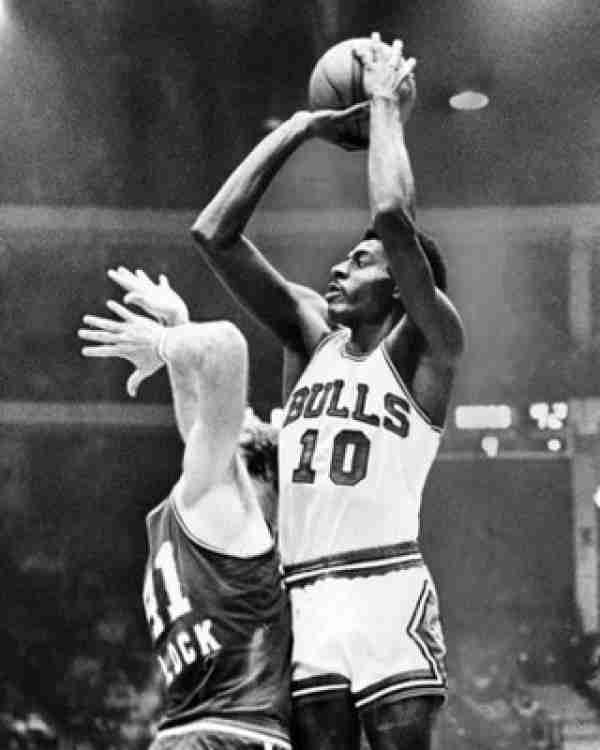
February 14, 1994. The United Center in Chicago. The Bulls are about to retire #10, and Bob Love — known as "Butterball" for the silky smoothness of his jump shot — is about to give a speech.
This moment matters for reasons that go far beyond basketball. Because in the years between Love's last game as a Bull and this ceremony, something had happened that no one in that arena had any business surviving. A severe stutter. Financial ruin. A job bussing tables at a Nordstrom restaurant in Seattle. Years of rebuilding from the ground up.
And now Bob Love — who once could barely finish a sentence — stood at center court in the building named for his former teammate and spoke without stuttering for the first time in public. The entire United Center was in tears.
The Shot That Made Chicago Believe
Before the fall, there was the rise. And the rise was magnificent.
Bob Love arrived in Chicago in 1968 from the Cincinnati Royals and immediately transformed the franchise. A 6'8" small forward with an effortless, high-release jumper that defenders called impossible to contest, Love gave the Bulls their first true scoring identity. Not a slasher. Not a post player. A shooter — a pure, beautiful, technical shooter who could get his shot from anywhere in the mid-range and beyond.
"Butterball" wasn't a nickname about his body. It was about the way the ball moved when it left his hands. Smooth. Unhurried. As if the arc was pre-determined by physics you couldn't argue with.
In the 1971-72 season, Love averaged 25.8 points per game — one of the highest single-season averages in franchise history at the time. The Bulls finished 57-25. For a franchise that had been nothing, this was everything.
He made three consecutive All-Star teams (1971, 1972, 1973). He averaged 21.3 points per game across nine seasons as a Bull. He and Jerry Sloan (#4, also retired) formed the spine of teams that went to the playoffs seven times. During the early 1970s, the Chicago Bulls were one of the most compelling teams in basketball — and Bob Love was the reason fans came to the stadium expecting to be entertained.
The Career and the Fall
A knee injury in 1974 changed everything. Love was never quite the same after surgery, and by 1977, his Bulls career was over. He bounced briefly to the New York Knicks and Seattle SuperSonics, then out of the league entirely.
What followed was a fall that even those closest to him didn't fully understand until later. Love struggled with a severe stutter that had plagued him since childhood — something he had managed through the structure and confidence of basketball. Without that structure, the stutter worsened. Work was difficult. Relationships frayed. The money that had come with NBA stardom evaporated.
By the early 1990s, Bob Love — three-time All-Star, franchise cornerstone — was bussing tables at a Nordstrom restaurant in Bellevue, Washington. A customer recognized him. Called the manager. The manager told the company's executive team. And Nordstrom — in one of the most extraordinary acts of corporate decency in sports history — offered to pay for years of speech therapy.
- Love attended therapy for two years
- The company paid every bill without condition
- Love repaid the debt by becoming a Nordstrom brand ambassador, visiting stores, speaking to employees
- He eventually gave speeches to thousands without a single hesitation
The Ceremony
When the Bulls retired his jersey in 1994, they weren't just honoring a great basketball player. They were honoring a survivor. Love's speech that night — delivered clearly, confidently, without the stutter that had stolen so many years from him — was one of the most moving moments in franchise history.
Michael Jordan, who grew up watching Love play and idolized his jump shot, sat courtside in tears. Phil Jackson later said it was the most emotional moment he experienced during his time with the Bulls. Jerry Reinsdorf, the Bulls' owner, described it as the proudest moment of his tenure with the franchise.
"I thought I had lost everything. I didn't know who I was without basketball. But getting that shot back — my voice — was bigger than any three-point play I ever made." — Bob Love, at his jersey retirement ceremony
Why #10 Is in the Rafters
Bob Love's #10 hangs in the United Center for 21.3 points per game, three All-Star selections, and nine seasons of pure scoring artistry that gave the Bulls their first offensive identity.
But it hangs there for something else too: for a man who fell as far as a former star can fall and found his way back through an unlikely combination of corporate generosity, personal determination, and two years of speech therapy. The ceremony in 1994 wasn't just a retired jersey night. It was proof that what someone does after the crowd stops cheering matters just as much as what they did to make it cheer.
Butterball was a great basketball player. He was a greater human being. And the United Center rafters remember both.
Nagustuhan mo ba ang analysis na ito?
Makakuha ng mas marami pang analysis na tulad nito sa iyong inbox.