Cette page contient des liens affiliés. Nous pouvons percevoir une commission si vous achetez via ces liens, sans frais supplémentaires pour vous. As an Amazon Associate I earn from qualifying purchases.
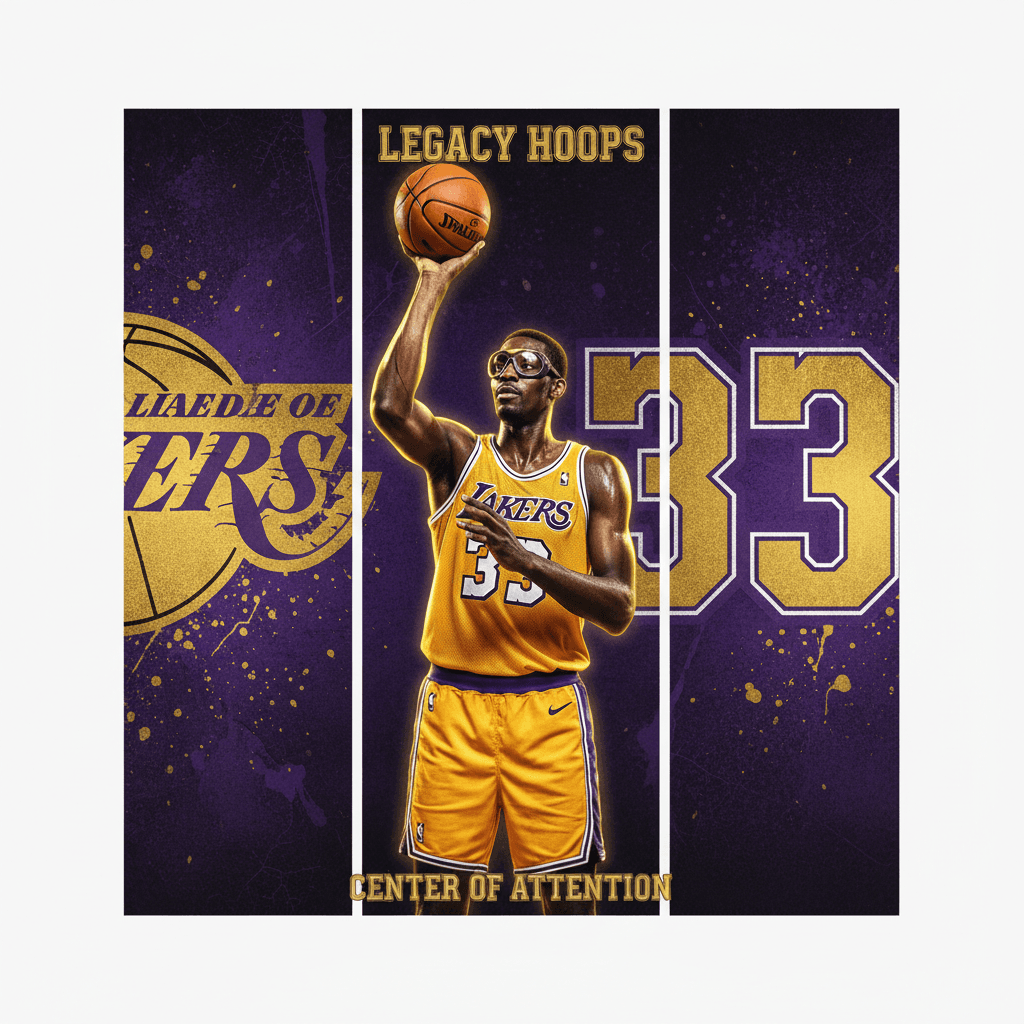
June 9, 1985. The Boston Garden parquet, the building where the Los Angeles Lakers had been broken so many times that the floor itself felt like an opponent. Game 2 of the NBA Finals, one night after the Celtics had humiliated Los Angeles by 34 points in the opener — a result the press had already nicknamed the Memorial Day Massacre. Kareem Abdul-Jabbar was 38 years old, and an entire sport had spent a year quietly agreeing he was finished. He answered with 30 points, 17 rebounds, and 44 minutes of refusal, the skyhook arcing over Robert Parish and Kevin McHale as if the calendar had been a rumor all along. The Lakers won that game, then won the series in six, and Kareem walked off as the oldest Finals MVP in league history. The number on his back was 33. Four years later it would never be worn in Los Angeles again.
There is a temptation, with a player this decorated, to reach immediately for the totals — the six MVPs, the 38,387 points, the twenty seasons. The numbers are real and they are staggering. But the totals are the residue of something harder to quantify: a man who was the best player in basketball at 24 and still the best player on the floor in a Finals at 38, who turned a single shot into a physical law that no defender ever repealed.
This is why the Lakers retired #33.
Lew Alcindor, and the Shot They Tried to Ban
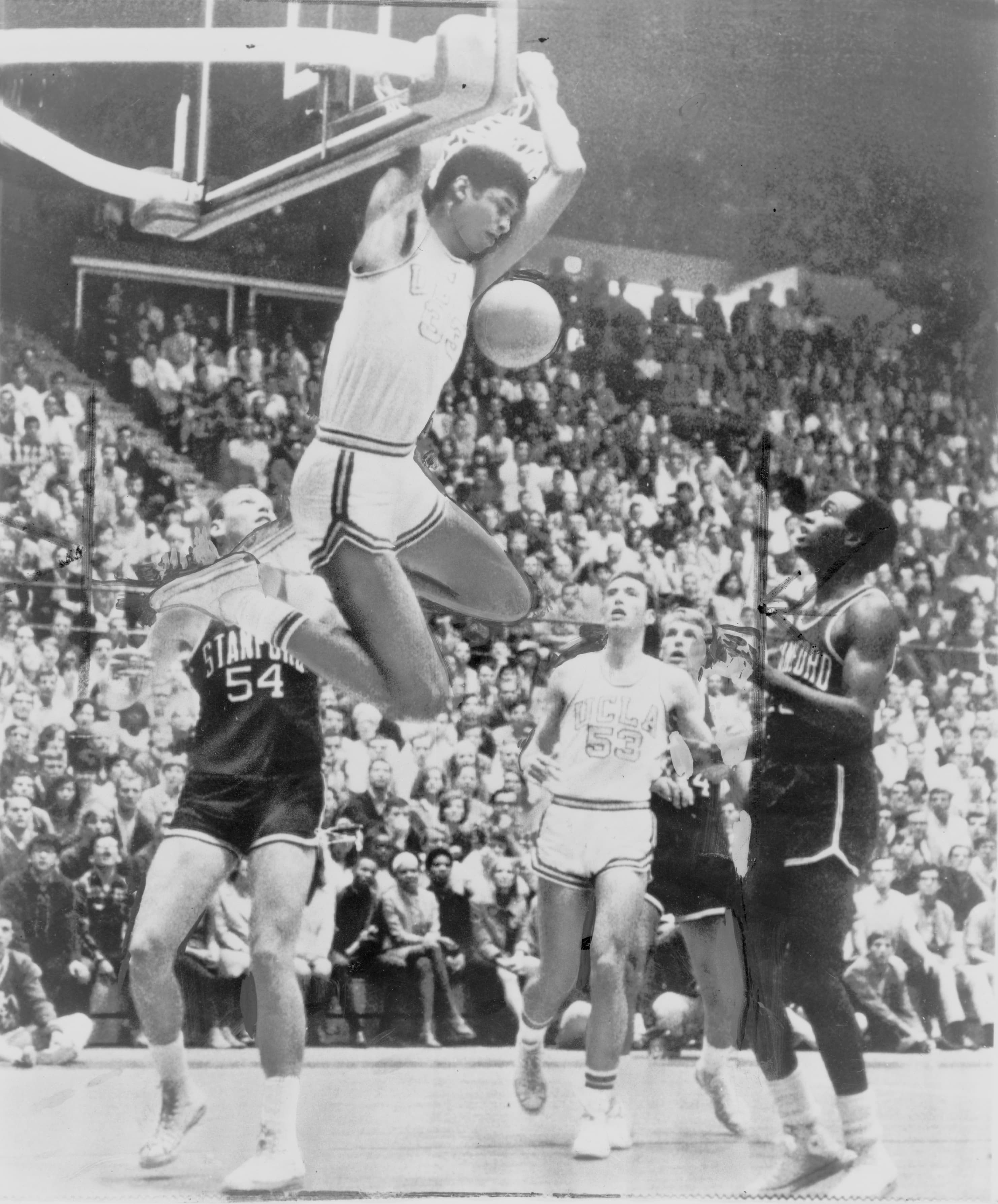
He was born Ferdinand Lewis Alcindor in New York City, and by the time he reached UCLA he was already the most dominant amateur the game had produced. Under John Wooden he won three consecutive NCAA championships and lost a total of two games across three varsity seasons. He was so unstoppable around the rim that in 1967 the NCAA banned the dunk — a rule so transparently aimed at one player that it was known for years, only half in jest, as the Alcindor Rule.
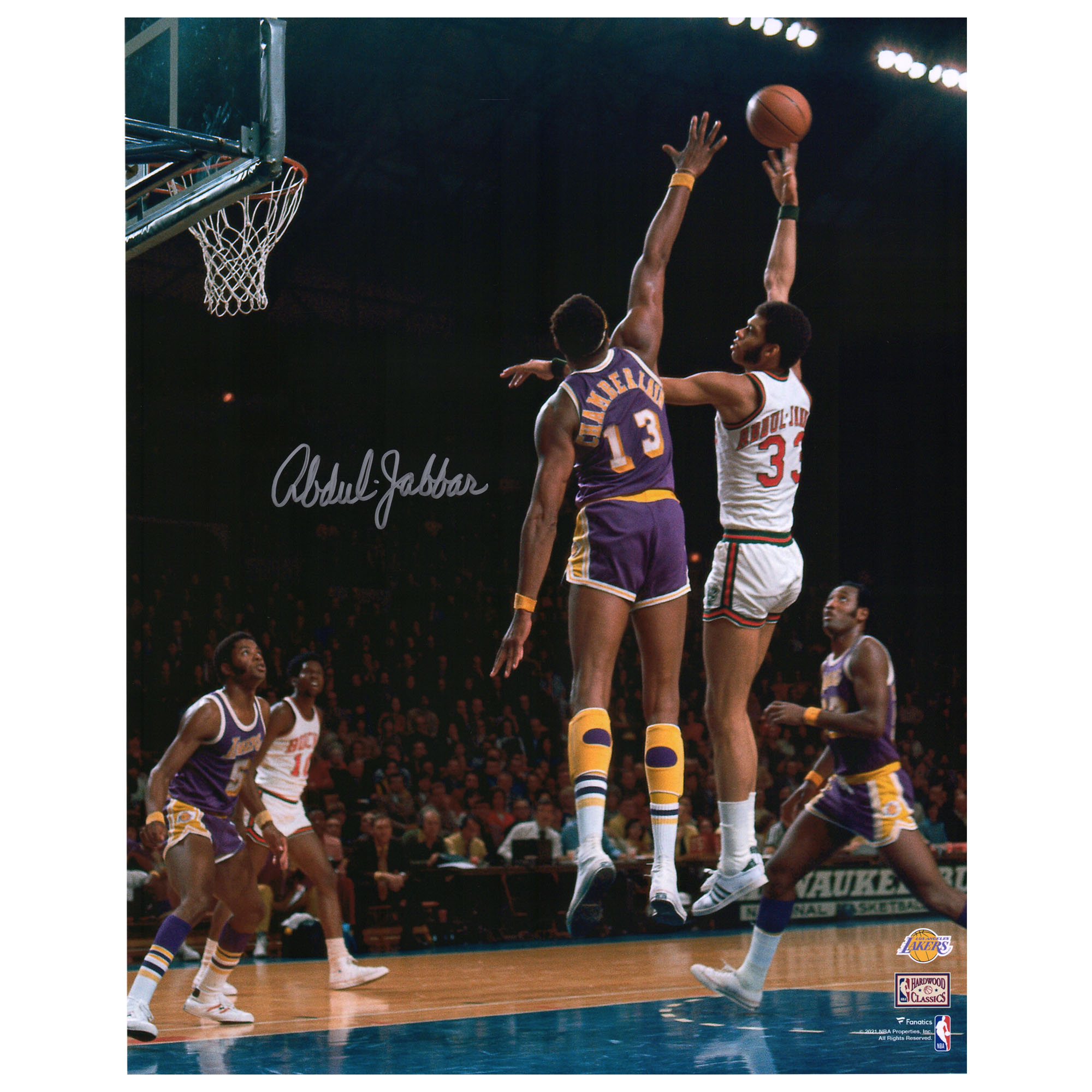
A lesser competitor treats that as an insult and sulks. Alcindor treated it as an assignment. Denied the dunk, he refined a running hook shot released from a fully extended arm at the top of a sweeping motion — a shot that, paired with his height, came off his hand from a release point no defender could reach without a ladder. The skyhook was not a workaround. It was an upgrade. The authorities tried to limit his impact and instead forced him to invent the most unblockable weapon basketball has ever seen.
Milwaukee drafted him first overall in 1969. In 1971 he led the Bucks to the franchise's only championship and was named Finals MVP, and that same year he took the name Kareem Abdul-Jabbar after converting to Islam. He had a title, a Finals MVP, and a regular-season MVP before his 24th birthday. Most careers would have been content to coast on that beginning. His had barely started.

The Trade That Built a Dynasty
On June 16, 1975, the Bucks traded Kareem to Los Angeles. He had asked to leave Milwaukee — he wanted a larger cultural community and a city that fit the breadth of his life off the court — and he arrived already the most accomplished player in the sport: two-time NCAA champion, NBA champion, three-time MVP. What the Lakers acquired was a foundation, though it would take four years for the building to rise on top of it.
Those first Los Angeles seasons were productive and frustrating in equal measure. Kareem won MVP awards in 1976 and 1977 — the fourth and fifth of his career — and still the team lacked the cast to reach the mountaintop. The roster had a generational center and not enough around him. The wait ended in 1979, when the Lakers used the first overall pick on a 19-year-old point guard out of Michigan State who played the game like a man throwing a party and inviting the whole arena. Kareem Abdul-Jabbar had spent his career as the answer to every question a defense could ask. Now he had a co-author.

Showtime
The partnership with Magic Johnson is one of the great pairings in the history of American team sports, and it worked because the two men were opposites who never competed for the same oxygen. Magic ran the break, surveyed the floor with that wide grin, and pushed the tempo until opponents drowned in it. Kareem was the half-court certainty waiting at the other end — when the run didn't produce a layup, the ball went into the post and the skyhook produced two points anyway. Speed and inevitability, in the same uniform.
The first title came in Kareem's sixth Los Angeles season. The Lakers won the 1980 championship in a Finals remembered for its closing act: with Kareem sidelined by a sprained ankle for the deciding Game 6, the rookie Magic started at center, scored 42 points, and finished the series himself. The image obscures the season underneath it — Kareem had been the regular-season MVP that year, the engine that made the rookie's coronation possible. Two years later the Lakers won the 1982 championship, the dynasty now fully assembled and fully aware of what it was.
Then came Boston, and the rivalry that defined the decade. In 1984 the Celtics beat the Lakers in seven brutal games, a series built on Boston's physical dominance and the open question of whether Kareem, at 37, could still carry a champion. The whispers grew loud. He heard all of them.
Revenge at 38
The 1985 Finals were a year of held breath answered in a week. After the 34-point loss in Game 1, the Game 2 line — 30 points, 17 rebounds, 44 minutes on a 38-year-old body in the hardest building in the league to win — reset the entire series. Kareem dominated Parish and McHale at an age when most centers have been retired for the better part of a decade, and the Lakers seized the 1985 championship in six games. It was the first time the Lakers had ever beaten the Celtics in the Finals, after eight prior defeats stretching back to the 1960s. Kareem was named Finals MVP, the oldest player ever to win it — 14 years after he had won his first.
He was not merely participating. Across that series he was the best player on the floor, and the floor included Larry Bird. There is no clean comparison for it in modern basketball, because modern basketball has no template for a player being the decisive force in a championship round at 38.

The Skyhook as Physics
It is worth slowing down on the shot itself, because the shot is the whole argument. Kareem caught the ball in the post with his back to the basket, felt the defender's pressure, planted his left foot, drove his right knee upward, and unfolded into a one-armed arc that sent the ball past his ear and over his head from a release point roughly eleven feet above the floor. The defender could be perfectly positioned, vertical, contesting with everything he had, and it changed nothing. The release happened above the defensive plane entirely. The shot was accurate from four to twelve feet, could be thrown with either hand, and did not care about double teams.
No player in NBA history has ever consistently blocked it. More telling: in the decades since, almost no one has even tried to learn it. The skyhook required a lifetime of repetition and a frame built to deliver it, and so it died with the man who perfected it — a signature move that is also, uniquely, a museum piece. Every other great shot in basketball has descendants. The skyhook has none.
Pat Riley, who coached Kareem through four of the Lakers' championships, often described the skyhook as the most beautiful thing in sports — and never understood why the game had stopped teaching it.

The Longevity Standard
Kareem played until he was 42, his final season a farewell tour where opposing arenas honored him with standing ovations on the way out. He retired holding records that looked carved in stone, and he had accumulated them before modern sports science, before nutrition optimization, before anyone had ever uttered the phrase load management. He played 80 or more games in 14 of his 20 seasons. He was one of the first NBA players to practice yoga, and he leaned on the mechanical efficiency of the skyhook — a shot that asked far less of his knees than the explosive post moves of his peers — to extend a prime past every reasonable expiration date.
The discipline behind the longevity is the part the totals can't show. A man does not stay the best player on a Finals floor at 38 by accident. He does it by treating his body as a 20-year project and his craft as something that could always be refined further, season after season, long after he had nothing left to prove.

The Numbers Behind the Number
- 6 NBA championships — one with Milwaukee in 1971, then five with the Lakers (1980, 1982, 1985, 1987, and 1988)
- 6 regular-season MVP awards — the most in NBA history, won across a span of 14 years (1971, 1972, 1974, 1976, 1977, 1980)
- 2 Finals MVP awards (1971 and 1985), the second of them at age 38
- 38,387 career points — the NBA's all-time scoring record for nearly four decades, until LeBron James passed it in February 2023
- 19× All-Star, the most All-Star selections in league history
- 1,560 games played and 57,446 minutes — durability that accompanied the scoring
- 15,837 field goals made, the overwhelming majority of them skyhooks no one could stop
- 3 NCAA championships at UCLA under John Wooden, where the dunk was banned to slow him down
- Naismith Memorial Basketball Hall of Fame, Class of 1995
None of those lines holds the full measure of him. Kareem was an athlete who studied martial arts under Bruce Lee, wrote books, and spoke with conviction on questions of race and justice at a time when athletes were told to stay silent — a man who brought a breadth of thought to the sport that few in any discipline have matched. The skyhook made him unstoppable on the floor. The mind made him singular off it.
Why #33 Hangs Forever
The Lakers raised #33 to the rafters in 1989, the year he finally walked away, and no Laker has worn it since. The decision was never really in question. Kareem gave 14 of his 20 seasons to Los Angeles, won five championships in purple and gold, claimed three of his six MVPs as a Laker, and authored the all-time scoring record one unblockable hook at a time. He was the half-court bedrock beneath the most exhilarating offense the league had ever seen.
What makes the number sacred is the same thing that made the player singular: he proved that greatness need not be a peak. It can be a plateau. He was dominant at 24 and dominant at 38, a champion as the best player on his team and a champion as the elder statesman beside a younger superstar, a man who reinvented his body and his role across two full decades without once compromising the standard. The skyhook never declined because it was never built on the things that decline.

That number hangs in the same building as the rest of the Showtime spine and the eras around it — alongside Magic Johnson's #32, the running mate who turned Kareem's certainty into a fast break; James Worthy's #42, the third pillar of those 1980s titles; and Kobe Bryant's twin numbers, the next great chapter of the franchise. None of them, alone, is the Lakers. Together they are the spine of it.
And here is the detail that sets Kareem apart from every other name in those rafters: his #33 hangs twice. Milwaukee retired the same number for the same man, honoring the title he delivered there in 1971 before he ever reached Los Angeles — a distinction explored in why the Bucks retired Kareem's #33. Two franchises, two cities, one number, one man neither of them could ever replace. The skyhook only ever belonged to one player. So did the 33 on his back.
Cette analyse vous plaît ?
Recevez davantage d'analyses comme celle-ci dans votre boîte mail.