Cette page contient des liens affiliés. Nous pouvons percevoir une commission si vous achetez via ces liens, sans frais supplémentaires pour vous. As an Amazon Associate I earn from qualifying purchases.
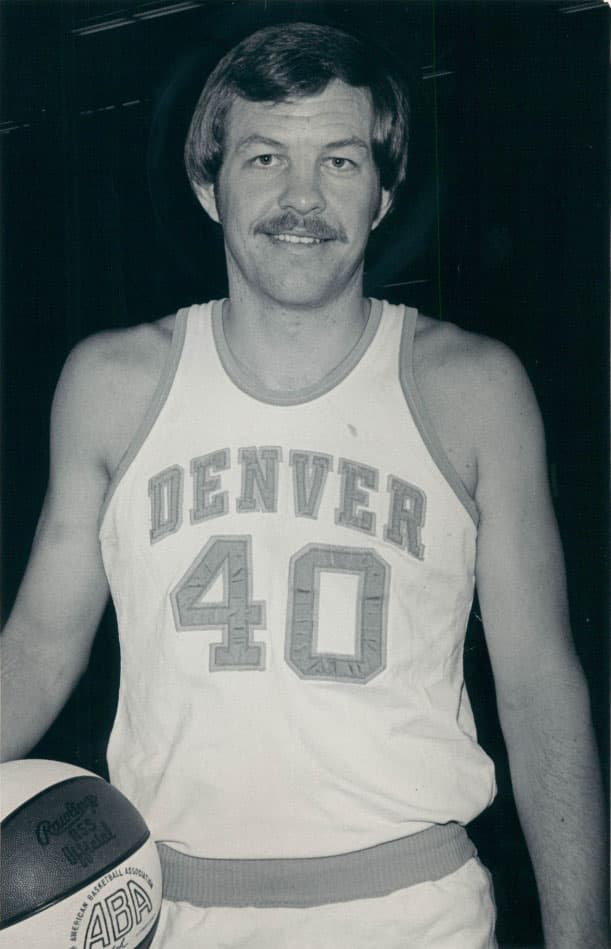
Every franchise has a first player, and for the Denver Nuggets — born in 1967 as the Denver Rockets of the American Basketball Association — that person was Byron Beck. He was the original Nugget, literally the first to sign a contract and wear the uniform. Beck was born September 25, 1945, in Donovan, Colorado, a small farming community on the eastern plains, attended the University of Denver, and was selected when the newly formed franchise built its first roster in 1967. He played from the inaugural 1967-68 ABA season through the final ABA season in 1975-76, then continued one season in the NBA after the merger — a physical, competitive big man who valued the team over personal statistics. He never won a scoring title or earned an All-Star selection; what he did was show up, compete, and define the franchise's founding character. The Nuggets retired #40 because being first is something that cannot be replicated. Beck built the foundation.
Colorado's Own
Byron Beck was born September 25, 1945, in Donovan, Colorado — a small farming community on the eastern plains of the state. He attended the University of Denver, played college basketball in the city where the Nuggets would eventually make their home, and was selected by the newly formed Denver Rockets franchise when they built their first roster in 1967. The connection between Beck and Denver is total: he was born in Colorado, educated in Colorado, and played his entire professional career in Colorado.

That kind of rootedness is almost impossible to find in modern professional sports. Players move between teams as a matter of career management, and franchise loyalty across an entire career is a rarity celebrated precisely because it is so uncommon. Beck did not move. He was signed as the first piece of the puzzle, and he stayed until the puzzle was finished — ten years later, as a veteran whose name had become synonymous with what it meant to be a Denver Nugget.

A Decade of Building
Beck played in the ABA from the franchise's inaugural 1967-68 season through the final ABA season in 1975-76, then continued for one season in the NBA as the franchise transitioned into the established league. Across those ten years, he was a physical, competitive big man who valued the team over personal statistics — a center whose presence on the court made the players around him better and whose presence in the locker room made the franchise feel stable.

The ABA years were formative for Denver basketball. The league itself was a wild, innovative experiment — with the red-white-and-blue ball, the three-point line, and a run-and-gun style that anticipated the modern NBA by decades. Beck was there for all of it, absorbing the culture of winning basketball while the franchise grew its identity and its fanbase. In those years, he was not just a player. He was the organizational constant — the player whose presence connected the earliest days of Denver basketball to the years that followed.

What the Original Nugget Represents
The retirement of Byron Beck's #40 is not primarily about statistics. No franchise retires a jersey purely because of points per game — they retire it because the player represented something the franchise needed to memorialize. What Beck represented was the beginning. He was the living proof that Denver could sustain professional basketball, could build a fanbase, could develop a culture.
Every legendary player who came after Beck — David Thompson, Alex English, Dan Issel, Dikembe Mutombo, Carmelo Anthony, Nikola Jokic — played for a franchise that Beck helped make real. The Nuggets did not appear fully formed. They were built year by year, starting in 1967 with a local kid from Donovan, Colorado, who put on the jersey first and made it mean something.

The retired numbers in a basketball arena tell the story of a franchise. Most tell stories of individual greatness — the scorer who redefined the position, the defender who changed the game. Beck's #40 tells a different story: the story of the foundation. The player who was there when there was nothing yet, who showed up when the uniform was new and the arena was empty and the city was still deciding whether it cared about this team.

Why the Nuggets Retired #40
The Denver Nuggets retired Byron Beck's #40 because franchises that understand their own history know they have an obligation to honor the people who created it. Beck's contribution was not defined by individual accolades. It was defined by presence — ten years of showing up, competing, and helping build a professional basketball culture in a city that is now home to NBA champions.

When Nikola Jokic held the Larry O'Brien Trophy above his head in June 2023 after Denver won its first NBA championship, the history that led to that moment stretched all the way back to 1967. It stretched back to a first roster, a first game, a first signing — a Colorado kid named Byron Beck who was the very first Denver Nugget.

#40 hangs in the rafters not because Beck scored the most points or made the most All-Star Games. It hangs there because he was first. And being first, in any endeavor, is something that cannot be replicated or taken away. The foundation is always the hardest part to build. Beck built it.
Cette analyse vous plaît ?
Recevez davantage d'analyses comme celle-ci dans votre boîte mail.