Cette page contient des liens affiliés. Nous pouvons percevoir une commission si vous achetez via ces liens, sans frais supplémentaires pour vous. As an Amazon Associate I earn from qualifying purchases.
The Denver Nuggets retired Dikembe Mutombo's number 55 because the case was complete and obvious. Mutombo came from Kinshasa to Georgetown on a USAID scholarship to study medicine before John Thompson developed him into the fourth overall pick of the 1991 NBA Draft. In Denver, the transformation was immediate: he averaged over three blocks per game in every one of his five Nuggets seasons, establishing himself as the best shot-blocking center in the world. He anchored the 1994 eighth-seed upset of the top-seeded Seattle SuperSonics — the first time an eighth seed defeated a first seed — collapsing to the floor in tears with the ball clutched to his chest. He won four Defensive Player of the Year awards, the first in 1995 as a Nugget, finished with 3,289 career blocks, and built the Biamba Marie Mutombo Hospital in Kinshasa. He passed away in September 2024.
From Kinshasa to Georgetown to Denver
Mutombo was born June 25, 1966, in Kinshasa, the capital of what was then Zaire. He grew up in a large family and excelled academically, earning the USAID scholarship that brought him to Georgetown University in Washington, D.C. Under coach John Thompson, Mutombo developed from a raw athletic center into one of the most dominant defensive players in college basketball. He won the Big East Defensive Player of the Year award and was drafted 4th overall by the Denver Nuggets in the 1991 NBA Draft.

In Denver, the transformation was immediate. Mutombo averaged over three blocks per game in every one of his five seasons with the Nuggets, instantly establishing himself as the best shot-blocking center in the world. His seven-foot-two frame, long arms, and extraordinary timing made the paint a hostile environment for any opposing player who dared enter it. More importantly, his energy, enthusiasm, and infectious personality made him one of the most beloved players in Nuggets history.

The 1994 Playoff Miracle
In May 1994, the Denver Nuggets entered the first round of the NBA Playoffs as the eighth seed, facing the Seattle SuperSonics — the first seed with the best record in the Western Conference. Nobody gave Denver a realistic chance. The series was expected to be a formality before Seattle moved on to deeper playoff rounds.
What happened instead was one of the greatest upsets in NBA playoff history. The Nuggets defeated the SuperSonics 3-2 in five games, becoming the first eighth seed to defeat a first seed in NBA playoff history. Mutombo was at the absolute center of it — protecting the rim, altering shots, and providing the defensive presence that made the Nuggets' upset possible. When the final whistle blew in Game 5, Mutombo collapsed to the floor in tears, clutching the basketball to his chest in an image that remains one of the most emotionally resonant moments in Nuggets franchise history.
That moment crystallized what Mutombo meant to Denver. He was not just a stat-line. He was the reason an impossible thing became possible. The upset of the Seattle SuperSonics stands as one of the defining moments in franchise history, and Mutombo was its author.
Four Defensive Player of the Year Awards
Mutombo won four Defensive Player of the Year awards across his career — in 1995 (while still a Nugget), 1997, 1998, and 2001. He finished with 3,289 career blocked shots, the second-highest total in NBA history. He was selected to eight All-Star Games, representing an era in which the league finally understood that rim protection was a skill worthy of its own recognition.
The finger wag was eventually banned by the NBA for taunting — a distinction that somehow only enhanced its legend. The very act of legislating against Mutombo's celebration was an acknowledgment of how powerful and psychologically effective it had become. When the finger went up after a block, the message was clear: not in my house. And for years, in the paint at McNichols Sports Arena and later Ball Arena, nobody could.
A Legacy Beyond Basketball
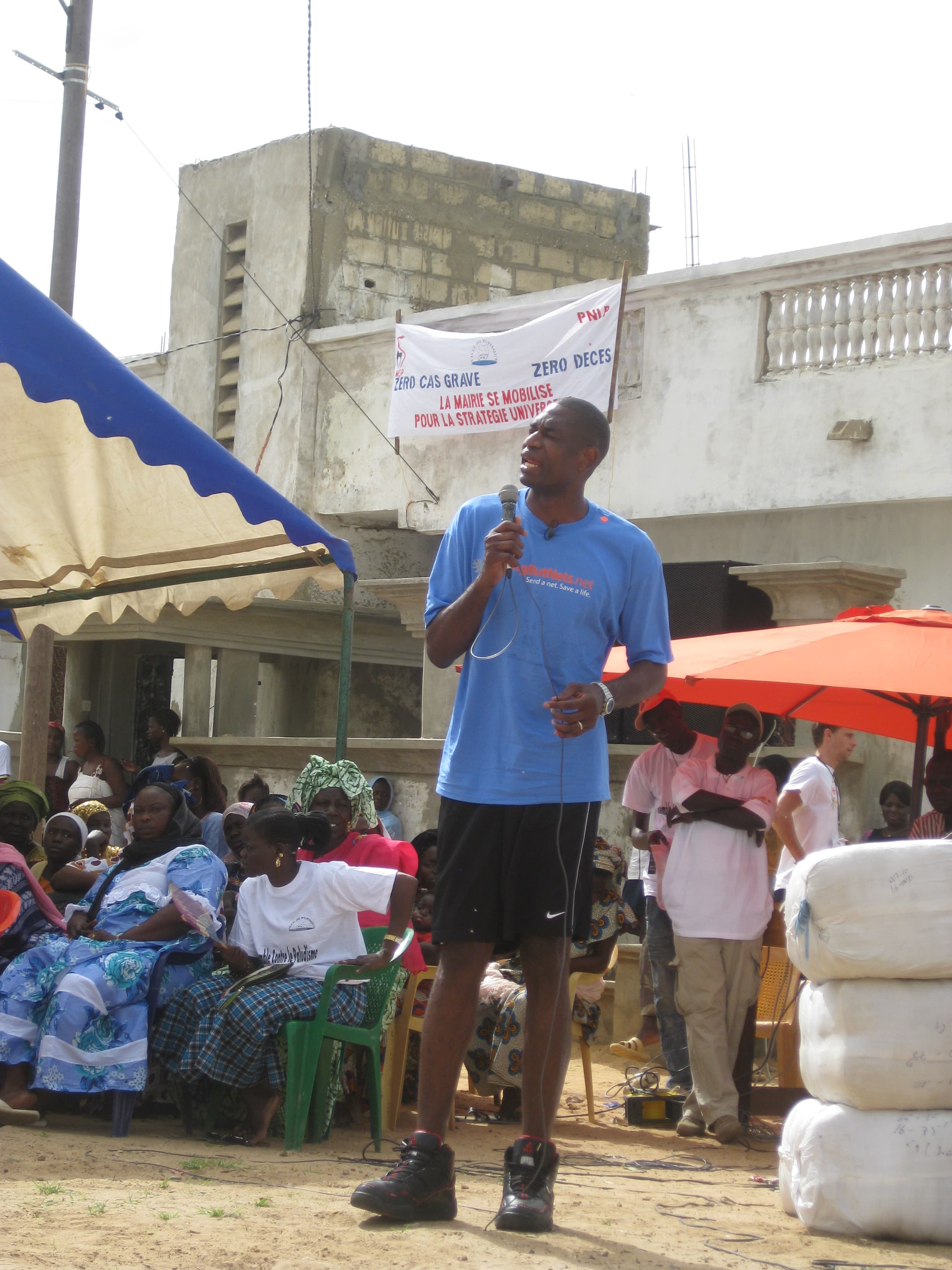
The Biamba Marie Mutombo Hospital in Kinshasa, named after his mother who died from a stroke, is the defining achievement of Dikembe Mutombo's post-basketball life. He donated more than fifteen million dollars of his own money to construct and operate it — a facility that provides medical care to millions of people in one of the most underserved regions on earth. He was named a United Nations Messenger of Peace. He became one of the most consequential humanitarians in the history of professional sports.

The hospital is not a footnote to Mutombo's basketball career. It is the purpose that basketball served. He came to the United States to study medicine. He ended up playing basketball at the highest level instead. And then, when the career was over, he found a way to build the thing he originally came to build: a place where people could receive medical care who otherwise could not. The arc of the story is extraordinary.
Why the Nuggets Retired #55
The Naismith Memorial Basketball Hall of Fame inducted Dikembe Mutombo in 2015. The Denver Nuggets retired #55 because the case was complete and obvious: four Defensive Player of the Year awards, 3,289 blocks, the 1994 playoff miracle, a personality that defined an era, and a humanitarian legacy that transcends the sport entirely.

Mutombo passed away in September 2024 after a battle with brain cancer, leaving behind a legacy that stretched from the NBA paint to the hospitals of Kinshasa to the United Nations. The retirement of #55 is now also a memorial — a permanent acknowledgment that the Denver Nuggets were lucky enough to be part of the story of one of the most complete human beings to ever play professional basketball.
Not in my house. The finger goes up one final time. #55 stays in the rafters, forever.
Cette analyse vous plaît ?
Recevez davantage d'analyses comme celle-ci dans votre boîte mail.