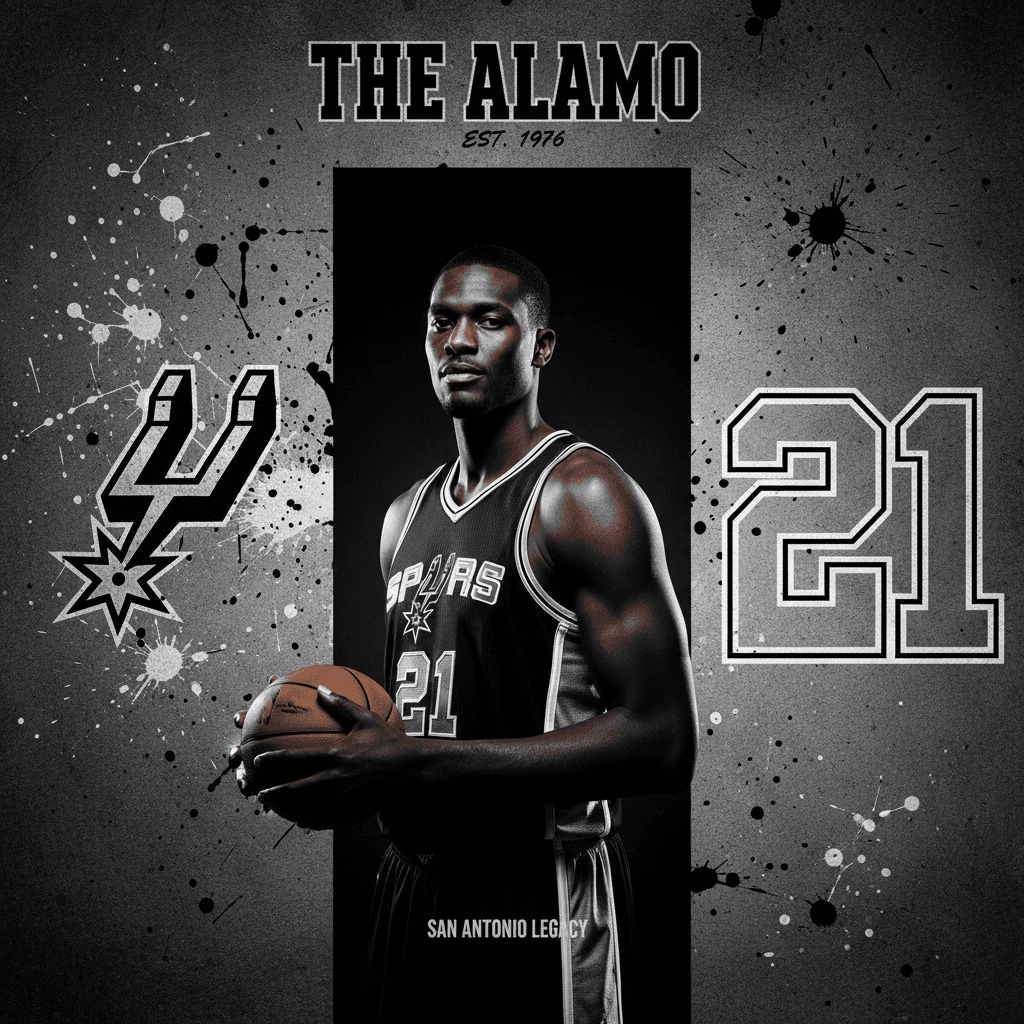
December 18, 2016. The San Antonio Spurs lowered the lights at the AT&T Center, and a black-and-white #21 began its climb to the rafters. There was no farewell tour, no city-to-city ovation, no months of tribute videos — because the man being honored had refused all of it. Tim Duncan had retired the previous July in the most Tim Duncan way imaginable: a short statement, no press conference, no goodbye game. Now Gregg Popovich stood at a microphone and tried to find words for nineteen seasons, and the coach who had built a quarter-century of dynasty around this one quiet man could not get through it without his voice cracking. The building that Duncan's championships paid for went silent, then loud, then silent again. A banner rose. The greatest power forward in the history of the sport had not wanted the ceremony. He got it anyway, because some debts a franchise simply has to pay.
Duncan would have preferred to be somewhere else. That was always the point of him.
The Island and the Pool
Tim Duncan was not supposed to play basketball. Growing up in St. Croix, in the U.S. Virgin Islands, he was a competitive swimmer — a genuine prospect in the 400-meter freestyle who had Olympic ambitions before he had ever taken the game seriously. Then Hurricane Hugo destroyed the island's only Olympic-sized pool in 1989, and Duncan, afraid of swimming in the open ocean where sharks were a real and not metaphorical concern, drifted toward the basketball court instead. He was fourteen. He was already tall, and growing. The discipline he had built in the water — the repetition, the indifference to glamour, the willingness to do an unglamorous thing ten thousand times until it became automatic — transferred to the hardwood almost without translation.
He arrived at Wake Forest in 1993 as a raw, coachable big man and left four years later as the most complete college player in the country. He could have entered the draft early and gone first overall as a sophomore. He stayed all four years, finished his degree in psychology, and learned the post game the way a craftsman learns a trade. When he finally declared, the San Antonio Spurs — who had bottomed out the previous season when David Robinson missed nearly the entire year with injury — held the first overall pick. They took Tim Duncan in 1997. In hindsight it is the easiest draft decision in modern NBA history. At the time it was simply the correct one, made by a franchise that had been rewarded, for once, for its misfortune.
The Twin Towers
The fear, when Duncan arrived, was redundancy. San Antonio already had a franchise center in David Robinson — a former MVP, a Naval Academy graduate, the face of the organization. Two seven-footers, one basketball. It should not have worked. It worked immediately, because both men were secure enough to subtract from their own games for the sake of the whole. Robinson moved to a complementary role without complaint. Duncan, a rookie, anchored the offense. They called them the Twin Towers, and for a few seasons they were the most punishing frontcourt in the league.
In the lockout-shortened 1998–99 season, in only his second year, Duncan led the Spurs to the franchise's first championship in 1999. He was twenty-three years old. He dominated the postseason with the kind of efficient, two-way force that would define the next decade — scoring in the low post, controlling the glass, blocking shots, and never once playing to the camera. He was named Finals MVP. The partnership with Robinson was the rare superstar pairing built entirely on mutual respect: the Admiral providing the veteran's gravity, the Fundamental providing the relentless, ageless engine. When Robinson retired in 2003, he did so with the satisfaction of a man handing the keys to someone who would never crash the car.
The Big Fundamental
Shaquille O'Neal gave Duncan the nickname, and he meant it as both tribute and gentle mockery. The Big Fundamental. There was nothing flashy about the way Tim Duncan played basketball, and that was precisely the threat. His bank shot off the glass from the elbow and the block became one of the most reliable weapons in the sport — geometry made flesh, the same shot at the same angle thousands of times, almost never blocked because it was released from a position no defender could reach. His footwork was textbook. His decision-making was, year after year, the most consistent in the league. Coaches teaching young big men how to play the position correctly did not show them highlight reels. They showed them Duncan.
In 2002 and 2003 he won back-to-back regular-season MVP awards, joining a short list of players to repeat. The 2003 championship run was perhaps his finest extended stretch of basketball: in the Finals against the New Jersey Nets he produced numbers so complete they read like a typo — points, rebounds, assists, and blocks all near or above the level of an entire functioning offense. He won Finals MVP again, by a margin that was not close. It was the kind of dominance that does not photograph well and does not trend, which is exactly why those who watched it closely have never stopped talking about it.
Popovich has never hidden what Duncan meant to him, speaking over the years about their bond in unusually personal terms — a rare openness from a coach famous for giving the public nothing, and a measure of how completely the franchise's identity had been built around one understated man.
The System and the Big Three
What separates Duncan from nearly every other all-time great is not a single peak but the duration of the plateau. As Robinson aged out, two new pillars rose beside Duncan — Tony Parker, a lightning-quick French point guard, and Manu Ginobili, an improvisational Argentine wing who played the game like jazz. The Big Three became the longest-running successful core in NBA history, and the architecture of it all was Duncan. He set the screens that freed Parker. He covered for the gambles that made Ginobili great. He anchored a defense that let Popovich's beautiful, selfless ball-movement offense breathe at the other end.
The 2005 title came in a brutal seven-game Finals against the Detroit Pistons — Duncan, gutting out a series in which the shots did not always fall, willing his team across the line on defense and rebounding alone. The 2007 sweep of the Cleveland Cavaliers was clinical, a dynasty operating at cruising speed. And then there was the long gap — seven years in which the Spurs stayed great and could not quite finish, including a 2013 Finals lost to Miami in a manner so cruel it would have broken most franchises.
The Last Statement
The 2014 championship was the answer to that heartbreak, and it was the most beautiful thing the franchise ever produced. The Spurs returned to the Finals against the same Miami Heat that had beaten them a year earlier, and this time they did not merely win — they dismantled their opponent with team basketball so fluid it looked rehearsed in a way no team could rehearse. The ball never stopped. Every pass led to a better pass. Duncan, by then thirty-eight years old, was no longer the best player on his own team, and he did not need to be. He had built the thing that made the best players possible. The final title was a collective statement, and his fingerprints were on every page of it.
He played two more seasons after that, still effective, still anchoring, still the first man in the gym and the last to ask for credit. When he walked away in 2016, he had made the playoffs in all nineteen of his seasons — every single year of his career, without exception, his team played in the postseason. No major star in the history of the league has matched that. It is, quietly, one of the most remarkable statistics in basketball, and it belongs to the player least likely to ever mention it.
The Numbers Behind the Number
- 5 NBA championships (1999, 2003, 2005, 2007, 2014)
- 3 NBA Finals MVP awards (1999, 2003, 2005)
- 2 regular-season MVP awards (2002, 2003) — won back-to-back
- 15× NBA All-Star across a 19-year career
- #1 overall pick in 1997 out of Wake Forest, after staying all four college years
- Made the playoffs in all 19 of his seasons — every year he played
- Nineteen seasons, one franchise, one head coach in Gregg Popovich — the longest such partnership in league history
- Anchored the Twin Towers with David Robinson and later the Big Three with Tony Parker and Manu Ginobili
- Widely regarded as the greatest power forward in NBA history
- Naismith Memorial Basketball Hall of Fame, Class of 2020
None of those numbers contains the thing that made Tim Duncan singular. The stats describe a great player; plenty of great players have similar lines. What they cannot capture is the absence — the refusal to demand attention, the technical fouls earned only for the smallest raised eyebrow at a referee, the postgame interviews answered in six words, the complete and total disinterest in being a celebrity in a league that runs on them. Duncan was the rarest thing professional sports produces: a transcendent talent with no interest whatsoever in being transcendent. He just wanted to win, correctly, and go home. That he did it in a mid-size market, in the same uniform, for two decades, is the reason an entire city loves him with a devotion usually reserved for people who beg for it. He never begged. That is why they never stopped.
Why #21 Hangs Forever
The Spurs raised Tim Duncan's #21 to the rafters of the AT&T Center in December 2016, in a ceremony that mirrored the man exactly — understated, brief, and overwhelming in its restraint. There were no fireworks. There was Popovich, undone. There were the banners Duncan's career had paid for, five of them, hanging above the floor where he had set ten thousand screens that nobody applauded.
The decision to retire the number was never in question. Some numbers are retired to honor a player. #21 was retired to acknowledge that a franchise had been, for nineteen straight years, structurally sound at its foundation — and that the player who served as that foundation would never be replaced, because the role he filled cannot be drafted, traded for, or developed. It can only be lucked into once, and San Antonio knows it got lucky in 1997 in a way that does not happen twice.
#21 witnessed all of it. The 1999 title with the Admiral. The back-to-back MVPs. The 2003 demolition of the Nets. The grinding seven games against Detroit in 2005. The clinical sweep in 2007. The seven-year wait and the perfect 2014 answer. Nineteen consecutive trips to the playoffs. One coach, one city, one quiet man who treated greatness as a job to be done well rather than a spotlight to be stood in.
The number hangs alongside the men who shared the dynasty with him — David Robinson's #50, the Admiral who handed him the franchise; Manu Ginobili's #20 and Tony Parker's #9, the running mates of the Big Three; and George Gervin's #44, the Iceman who came before all of them. Each tells its own story of what a San Antonio Spur is supposed to be. But #21 is the one the modern franchise was built around — the steady, unglamorous, fundamentally sound number at the center of everything. It hangs forever because the team San Antonio became is, in every meaningful sense, the team Tim Duncan made it.
Cette analyse vous plaît ?
Recevez davantage d'analyses comme celle-ci dans votre boîte mail.