Halaman ini mengandung tautan afiliasi. Kami mungkin mendapatkan komisi jika Anda membeli melalui tautan ini, tanpa biaya tambahan untuk Anda. As an Amazon Associate I earn from qualifying purchases.
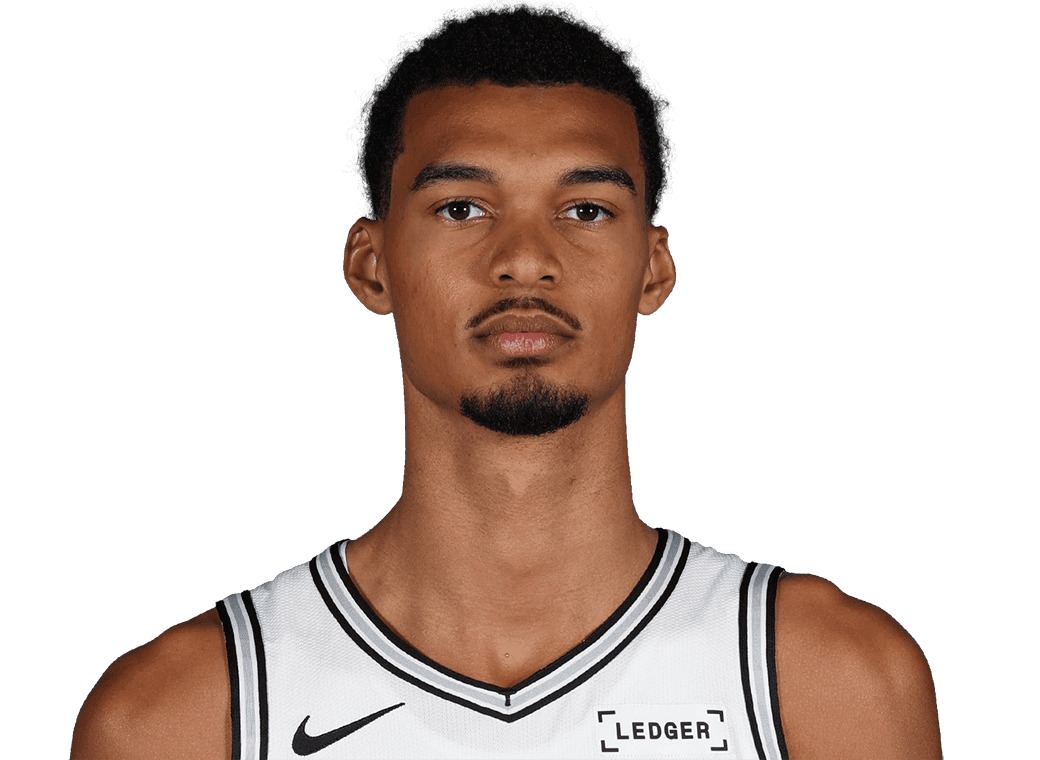
Victor Wembanyama is not a better version of an existing center — he is a 7'4" player who protects the rim, recovers to the perimeter, and shoots like a guard within the same possession, as a matter of routine. Through two NBA seasons with San Antonio, his combination of 3.2 blocks and 5.1 three-point attempts per game has no precedent at his height. Opponents shoot 52.3% at the rim with him in the paint versus a 63.1% league average — a 10.8-point swing, the largest on record since the NBA began tracking spatial shooting. He contests at the rim (4.2 within six feet) and beyond the arc (2.1 per game) in the same trip, letting the Spurs switch 1-through-5. On offense his estimated 10'6" release is effectively unblockable; he shoots 36.4% from three (41.2% on catch-and-shoot) and lifts San Antonio's offensive rating from 104.2 to 115.4 when on court. He is 22, and there is no comparison.
A Prototype That Shouldn't Exist
The basketball world has seen tall players. It has seen skilled players. What it has never produced is this: a 7'4" player who moves like a wing, shoots like a guard, and protects the rim like a generational shot-blocker — simultaneously, within the same possession, as a matter of routine.
Through his first two NBA seasons with the San Antonio Spurs, Wembanyama has posted numbers that exist in their own statistical universe. His combination of blocks per game (3.2) and three-point attempts per game (5.1) has no precedent in NBA history. Not approximate precedent. None. No player his height has ever attempted threes at this volume while simultaneously anchoring an elite defense.

"When I'm watching film, I keep looking for the comparison. There isn't one. He's not Hakeem with a jumper or KG in a taller body. He's a new thing." — Western Conference assistant coach, speaking on condition of anonymity
The Defensive Architecture
Start with the number that matters most: opponents shoot 52.3% at the rim when Wembanyama is in the paint, compared to the league average of 63.1%. That 10.8 percentage point difference is the largest for any player since the NBA began tracking spatial shooting data. Let that breathe for a moment.

Every single shot taken within eight feet of the basket, across an entire season, is 10.8% less likely to go in when Wembanyama is nearby. That's not a rim protector. That's a defensive ecosystem.
Traditional rim protectors like Rudy Gobert or the late-career Dikembe Mutombo were largely stationary deterrents — they discouraged shots through physical presence and positioning. Wembanyama is different in kind, not just degree. He actively hunts blocks while maintaining the ability to recover and contest perimeter shots. Watch the Spurs' defensive possessions carefully and you'll notice something that defies positional logic:
- He contests shots at the rim at an elite rate (4.2 per game within 6 feet)
- He also contests shots beyond the arc (2.1 perimeter contests per game — higher than most wing defenders)
- He does both within the same possession, recovering from paint protection to perimeter closeout faster than any center in the tracking data era
This versatility allows San Antonio to switch more aggressively than any team with a traditional center should be able to. When Wembanyama can guard 1-through-5 on a switch and still function as the primary rim protector, the entire defensive scheme changes. He's not filling a role. He's replacing three of them.
The Offensive Evolution: Shooting From Orbit
Here's where Wembanyama becomes truly unprecedented. At 7'4", he runs pick-and-pop actions, pulls up from 28 feet, and — perhaps most impressively — creates his own shot off the dribble with a handle that would be respectable for a 6'3" guard.

His shot mechanics are remarkably clean. The release point, estimated at approximately 10'6" above the floor, is essentially unblockable. Defenders aren't contesting the shot so much as performing a ritual — jumping because that's what you're supposed to do, knowing the ball is leaving his hands from a point they can't physically reach.
Wembanyama's three-point percentage: 36.4%. Seems pedestrian until you learn that nearly 40% of his threes are pull-ups or step-backs. His catch-and-shoot percentage — 41.2% — ranks in the top quartile among ALL NBA players, regardless of position.
The pump-fake game compounds the problem. Because defenders know they need to close out hard on his threes, they're vulnerable to fakes that open up driving lanes. A 7'4" player driving past a flying closeout and finishing with either length at the rim or soft touch around the basket is not a defensive scenario any coach has drawn up a solution for. There isn't one.

The Spacing Revolution
Wembanyama's shooting gravity fundamentally alters the geometry of NBA offense. When a 7'4" center can credibly punish drop coverage from 27 feet, the traditional defensive playbook collapses. Teams cannot sag off him to protect the paint — doing so is an open invitation for a catch-and-shoot three at a 41% clip. But they can't play up on him either, because his length and handle make him a dangerous driver.
The on/off numbers tell the story with surgical clarity:

- Spurs offensive rating, Wembanyama on court: 115.4
- Spurs offensive rating, Wembanyama off court: 104.2
- Differential: +11.2 points per 100 possessions
For context, San Antonio scores more efficiently with their center spacing the floor than most teams do with dedicated floor-spacing wings. His gravity opens driving lanes for guards that wouldn't exist with a non-shooting center. Every backdoor cut is a little wider. Every pick-and-roll read has an extra half-second of space. The Spurs' offense is better at everything when the defense has to respect Wembanyama's range.
Historical Context: The Comparison Trap
Comparisons to previous NBA centers feel insufficient because they are. Hakeem Olajuwon had the footwork. Kareem Abdul-Jabbar had the scoring touch and longevity. Kevin Garnett had the perimeter versatility for his era. But none of them operated as true perimeter players. None of them were credible three-point threats. None of them led their team in perimeter shot contests while also leading in blocks.

The closest approximation might be a hypothetical fusion: KG's defensive versatility, Dirk Nowitzki's shooting, and Hakeem's shot-blocking instincts — compressed into a player four inches taller than any of them. That's the archetype Wembanyama is building. And at 22 years old, he's still years from his theoretical prime.
That last point deserves emphasis. The players who redefined their positions — Curry with shooting, LeBron with point-forward play, Jokic with center playmaking — generally reached their most devastating form between ages 26-30. If Wembanyama at 22 is already producing historically unique numbers, the ceiling isn't just high. It's in a room no one has entered.

What This Means for the Sport
Wembanyama isn't just having a great career. He's actively changing how basketball development programs worldwide will train tall players. Youth coaches are already teaching 6'8" fourteen-year-olds to handle, shoot, and read the floor rather than simply occupy space near the basket. The next generation of seven-footers will grow up in a world where Wembanyama's skill set is the aspiration, not the exception.
The center position isn't dying. It's evolving. And Victor Wembanyama is the evolutionary leap that's pulling the entire sport forward — one impossible, shouldn't-exist-at-his-height possession at a time.
Menikmati analisis ini?
Dapatkan lebih banyak breakdown seperti ini langsung ke kotak masuk Anda.