Essential Ankle Braces for Basketball: Balancing Protection and Speed

Halaman ini mengandung tautan afiliasi. Kami mungkin mendapatkan komisi jika Anda membeli melalui tautan ini, tanpa biaya tambahan untuk Anda. As an Amazon Associate I earn from qualifying purchases.
You hear it before you feel it. A wet, popping sound that cuts through the squeak of sneakers and the thud of the basketball. Your foot lands on another player's shoe, your ankle rolls inward at an angle that ankles aren't designed to accommodate, and the gym goes quiet.
If you've played basketball long enough, you've experienced some version of this moment. Ankle sprains are the most common injury in basketball. In NCAA men's and women's college basketball from 1988 to 2004, ankle ligament sprains made up about a quarter of all injuries (Dick et al. and Agel et al., Journal of Athletic Training, 2007). They also tend to come back: in a 1994 survey of Hong Kong athletes, 73% reported recurrent ankle sprains (Yeung et al., British Journal of Sports Medicine).
How We Picked: We did not wear-test these braces ourselves. We compared five popular options using manufacturer specs and published sports-medicine research. Here's how they stack up.
How Ankle Braces Work (And What They Can't Do)
Before the rankings: a brief reality check. In a randomized trial of 1,460 high school basketball players, those assigned lace-up ankle braces had about one-third the rate of acute ankle injuries of those without (McGuine et al., American Journal of Sports Medicine, 2011). That's significant. But it doesn't eliminate the risk. No external device can fully replicate the stabilizing function of healthy ligaments and trained proprioceptive muscles.
What braces do is limit the extreme ranges of motion — specifically inversion (rolling inward) and eversion (rolling outward) — where sprains occur. They're a physical stop that kicks in at the danger point, preventing your ankle from reaching the angles that damage ligaments. The best braces do this while allowing the normal motion you need for basketball: dorsiflexion (pointing toes up), plantarflexion (pointing toes down), and moderate lateral movement.
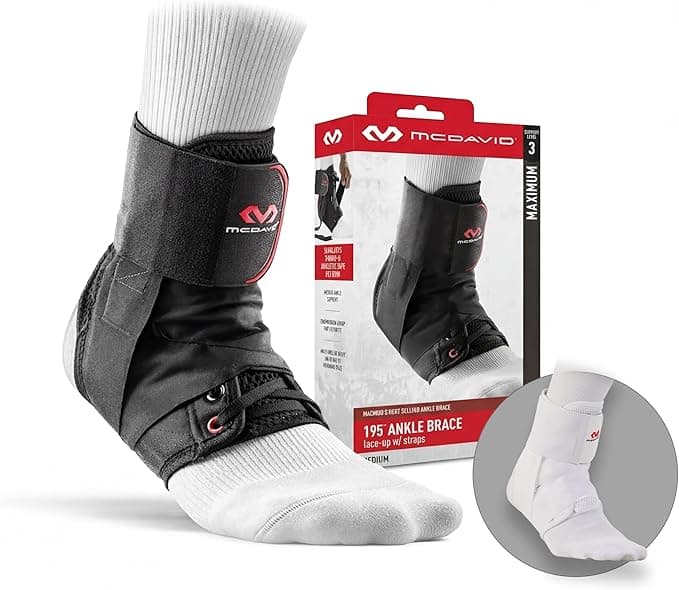
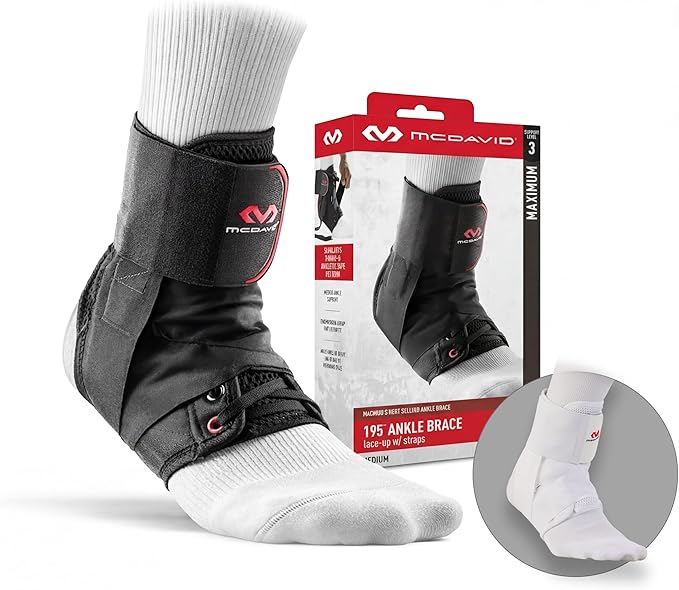
1. McDavid Bio-Logix — Best Overall ($45)
The Bio-Logix wins because it answers the question every basketball player actually asks: "Which brace protects me without making me feel slow?"
Its hinged design allows natural up-and-down foot movement while limiting the lateral rolling that causes sprains. McDavid builds it with an internal Flex-Link hinge, a molded TPU exoskeleton, and figure-8 and heel-lock straps for side-to-side stability. Expect some trade-off, though: a 2011 study of tape, a lace-up brace, and a semi-rigid brace found that ankle stabilizers affected agility but not vertical jump (Ambegaonkar et al., Foot & Ankle Specialist).
Its figure-8 and heel-lock straps adjust, so you can set the fit looser for practice and tighter for games.
Best for: Most basketball players. Our pick for the best balance of protection and mobility among these five.
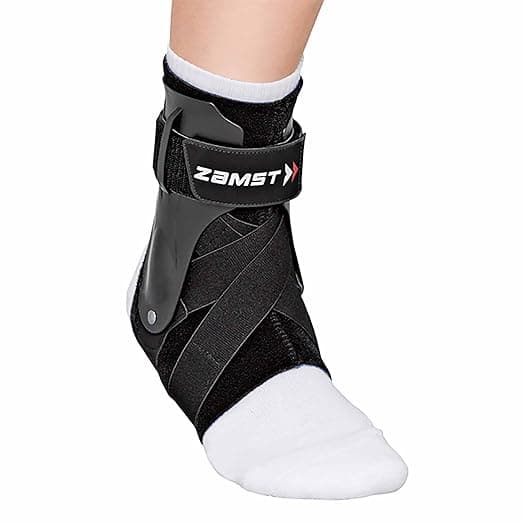
2. Zamst A2-DX — Best Maximum Protection ($55)
If you've sprained your ankle severely or have chronic instability, the A2-DX is designed for that situation. Zamst's specs list protective guards that limit excessive inward and outward ankle movement, plus a dual X-strap stabilizer. Zamst rates its support level "Strong" and names chronic ankle instability as an intended use.
The trade-off is structure. A brace built this firmly gives your ankle less freedom than a soft lace-up, and guards who rely on explosive first steps should weigh that before choosing it.
Best for: Players with significant injury history, post-injury return, big men who prioritize protection over explosiveness.
3. ASO Ankle Stabilizer — Best Soft Support ($25)
The ASO is Med Spec’s original lace-up ankle stabilizer. The nylon lace-up construction provides moderate compression without rigid elements.
With no rigid stays, it offers less structure than the hinged and shell-style braces on this list. For players without injury history seeking preventive support, this may be enough. For players with chronic instability, it likely isn't.

At $25, the price point makes it accessible for every player. If the choice is between no brace and an ASO, the ASO is an easy yes.
Best for: Preventive support, players who can't tolerate rigid braces, budget-conscious players.
4. Active Ankle T2 — Best Budget Rigid ($30)
Solid protection at the lowest rigid-brace price point. Active Ankle pairs the rigid shell with an anatomical bilateral hinge that allows full up-and-down foot motion. The trade-off: a hard shell is more to fit inside your shoe than a soft lace-up brace.
Players with narrow feet or low-volume shoes may struggle with the fit. Active Ankle says its single strap adjusts for both low-top and high-top shoes, so check its sizing chart before you buy.
Best for: Budget-conscious players who need rigid protection and can tolerate some bulk.
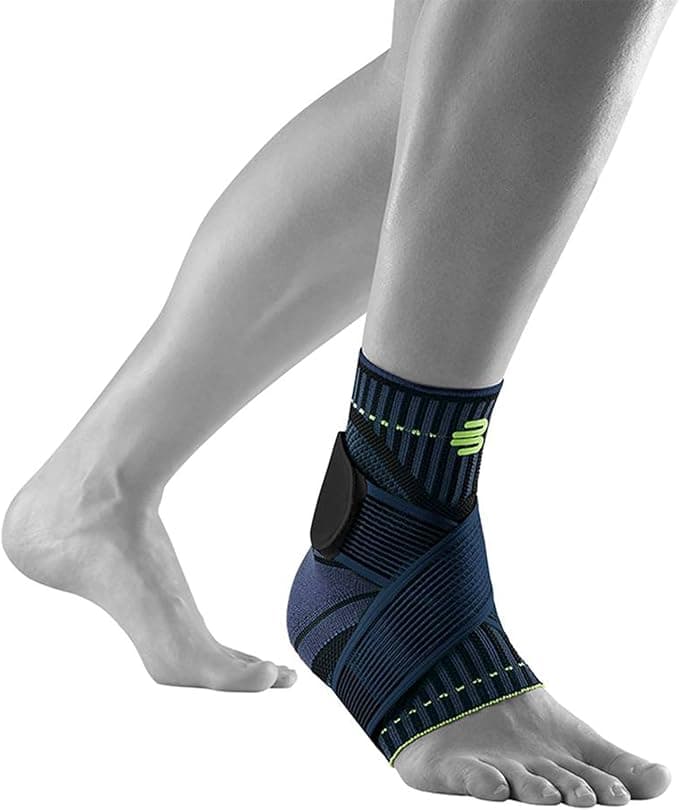
5. Bauerfeind Sports Ankle Support — Premium Compression ($70)
The Bauerfeind is a knitted compression support rather than a brace with rigid parts. Bauerfeind says its figure-8 strap system provides individually adjustable stabilization similar to athletic taping.

But it has no rigid stays, shell, or hinge — structurally closer to the ASO soft brace — which makes the $70 price tag difficult to justify for on-court basketball. The Bauerfeind excels for rehabilitation and daily wear beyond basketball. For on-court protection specifically, the hinged McDavid Bio-Logix offers more structure at a lower price.
Best for: Post-injury rehabilitation, daily ankle support that extends beyond basketball.
The Bottom Line
For most basketball players: the McDavid Bio-Logix ($45). Hinged side-to-side support that still lets your foot flex up and down. If you play basketball regularly and have functioning ankles you'd like to keep, this is the brace.
For chronic instability or post-injury return: the Zamst A2-DX ($55). Accept the mobility trade-off. Your ankles will thank you. If you're coming back from an ankle injury, talk to a physio or doctor about the right support; this guide isn't medical advice.
For prevention on a budget: the ASO ($25). Basic support is better than no support, and $25 is cheaper than an ER visit.
The most expensive ankle brace is the one you don't wear. Find one that's comfortable enough to become automatic, and wear it every time you step on the court. Your future self — the one still playing basketball without chronic ankle pain — will be grateful.