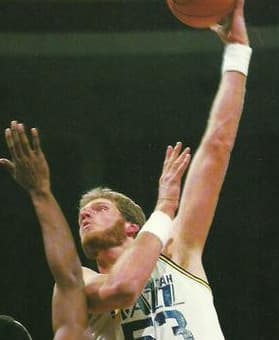
Mark Eaton went from auto mechanic to two-time Defensive Player of the Year, setting the all-time single-season blocks record at 5.56 per game. Here is why #53 belongs in the rafters.
Bu makale İngilizceden otomatik olarak çevrilmiştir.View original
Diosh Lequiron
··7 dk okuma·
M
Share
Bu sayfa ortaklık bağlantıları içermektedir. Bu bağlantılar üzerinden satın alma yaparsanız, size ek maliyet olmaksızın komisyon kazanabiliriz. As an Amazon Associate I earn from qualifying purchases.
Mark Eaton was 21 years old and working as an auto mechanic in Bellflower, California when a UCLA assistant coach spotted him in a pickup game and suggested he try out. He had not played organized basketball since high school. He was 7 feet 4 inches tall. He went undrafted and joined the Jazz in 1982 on a developmental basis. Within two years he was the most intimidating defensive presence in the Western Conference. In the 1984-85 season Eaton averaged 5.56 blocked shots per game — still the all-time single-season record, a number the closest challengers have only half approached. He was named Defensive Player of the Year in 1985 and 1989, made the All-Defensive First Team twice, and played eleven seasons in Utah. The Jazz retired #53 because Eaton represents mastery of role: asked only to protect the paint, he did it better than anyone who has ever played the game.
The Most Improbable Path to the Rafters
Eaton's journey from auto mechanic to two-time Defensive Player of the Year is one of the most unlikely development stories in professional basketball history. He attended a junior college, transferred to Arizona State, went undrafted, and joined the Jazz in 1982 on a developmental basis. Within two years, he was the most intimidating defensive presence in the Western Conference.
Vince Williams Jr Youth Fanatics Black Utah Jazz Fast Break Custom Replica Jersey - Statement Edition
In the 1984-85 season, Eaton averaged 5.56 blocked shots per game — a number so far beyond what any other player has achieved that it sits in the same category as Maravich's college scoring average: a record that is not merely intact but unthreatened. The closest anyone has come in recent decades is roughly half that total. Eaton did not just block shots. He fundamentally altered the geometry of opponent offense from the moment he stepped on the floor.
Lauri Markkanen Youth Fanatics White Utah Jazz Fast Break Replica Custom Jersey - Association Edition
What a 7-Foot-4 Center Does to a Defense
The value of Mark Eaton was not captured in his blocked shots totals, though those totals were extraordinary. It was captured in the shots that opposing players chose not to take — the drivers who pulled up short, the big men who redirected their angles, the coaches who drew up plays that avoided the paint entirely because they knew what was waiting there. Eaton's deterrent effect was as real as his recorded blocks, and entirely invisible to any box score.
Unisex Nike Ace Bailey Purple Utah Jazz Swingman Jersey - Icon Edition
He was named Defensive Player of the Year in 1985 and 1989. He was named to the All-Defensive First Team twice. He played eleven seasons in Utah, never averaging more than 7.7 points per game, and was one of the most indispensable players on some of the best Jazz rosters of the 1980s. His offensive limitations were real and significant. His defensive impact was generational.
Unisex Nike Lauri Markkanen Purple Utah Jazz Swingman Jersey - Icon Edition
Jerry Sloan built defensive systems around Eaton's presence the way architects design buildings around load-bearing walls. The Jazz's identity in the late 1980s was defensive toughness and interior protection, and that identity began with a mechanic who learned to play basketball at 21 and mastered one specific skill — protecting the rim — at a level nobody has matched since.
Walker Kessler Youth Fanatics White Utah Jazz Fast Break Replica Custom Jersey - Association Edition
Why #53 Is in the Rafters
The Jazz retired #53 because Mark Eaton represents something the organization has always valued: mastery of role. He was not asked to score. He was not asked to create. He was asked to protect the paint and alter the course of every opponent's offensive possession, and he did this better than anyone who has ever played the game.
Men's Fanatics Keyonte George Black Utah Jazz Fast Break Replica Jersey - Statement Edition
After his playing career, Eaton became a successful businessman and author in Utah, writing about leadership and excellence with the same intensity he brought to blocking shots. He passed away in 2021, but his legacy in Salt Lake City is secure — a number in the rafters, a record in the books, and a reminder that the most improbable stories in basketball are sometimes the most enduring ones.
John Konchar Men's Fanatics Black Utah Jazz Fast Break Custom Jersey - Statement Edition
Bu analizi beğendiniz mi?
Bunun gibi daha fazla içeriği doğrudan gelen kutunuza alın.
Scottie Pippen is the greatest example in basketball history of what it means to be exactly what your team needs. Without Pippen's #33, there is no second three-peat, no dynasty mythology, and arguably no six championships at all.
October 1, 1994: the Bulls retire #23 for the first time. Eighteen months later, Jordan faxed two words and they took it back down. The story of six championships, two three-peats, and the number that bent the gravity of basketball around itself.
Bob Love was the Chicago Bulls' first great offensive player — a jump-shooting artist who averaged 21 points a game and made three All-Star teams. But the story of why the Bulls retired his #10 has as much to do with what happened after basketball as during it.