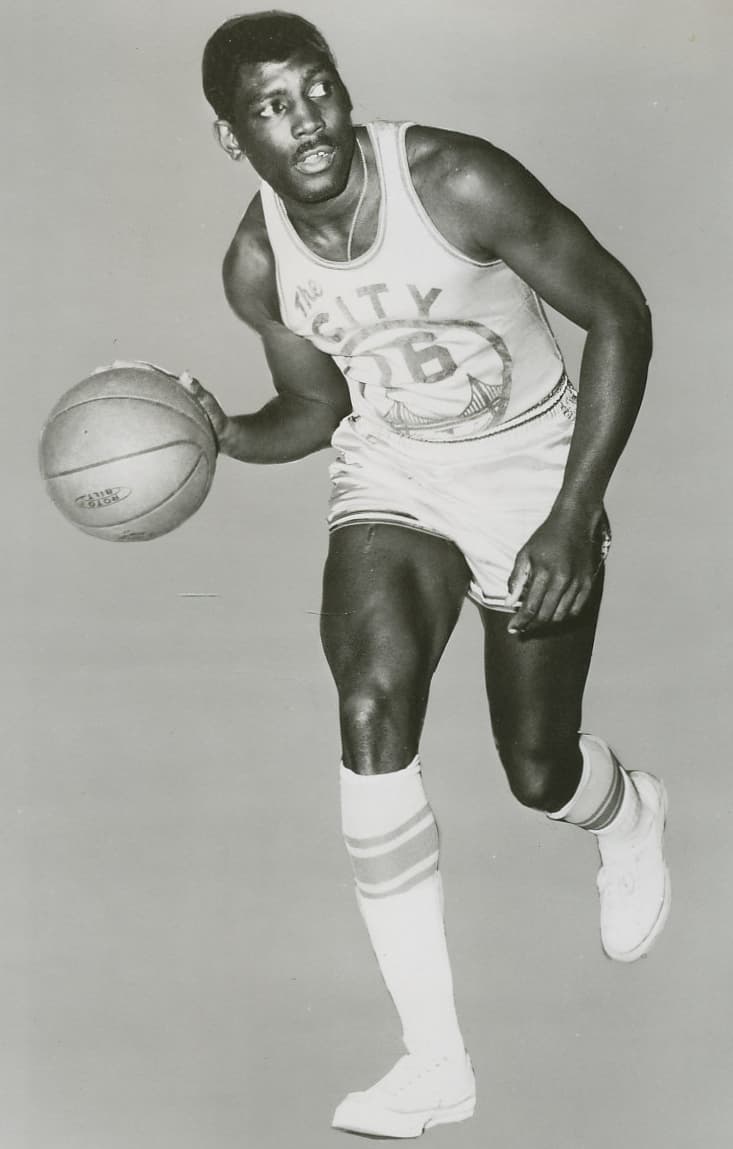
No one has given more to the Golden State Warriors than Al Attles, and the franchise retired #16 for all of it: eleven seasons as a player, fourteen years as head coach, then general manager and ambassador. Drafted by the Philadelphia Warriors in the second round in 1960 out of North Carolina A&T, Attles was not expected to stick — he lasted eleven seasons, averaging 8.9 points per game as a defensive-minded guard whose competitiveness set the tone. He once scored 58 points on November 15, 1962, the second-highest total in the same game Wilt Chamberlain scored 73. As head coach from 1969 to 1983, he compiled a 557-518 record and led the 1975 Warriors, behind Rick Barry, to a stunning 4-0 Finals sweep of the favored Washington Bullets. Attles remains the only Black head coach to win an NBA title before 1980. #16 is the franchise's answer to what a Warrior actually is.
Eleven Seasons on the Court
Attles was drafted by the Philadelphia Warriors in 1960, a second-round pick out of North Carolina A&T who was not expected to stick in the league. He stuck for eleven seasons. He played through the franchise's relocation to San Francisco, through the Wilt Chamberlain era, through roster rebuilds and coaching changes, averaging 8.9 points per game as a scrappy, defensive-minded guard who opponents consistently found difficult to deal with.
His numbers were never the headline. What his teammates remembered — and what coaches later confirmed — was his defensive intensity, his competitiveness, and his ability to raise the performance level of everyone around him through sheer force of effort. He was the player who set the tone in practice, the one who held standards not through words but through example.
Attles scored 58 points in a game on November 15, 1962 — against the same New York Knicks team, on the same night, that Wilt Chamberlain scored 73. Attles was the second-highest scorer in that game. The footnote tells you something about the era he played in.
The Championship Coach
Attles became the Warriors' head coach in 1969 and held the position until 1983, compiling a 557-518 record. The 1975 season was the apex: a Golden State Warriors team led by Rick Barry swept the heavily favored Washington Bullets 4-0 to win the NBA championship — one of the great upsets in Finals history.
What made the 1975 title remarkable was the depth of contribution. Barry was the star, but Attles rotated 11 players through meaningful minutes across the Finals. He trusted his bench in a way that was unusual for the era, and the team responded by outplaying a Bullets roster that featured Elvin Hayes, Wes Unseld, and Phil Chenier. The sweep was not a fluke. It was coaching.
Attles remains the only Black head coach to have won an NBA championship before 1980. His 1975 title came two years before Bill Russell's celebrated coaching career, in an era when opportunities for Black coaches in professional sports were systematically limited. That he built a championship team and remains one of the most respected figures the sport has produced is a fact that his own modest demeanor has never allowed him to emphasize.
A Warrior for Life
After coaching, Attles served as the Warriors' general manager and remained with the organization as an ambassador and community figure through the franchise's transition from Oakland to San Francisco. He has been present at Chase Center. He was present at Oracle Arena. He was present at the Oakland Coliseum before that. He has been a Warrior, in some capacity, for longer than most current players have been alive.
The Warriors have gone through ownership changes, arena changes, roster transformations, and dynasty cycles. Through all of it, Al Attles has been there — not demanding recognition, not positioning himself for credit, but simply being the institutional memory and moral anchor of an organization that has always needed one.
Why the Warriors Retired #16
The Warriors retired Al Attles's #16 because there is no other number that could go in those rafters and mean more to the people who have worked for this franchise. Championships are won by collections of talent. Dynasties are built by front offices. But organizations — the culture, the standards, the sense of what it means to wear the jersey — are built by individuals like Attles, who gave everything they had to the franchise and asked for nothing in return except the chance to compete.
#16 is not just a retired number. It is the franchise's answer to the question of what a Warrior actually is.
Bu analizi beğendiniz mi?
Bunun gibi daha fazla içeriği doğrudan gelen kutunuza alın.