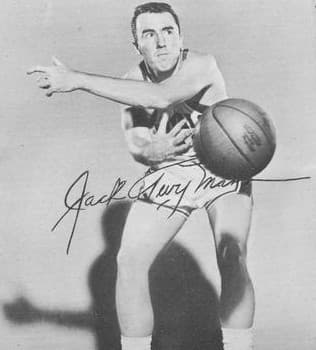
Jack Twyman's number 14 hangs in Sacramento's rafters for two reasons. The first is athletic: Twyman was one of the NBA's finest pure scorers across eleven seasons with the Cincinnati Royals, a six-time All-Star who won the scoring title in 1959-60 with 31.2 points per game and averaged over 25 points per game for four consecutive seasons. The Rochester Royals selected him in the second round of the 1955 NBA Draft. The second reason is human: in March 1958, teammate Maurice Stokes suffered a traumatic brain injury, and Twyman became his legal guardian, spending twelve years organizing Stokes' medical care and raising money through charity games until Stokes died in 1970. The Sacramento Kings retired #14 because Twyman was both an elite NBA scorer and an extraordinary human being — either quality alone would merit recognition, and together they make him one of the most complete figures in franchise history.
Pittsburgh to Cincinnati: Building an Elite Scorer
John Kennedy Twyman was born May 21, 1934, in Pittsburgh, Pennsylvania. He attended Central Catholic High School before going on to the University of Cincinnati, where his scoring and athleticism made him a highly regarded NBA prospect. The Rochester Royals selected him in the second round of the 1955 NBA Draft, and as the franchise relocated to Cincinnati in 1957, Twyman became one of the defining players of the Cincinnati Royals era.
Twyman was a gifted right-handed scorer whose combination of size, footwork, and shooting touch made him one of the most difficult players in the league to guard during his peak years. He averaged over 25 points per game for four consecutive seasons, earned six All-Star selections, and won the NBA scoring title in 1959-60 with 31.2 points per game — numbers that placed him alongside the elite scorers of his generation.
Maurice Stokes and Basketball's Most Remarkable Act of Loyalty
In March 1958, Royals teammate Maurice Stokes suffered a traumatic brain injury after a fall during a game, leaving him partially paralyzed and unable to speak. Stokes had no family in Cincinnati and no resources to cover the medical care he required. Twyman stepped forward, became Stokes' legal guardian, and spent the next twelve years organizing his medical care, advocating for his welfare, and raising money through charity basketball games — many featuring NBA stars — to cover Stokes' extensive treatment costs.
Stokes died in 1970. For twelve years, Twyman had been his primary advocate, friend, and legal protector — a commitment that cost him time, money, and energy throughout his playing career and beyond it. The basketball community recognized the significance of what Twyman did, and when Stokes was inducted into the Hall of Fame in 2004, Twyman presented him — a posthumous tribute that completed one of the sport's most moving stories.
Why the Kings Retired #14
The Sacramento Kings retired Jack Twyman's number 14 because he was both an elite NBA scorer and an extraordinary human being, and either quality alone would merit recognition. Together, they make him one of the most complete figures in franchise history — a player who gave the Cincinnati Royals exceptional basketball for eleven years and gave the world a lesson in what loyalty and compassion look like when they are truly lived, not just spoken about.
Number 14 in the rafters is a reminder that the franchise's history includes more than wins and losses and scoring averages. It includes the kind of character that Jack Twyman demonstrated for twelve years on behalf of Maurice Stokes — quiet, consistent, and ultimately irreplaceable. That is worth remembering. That is worth a retired number.
Gefällt Ihnen diese Analyse?
Erhalten Sie weitere Analysen wie diese direkt in Ihr Postfach.