The Houston Rockets retired Rudy Tomjanovich's #45 at the end of the 1982-83 season, his last as a player. Selected second overall by San Diego in the 1970 Draft, Tomjanovich moved with the franchise to Houston and over eleven seasons made five All-Star appearances while averaging 17.4 points and 8.1 rebounds. On December 9, 1977, a punch from Kermit Washington fractured his skull and nearly killed him; doctors were certain he would never play again. Fourteen months later he was back on an NBA court, playing four more seasons in double figures. The retirement honored that body of work — five All-Star nods, 13,383 career points, the most extraordinary comeback in the sport's history. Everything that followed, the two championships he coached and the statue outside the Toyota Center, was a bonus no one could have predicted. #45 honors a man who became the soul of the franchise.
The Player: A Scorer Who Survived the Impossible
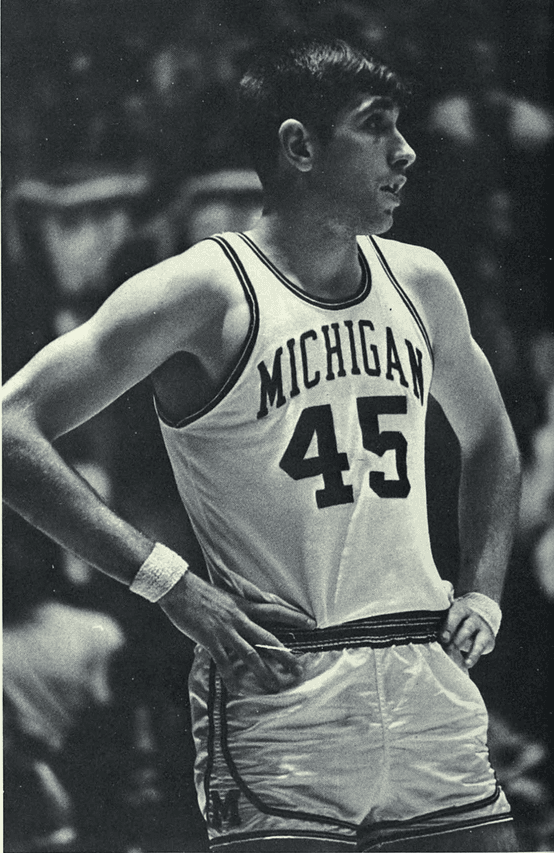
Rudy Tomjanovich was born on November 24, 1948 in Hamtramck, Michigan. He was a two-time All-American at the University of Michigan and was selected second overall by San Diego in the 1970 NBA Draft — the same draft that produced Calvin Murphy. When the franchise moved to Houston, Tomjanovich moved with it, and over eleven seasons became one of the great forwards in Rockets history. He made five All-Star appearances, averaged 17.4 points and 8.1 rebounds per game across his career, and was as consistent and reliable a performer as the franchise had.
None of that is the part of the story that defines him.
On December 9, 1977, during a game between the Rockets and the Los Angeles Lakers, Kermit Washington threw a punch that connected with Tomjanovich's face with such force that it nearly killed him. The damage was catastrophic: a fractured skull, a broken nose, broken jaw and cheekbones, a cerebral concussion, and a leakage of spinal fluid from his brain cavity. Doctors were uncertain he would survive. They were certain he would never play basketball again.
Tomjanovich came back. Fourteen months later, he was on an NBA court, playing basketball. He played four more seasons after the incident, averaging double figures in scoring each year. The resilience required to do what he did is almost impossible to comprehend from the outside.
The Coach: Two Championships and a Masterclass in Adjustability
When Tomjanovich retired from playing in 1981, he stayed in Houston, working as a scout and then as an assistant coach. In 1991, he was named interim head coach and eventually given the permanent job. The franchise he inherited was not a championship contender. The franchise he left was a two-time champion.
His coaching philosophy was built on player empowerment, defensive accountability, and situational intelligence. He understood Hakeem Olajuwon intuitively and built game plans around what Hakeem did best. He managed veterans and young players with equal facility. He knew when to be demanding and when to trust his players to self-organize.
The 1994 championship run — seven games against the Knicks, with Olajuwon at his absolute peak — validated everything. The 1995 run, which required overcoming the top-seeded Sonics with a team that barely made the playoffs, was the coaching performance of his career. He made adjustments on the fly, managed minutes brilliantly, and got maximum production from every player on the roster. His 1995 championship ring was earned through ingenuity as much as talent.
34 Years and One Franchise
Rudy Tomjanovich spent 34 years with the Houston Rockets organization across two roles. As a player, he gave them 11 seasons of reliable excellence through one of the most traumatic events in basketball history. As a coach, he gave them the two best seasons in franchise history. No one in the organization's history has contributed across so many dimensions for so long.
He was named one of the Top 10 coaches in NBA history in 1996. He led the U.S. Olympic team to a gold medal at the 2000 Sydney Games. He is one of only two people in Rockets history — along with Hakeem Olajuwon — to have a statue outside the Toyota Center.
Why the Rockets Retired #45
The Rockets retired Rudy Tomjanovich's #45 at the end of the 1982–83 season, his last as a player. The retirement was an acknowledgment of what he had given the franchise as a player — five All-Star appearances, 13,383 career points, and the most extraordinary comeback in the history of the sport. Everything that came after — the coaching, the championships, the statue outside the arena — was a bonus that no one could have predicted when that jersey went to the rafters.
Number 45 honors a man who was punched hard enough to nearly die and came back to play. A man who stayed in Houston when he didn't have to. A man who led Houston to the only championships in franchise history. Rudy Tomjanovich didn't just wear a Rockets uniform. He became the soul of the franchise, and the number in those rafters belongs to the whole body of work.
Gefällt Ihnen diese Analyse?
Erhalten Sie weitere Analysen wie diese direkt in Ihr Postfach.