Diese Seite enthält Affiliate-Links. Wir erhalten möglicherweise eine Provision, wenn Sie über diese Links kaufen, ohne zusätzliche Kosten für Sie. As an Amazon Associate I earn from qualifying purchases.
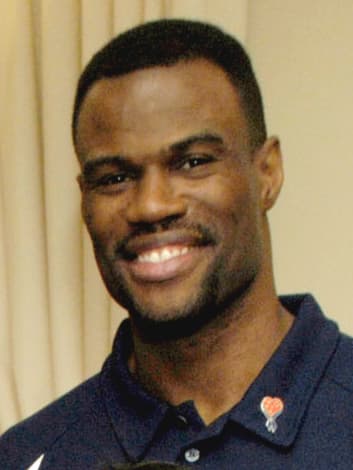
The final day of the 1993–94 regular season, the Los Angeles Clippers' arena, and David Robinson needs a number nobody on the Spurs bench can quite believe. Shaquille O'Neal has finished his own game, and the scoring title — the one award the 22-year-old in Orlando wants most — comes down to math. Robinson has to score in the seventies to take it. So he does. He pours in 71 points, a figure that sounds invented until you watch the box score, methodically, possession by possession, a 7'1" center attacking smaller bodies and taller ones with the same patience he brought to everything. When the buzzer sounds he is the league's scoring champion by the thinnest of margins, having out-dueled the most physically overwhelming young player the sport had produced in a generation. It was the kind of performance that revealed who David Robinson was: a man who, when a thing was worth doing, did it completely. The Spurs would retire his San Antonio #50 a decade later, but the case was already being made that afternoon in Los Angeles.
There has never been another path to the NBA quite like his. To understand why the number hangs, you have to start with the ships.
The Admiral Came Late — and On Purpose
David Robinson did not grow into basketball the way the legends usually do. He grew tall late, was a strong student before he was a dominant athlete, and chose the United States Naval Academy at a time when choosing Annapolis meant accepting that a professional sports career was, by the terms of the commitment, nearly impossible. Midshipmen owe the Navy active-duty service after graduation. Robinson grew several inches during his time at the Academy — past the height limit for many shipboard assignments — but the obligation remained. When San Antonio drafted him first overall in 1987, they were not drafting a player they could use that fall. They were drafting a naval officer who still owed his country two years of service, and they decided he was worth the wait.

So the Spurs waited. Robinson served his commitment, kept his body in shape, represented the United States in international competition, and finally arrived in San Antonio in 1989 — two years after his name was called, twenty-four years old, a rookie who had already been an officer. The nickname "The Admiral" was a play on the Navy roots, and it fit a man who carried himself with a discipline the league was not used to seeing in someone that gifted. Most franchises would never have built a draft around a player they could not have for two seasons. The Spurs did, and the gamble defined the next fourteen years of the organization.
The Largest Leap in Franchise History
The impact was immediate and almost absurd. The season before Robinson arrived, the Spurs were a lottery team. In his rookie year, 1989–90, they improved by 35 wins — the largest single-season turnaround the NBA had ever recorded at the time. A roster that had been an afterthought became a 56-win playoff team essentially because one man walked through the door. He won Rookie of the Year going away, and there was no ambiguity about what he was: a 7'1", 235-pound center who moved like a wing, ran the floor like a guard, and protected the rim like the era's most feared shot-blockers.

That combination of size and speed had no real precedent at the position. Robinson could face up from the elbow, beat slower centers off the dribble, finish above the rim in transition, and then sprint back to erase a layup at the other end. Four times he led the NBA in blocked shots. In an era stacked with monumental centers — Hakeem Olajuwon, Patrick Ewing, Shaquille O'Neal, Alonzo Mourning — he was, on his best nights, the most complete two-way force of the group. The individual honors stacked up quickly: Defensive Player of the Year in 1992, when he turned the lane into a closed door, and a scoring title in 1994 that he sealed with the 71-point afternoon in Los Angeles. He even produced, that same February, a performance so rare it has its own line in the record books — a game in which he reached double figures in four statistical categories, the sort of all-around dominance only a handful of players have ever managed.
The MVP and the Weight of the Solo Years
The 1994–95 season was the summit of David Robinson's individual prime. He averaged 27.6 points, 10.8 rebounds, more than three assists, and more than three blocks a night — a stat line that belongs on the short list of the greatest single seasons a center has ever assembled. He won the MVP that year by a comfortable margin, the clear best player in a Western Conference loaded with talent. For a stretch in the mid-1990s, the argument over the league's most valuable big man genuinely ran through San Antonio.

And yet the trophies came faster than the rings. The Robinson-led Spurs were perennial contenders who kept running into walls in the playoffs — sometimes Olajuwon's Rockets, sometimes the broader brutality of the Western bracket. The narrative that hardened around him in those years, that he was a regular-season giant who shrank in May, was always more convenient than true. What those teams lacked was not a superstar; it was a second one. Robinson had carried San Antonio further than its roster had any right to go. The missing piece was about to arrive in the cruelest way imaginable.
The Injury That Built a Dynasty
In 1996–97, Robinson played a fraction of the season. Injuries — a back problem, then a broken bone in his foot — limited him to a handful of games, and without their anchor the Spurs collapsed into one of the worst records in the league. It was the lowest point of his career and, viewed from any angle except the long one, a disaster. But the NBA's draft lottery rewards the fallen, and San Antonio's terrible season delivered the first overall pick in a draft with a generational talent at the top.

That pick became Tim Duncan. The injury that ruined a season had handed the franchise its future. When Robinson returned to health alongside the rookie from Wake Forest, San Antonio suddenly had two of the best big men alive on the same frontline. The basketball press gave them a name that has outlived both of their careers: the Twin Towers. Two seven-footers who could each anchor a defense and score with their backs to the basket, sharing a paint that opponents found almost impossible to enter. It is the rare partnership where the whole genuinely exceeded an already-enormous sum of parts.
Choosing to Step Back
Here is where David Robinson's character did something his statistics never could. He was, by the time Duncan arrived, an MVP, a former scoring champion, the face of the franchise, a man with every justification to demand that the offense remain his. Instead he read the situation with the same clarity he brought to everything and made the harder choice. He deferred. He let Duncan become the first option, surrendered shots and touches he had earned over nearly a decade, and reinvented himself as the defensive backbone, the locker-room conscience, and the elder presence a young champion needs.

The result was the 1999 NBA championship — the first title in Spurs history, the Twin Towers smothering every opponent who tried to score inside, and validation of everything Robinson had poured into a franchise that did not exist as a contender before he arrived. It was his first ring, won in his thirties, as the second-best player on his own team. He had spent the solo years being told he could not win the big one. He answered by helping to win it the moment the right partner stood beside him — and by being secure enough not to need the credit.
The Perfect Last Season
The ending was the kind storytellers do not dare to invent because it would seem too neat. Robinson announced that the 2002–03 season would be his last, and the Spurs spent that year chasing a sendoff worthy of him. They reached the Finals, dispatched their opponent, and won the 2003 championship in what was, by design, David Robinson's final act as a professional. He went out as the elder statesman of a champion — no longer the star, but the heart — having entered the league turning a lottery team into a contender and leaving it a two-time champion in his last game. Fourteen seasons in San Antonio. Zero requests to play anywhere else. Two titles bracketing a career of relentless, uncomplaining excellence.

He retired with totals that reflect the fullness of it: better than 20,000 points, better than 10,000 rebounds, and nearly 3,000 blocked shots — one of the most complete two-way résumés any center has carried out of the game. But the box score was never the point with Robinson. The point was the standard.
The Numbers Behind the Number
- 2 NBA championships (1999 with a young Tim Duncan, and 2003 as the elder statesman in his final season)
- 1995 NBA Most Valuable Player — the best player in the league at his peak
- 1992 Defensive Player of the Year — the era's most disruptive interior presence
- 1990 Rookie of the Year, after powering the largest single-season turnaround in league history at the time
- 1994 scoring champion — clinched with a 71-point performance on the final day to edge Shaquille O'Neal
- 10× NBA All-Star and a four-time league leader in blocked shots
- A rare four-category statistical game in February 1994 — all-around dominance almost no one has matched
- Two-time Olympic gold medalist, including a place on the 1992 Dream Team
- Hall of Fame, Class of 2009 — first ballot, as it had to be
- Fourteen seasons, one franchise — every game of his career in a Spurs uniform
None of those lines holds what David Robinson meant to San Antonio, because the most important things he did never appeared in a box score. He founded the Carver Academy, a school for underserved children in San Antonio, and committed millions of dollars of his own money to it — a level of personal philanthropy almost unheard of for an active superstar. He represented the United States with the same seriousness he had brought to wearing its uniform in the Navy. He played fourteen years without a public complaint, a trade demand, or a scandal. In a sport that rewards ego, he built a career on the opposite, and the franchise's entire culture — the selflessness Gregg Popovich would later make famous — was poured into a foundation that Robinson laid first.

Why #50 Hangs Forever
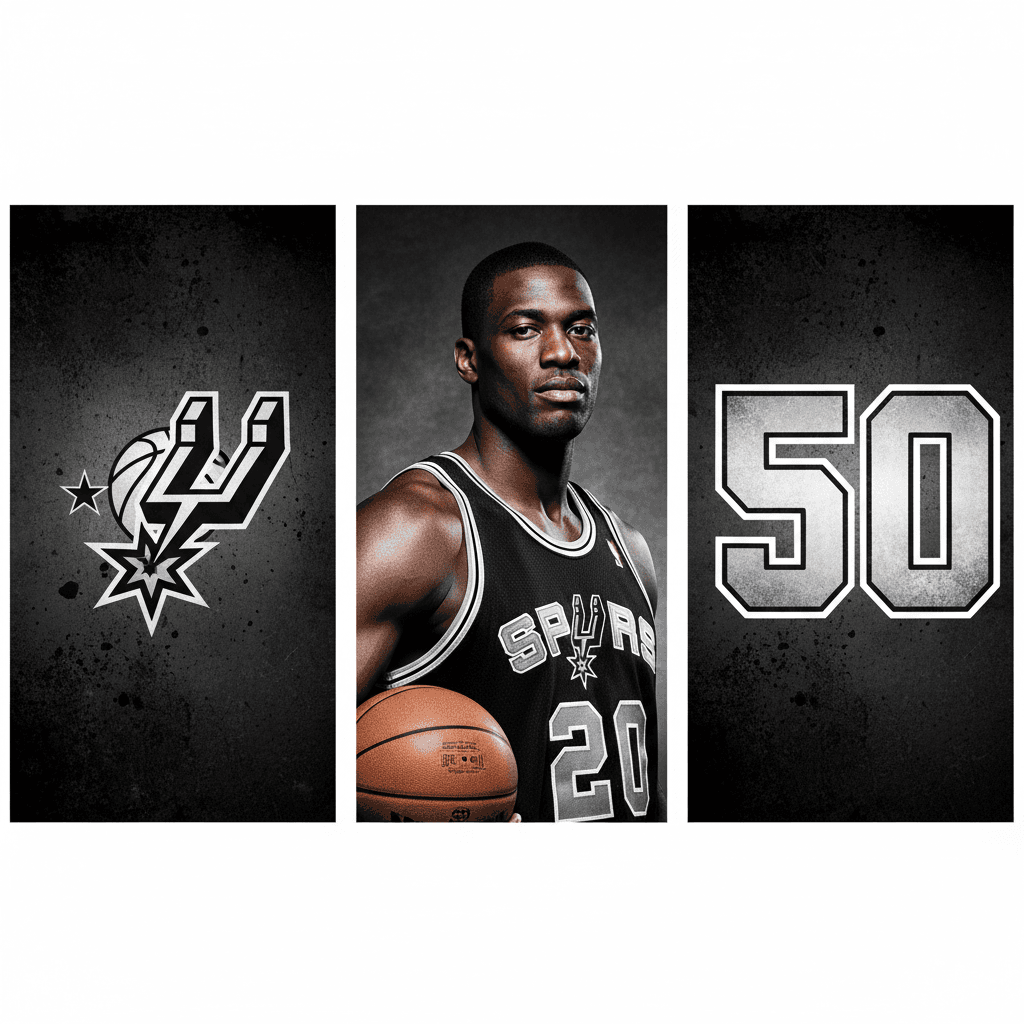
The Spurs retired David Robinson's #50 and sent it to the rafters, where it has stayed ever since, untouched by any player who came after. The decision required no debate. Some numbers honor a great player. This one honors the man who turned a franchise into a destination — who arrived two years late because his country came first, improved a lottery team by 35 wins in a single season, won an MVP and a scoring title, and then, when greatness asked him to share the spotlight, did it without a flicker of resentment and won two championships for the trouble.
#50 witnessed all of it. The 71-point afternoon. The MVP. The closed-door defense that earned a Defensive Player of the Year. The injury that ruined a season and built a dynasty. The decision to step aside for a younger man and the championships that decision made possible. The whole arc of a basketball life lived without a shortcut.
The number hangs alongside the other pillars of the franchise — Tim Duncan's #21, the partner who completed the Twin Towers; George Gervin's #44, the artist who carried the Spurs before Robinson arrived; and Manu Ginobili's #20, who would help extend the dynasty Robinson started. None of them, alone, is the franchise. Together they are its spine. And #50 is the number that runs straight down the center of it — the Admiral who anchored everything San Antonio basketball would become.
Gefällt Ihnen diese Analyse?
Erhalten Sie weitere Analysen wie diese direkt in Ihr Postfach.