Austin Reaves: The Basketball IQ Behind a Lakers Cornerstone
No draft pick. No lottery status. No combine buzz. Just pure basketball intelligence that turned an NBDL journey into a Lakers starting role. The case for Reaves as the NBA's most analytically undervalued player.
Diosh Lequiron
··11 min read·
M
Share
This page contains affiliate links. We may earn a commission if you purchase through these links, at no extra cost to you. As an Amazon Associate I earn from qualifying purchases.
There is no athletic explanation for Austin Reaves — no elite first step, no exceptional wingspan, a pre-draft profile that generated zero first-round offers — yet he starts for the Lakers alongside LeBron James and Luka Doncic and makes his team measurably better. This analysis argues the explanation is cognitive, not physical, and breaks down the specific skills behind it. Shot selection is the foundation: Reaves's attempt quality ranks in the NBA's top 5%, with 44% of his threes coming from the corner and his 2025-26 mark at 41.8% on 6.1 attempts. His off-ball movement creates separation through timing rather than athleticism — separation that does not erode with age. The piece also examines his clutch data, his complementary fit with Doncic (a +12.8 net rating together), and why his undrafted path has become a teaching case in NBA executive development about the limits of measuring physical tools over basketball intelligence.
Shot Selection: The Foundation of Everything
The most underrated basketball skill is knowing which shots to take. Knowing which shots not to take is harder, rarer, and more valuable. Reaves doesn't attempt bad shots. Over his last three full seasons, his shot-attempt quality ranks in the top 5% of NBA players by frequency of high-value attempts (corner threes, layups, catch-and-shoot open threes) relative to total field goal attempts.
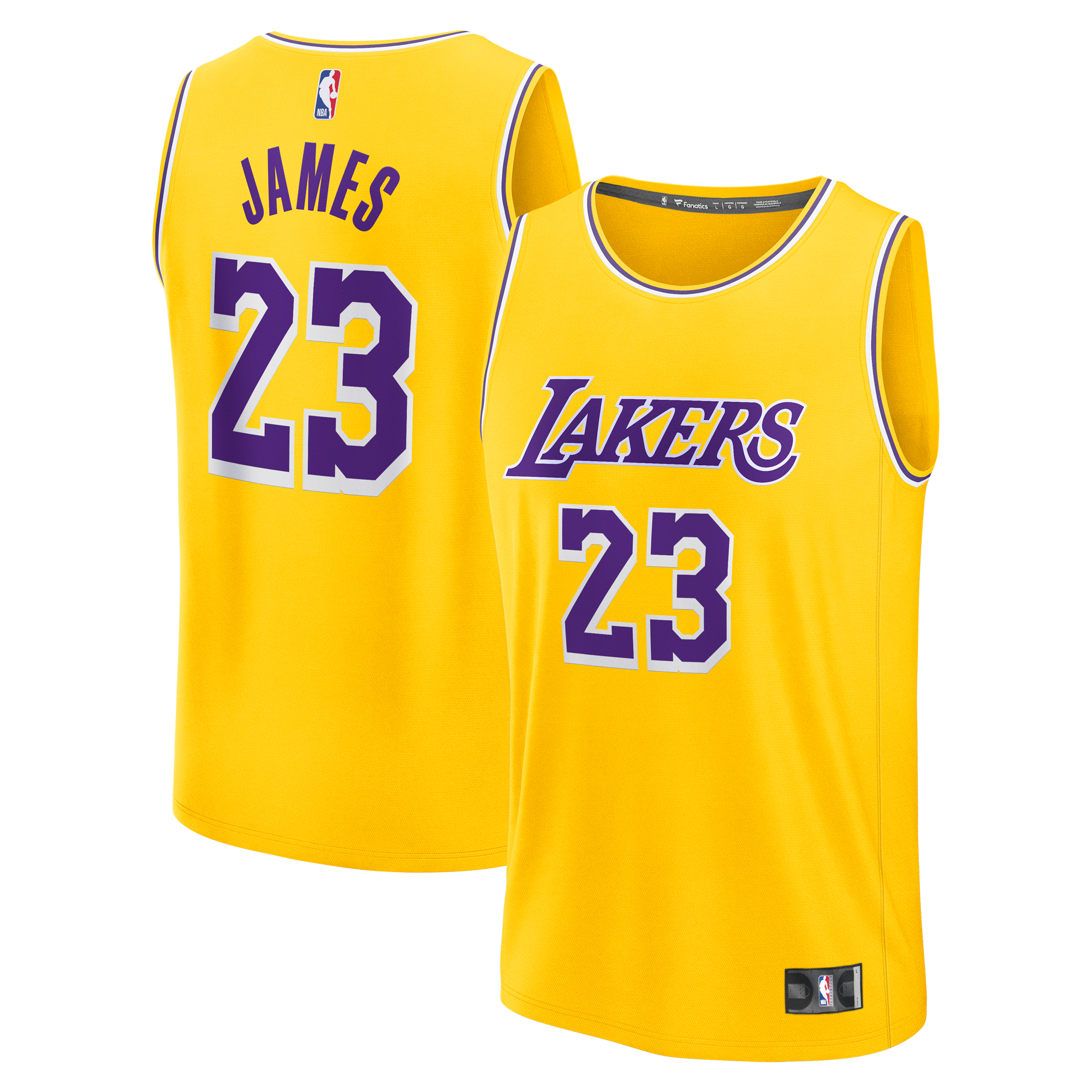
Men's LeBron James Gold Los Angeles Lakers Fast Break Replica Jersey - Icon Edition
His three-point shooting in 2025-26 — 41.8% on 6.1 attempts per game — reflects this selectivity. The percentage is good. The volume is high. The combination is elite. But the key number is where his attempts come from: 44% of his threes are corner threes (where the three-point line is shorter and the angle into the basket is better), and 81% of his non-corner threes are catch-and-shoot attempts with an open look rather than a contested pull-up.
"What makes Austin so difficult to guard is that he never gives you a weakness to exploit. You want him to dribble — he puts it on the floor and attacks. You back off — he shoots 42%. You deny — LeBron or Luka gets an open lane. There's no right answer when he's playing well." — NBA defensive coordinator
Austin Reaves Los Angeles Lakers Autographed Gold Nike Icon Swingman Jersey
Off-Ball Movement: The Invisible Skill
Reaves's off-ball movement is among the best in the NBA at any position. He averages 2.9 miles per game of off-ball running — in the top 10 for guards — not from running fast but from moving purposefully. Every cut has a logic. Every change of direction is timed to exploit defensive positioning rather than create it.
The specific skill: Reaves identifies when his defender's attention has been captured by the ball — by LeBron's drive, by Doncic's isolation — and he cuts precisely when that attention is divided. He doesn't create separation through athleticism; he creates it through timing. The mathematical difference is small. The practical difference is enormous: athletic separation disappears when the athlete ages, timing separation is available forever.
Unisex Nike Austin Reaves Gold Los Angeles Lakers Swingman Jersey - Icon Edition
This is why Reaves's value projections at age 30 look different from most perimeter players. His skill set doesn't depend on physical tools that erode. A player who wins through intelligence, timing, and shooting mechanics can do so at 28, 32, and potentially 36.
Clutch Performance: The Data Behind the Reputation
Reaves has developed a reputation for clutch shots — the kind of reputation that usually precedes the statistical examination. In this case, the statistics support the reputation:
Austin Reaves Los Angeles Lakers Autographed 16" x 20" Dunking Spotlight Photograph
Clutch FG%: 47.2% (top 5 among guards with high clutch-time usage)
Clutch 3P%: 44.1% (career — best among guards with 100+ clutch three attempts)
Late-and-close game-winner rate: 3 game-winners in the last two seasons, tied for most among guards with 15+ such opportunities
The clutch efficiency is an extension of his shot selection philosophy: in clutch situations, while most players attempt harder shots because of the moment, Reaves continues seeking his best looks. This is a discipline that sounds simple and is almost impossible to consistently execute under pressure.
Austin Reaves Men's Fanatics White Los Angeles Lakers Fast Break Custom Replica Jersey - Association Edition
The Doncic-Reaves Pairing
Luka Doncic's acquisition from Dallas has created something unexpected in Los Angeles: a backcourt pairing where both players make each other better through complementary skills rather than competing for the same resources.
Doncic needs shooters who punish defenses that collapse to stop his drives. Reaves is one of the most efficient punishers in the league. Doncic's gravity creates corner three opportunities that Reaves converts at 44.8%. Reaves's movement without the ball keeps his defender occupied in ways that make Doncic's isolation more navigable.
Luka Dončić & Austin Reaves Los Angeles Lakers Facsimile Signature Framed 11" x 14" Spotlight Photograph
Their on-court partnership in 2025-26 has produced a net rating of +12.8 — among the best two-man combinations in the league. The fit isn't accidental. It's the product of Reaves adapting his positioning and cutting patterns to maximize what Doncic's ball-handling creates, and Doncic learning when to look for Reaves's movement rather than creating his own shot.
Reaves in 2025-26 through 50 games: 18.4 PPG, 4.8 APG, 4.2 RPG. 49.1% FG, 41.8% 3P, 89.3% FT. Net rating with LeBron: +10.2. Net rating with Doncic: +12.8. Net rating with both: +14.1. Net rating without either: +3.7.
Austin Reaves Men's Fanatics White Los Angeles Lakers Fast Break Custom Replica Jersey - Association Edition
The Undrafted Legacy
Reaves's path — undrafted out of Arkansas, G League, two-way contract, full deal, starter — has become something the NBA uses as a teachable example in executive development programs. Not because undrafted players rarely make it (they don't, mostly), but because the specific combination of attributes that allowed Reaves to make it reveals things about player evaluation that top-15 picks often obscure.
Physical tools are easier to measure than basketball intelligence. Drafts optimize for the measurable. Reaves was unmeasurably good at things that don't show up in combine numbers: understanding leverage, exploiting defensive attention, making teammates' lives easier. These skills compound over time. They are the difference between a player who peaks in year two and a player who is still improving in year eight.
Josh Hart Los Angeles Lakers 2017-18 Panini Immaculate Collection Jersey Number Tri-Color Relic #JP-JHT #60/75 Card
The NBA is full of players who were supposed to be stars and aren't. Reaves was supposed to be a camp invite. The gap between expectation and reality is the most interesting story in professional basketball — and Reaves is its best current narrator.
Enjoying this analysis?
Get more breakdowns like this delivered to your inbox.
Boozer and Peterson opened as 2027 NBA Rookie of the Year co-favorites over No. 1 pick AJ Dybantsa. We break down role, usage and the real case for each.
AJ Dybantsa is the presumptive face of the Wizards' rebuild — brought in as the No. 1 overall pick even though Washington already has six NBA wings on the roster. A look at the record-breaking BYU season, the Darryn Peterson decision, and why talent still beats a crowded depth chart.
Dylan Harper arrived as the No. 2 pick and finished his rookie year as an All-Rookie First Team guard starting in the NBA Finals. A film-room look at the Filipino-American lead guard powering San Antonio's next era alongside Victor Wembanyama.