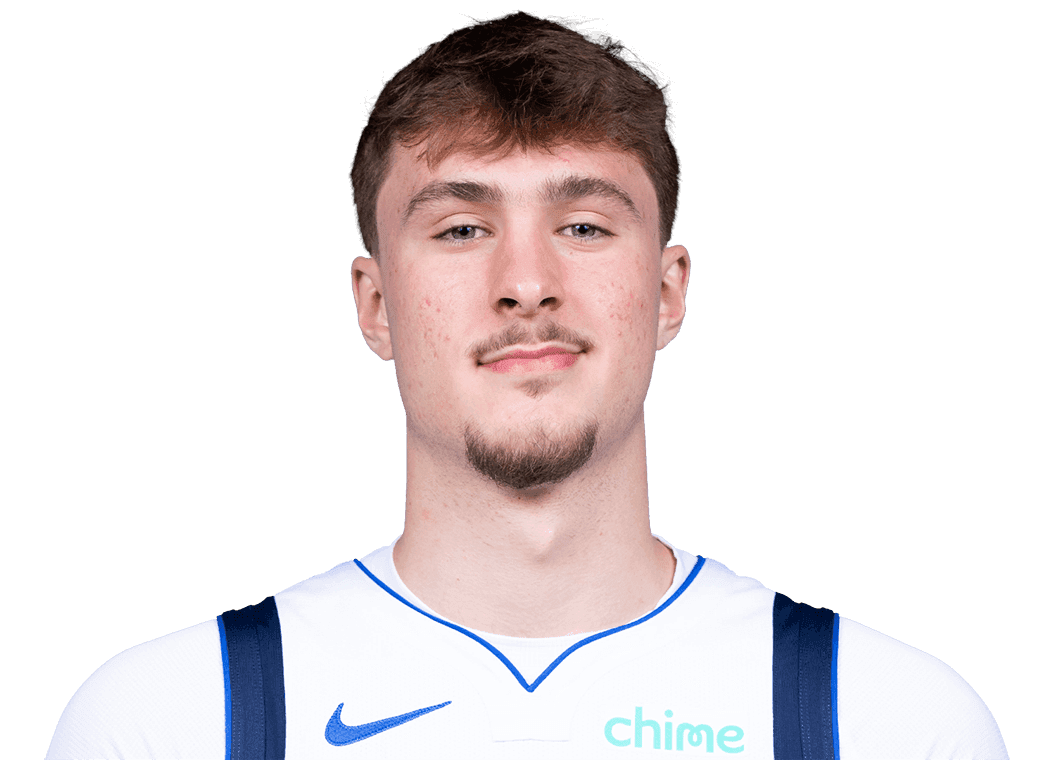
Cooper Flagg's Rookie Season: How Dallas's #1 Pick Exceeded Every Expectation
Twenty-plus points a night, elite two-way impact, and a basketball IQ that coaches describe as unprecedented for a 19-year-old. Cooper Flagg isn't just the best rookie in years — he's rewriting what Year One can look like.
Diosh Lequiron
··12 min read·
M
Share
This page contains affiliate links. We may earn a commission if you purchase through these links, at no extra cost to you. As an Amazon Associate I earn from qualifying purchases.
Cooper Flagg has been in the NBA for four months and plays like it has been four years. The 2025 number-one overall pick has produced one of the most statistically impressive rookie seasons of the modern era, and the analytical case is that his basketball IQ is outrunning his physical development. At 6'9" with a 7'2" wingspan he shoots 38.4% from three on 5.2 attempts, a size-and-accuracy combination without precedent at age 19. His 108.4 defensive rating is an All-Defensive-Team number, not a rookie one, supported by 2.2 blocks and 1.6 steals per game across a guard-through-forward switching range. Through 54 games he averages 21.3 points, 8.2 rebounds, 3.4 assists, with 4.8 win shares by December — a combined profile no player has matched at his age. Why it matters: Dallas built deliberately around him, which means the most important fact about this rookie season is that it is just the beginning.
The Offensive Foundation: Shooting at His Size
Flagg stands 6'9" with a 7'2" wingspan and shoots 38.4% from three on 5.2 attempts per game. At his size and age, those numbers don't have a precedent. NBA history has produced athletic forwards who could shoot threes, or shooting forwards who lacked athleticism. A 19-year-old who combines elite length with a shooting stroke this reliable is a categorically new development.
Youth Nike Cooper Flagg Blue Dallas Mavericks Swingman Jersey - Icon Edition
His shot comes off screens with exceptional footwork — feet set before the pass arrives, quick trigger, high release that creates separation from the closing defender. Off the dribble, he has a reliable step-back that he uses sparingly and wisely, identifying only the situations where the separation justifies the shot difficulty.
"What you don't see in the numbers is shot selection. He doesn't take the bad ones. A lot of young guys take whatever's available because they're aggressive. Flagg is aggressive and selective simultaneously. That combination is extremely rare at any age." — Western Conference advance scout
Cooper Flagg Dallas Mavericks Autographed Wilson Authentic Series Indoor/Outdoor Basketball with Acrylic Curved Logo Basketball Case
The Defensive Dimension
Flagg guards 1-through-4 with genuine effectiveness — not the nominal switchability that teams claim for most forwards, but actual defensive production across positions. His lateral quickness tests in the 95th percentile for his position group. His anticipation — the ability to read offensive intentions before they're executed — has been described by Dallas coaching staff as the highest they've seen in a rookie at any position.
The block numbers (2.2 per game) are impressive but slightly misleading: Flagg gets blocks through positioning more than athleticism, identifying where shots will be attempted before they're released and arriving at the contest point before the shooter. This anticipatory shot-blocking is harder to develop than athletic blocking because it requires game modeling — predicting offensive reads in real time — rather than raw physical gifts.
Cooper Flagg Men's Fanatics Navy Dallas Mavericks Fast Break Custom Jersey - Statement Edition
His defensive rating in 2025-26 is 108.4. For context, the league average is approximately 113. A 19-year-old defensive rating of 108.4 is not a rookie number. It's an All-Defensive-Team number.
Defensive rating when on court: 108.4 (top 25 in the NBA)
Blocks per game: 2.2 (6th in the NBA, highest among forwards)
Steals per game: 1.6 (top 15 in the NBA)
Defensive switchability range: PG through PF
The Basketball IQ Question
Basketball IQ is a term that gets applied loosely to almost any player who makes good decisions. With Flagg, analysts are using it to describe something more specific: the ability to process game situations at a cognitive speed that exceeds his physical development.
Men's NBA x Hugo Boss Black Dallas Mavericks Slam Dunk Jersey Tracksuit Pants
A concrete example: In pick-and-roll defense, rookies typically need one or two seasons to understand how to navigate screens, communicate switches, and position themselves to prevent both the ball-handler and the roll-man from being exploitable. Flagg navigated all three coverage types correctly in his second preseason game. Coaches spent three practices explaining the concepts. He applied them the first time, correctly, under game conditions.
Marvin Bagley III Men's Fanatics Navy Dallas Mavericks Fast Break Custom Jersey - Statement Edition
Dallas head coach Jason Kidd — himself one of the highest-IQ players in NBA history — described Flagg's basketball intelligence as "not something you coach. You create the conditions and hope they absorb it. He was absorbing it before we started explaining." This is the kind of player-coach relationship that accelerates development dramatically: when the player learns faster than the curriculum teaches, both grow.
The Historical Comparisons
Early-career comparison attempts have produced names that set an unusually high bar: Kevin Durant for the shot and fluidity, Scottie Pippen for defensive versatility, Dirk Nowitzki for the combination of size and shooting at forward. None of the comparisons are quite right. All of them are directionally accurate.
Dereck Lively II Dallas Mavericks Autographed 2023-24 Panini One & One Presenting #P-DLV #8/10 Rookie Card
More useful than specific player comparisons is the archetype: Flagg represents the fullest realization so far of the "3-and-D forward who also generates offense" — a player built precisely for the NBA's current competitive landscape, where defensive switchability is the most valuable commodity and shooting spacing is the engine of every elite offense.
Flagg through 54 games in 2025-26: 21.3 PPG, 8.2 RPG, 3.4 APG, 2.2 BPG, 1.6 SPG. 51.2% FG, 38.4% 3P, 82.1% FT. Win shares through December: 4.8 (tied for 3rd in the NBA). Age: 19 years, 3 months. Previous players with equivalent combined stats at this age: Zero.
The Mavericks' construction has been deliberate since acquiring the pick that became Flagg. Their roster around him — Kyrie Irving as a veteran playmaker, Daniel Gafford as a finishing center, a supporting cast of shooters and defenders — is designed to complement a player who can score, defend, and facilitate without needing to be the primary ball-handler.
Irving, in particular, has served as a mentor whose primary contribution isn't points — it's teaching Flagg how to read defenses at the NBA level. The veteran-rookie pairing echoes successful historical models: young players with elite IQ developing under veterans who can articulate things that most players just do intuitively. The knowledge transfer is visible in how Flagg's decision-making has evolved from game 5 to game 54.
The NBA's next star has arrived. Dallas got him. And at 19, with everything that comes next, the most important thing about Cooper Flagg's rookie season is that it's just the beginning.
Enjoying this analysis?
Get more breakdowns like this delivered to your inbox.
Boozer and Peterson opened as 2027 NBA Rookie of the Year co-favorites over No. 1 pick AJ Dybantsa. We break down role, usage and the real case for each.
AJ Dybantsa is the presumptive face of the Wizards' rebuild — brought in as the No. 1 overall pick even though Washington already has six NBA wings on the roster. A look at the record-breaking BYU season, the Darryn Peterson decision, and why talent still beats a crowded depth chart.
Dylan Harper arrived as the No. 2 pick and finished his rookie year as an All-Rookie First Team guard starting in the NBA Finals. A film-room look at the Filipino-American lead guard powering San Antonio's next era alongside Victor Wembanyama.