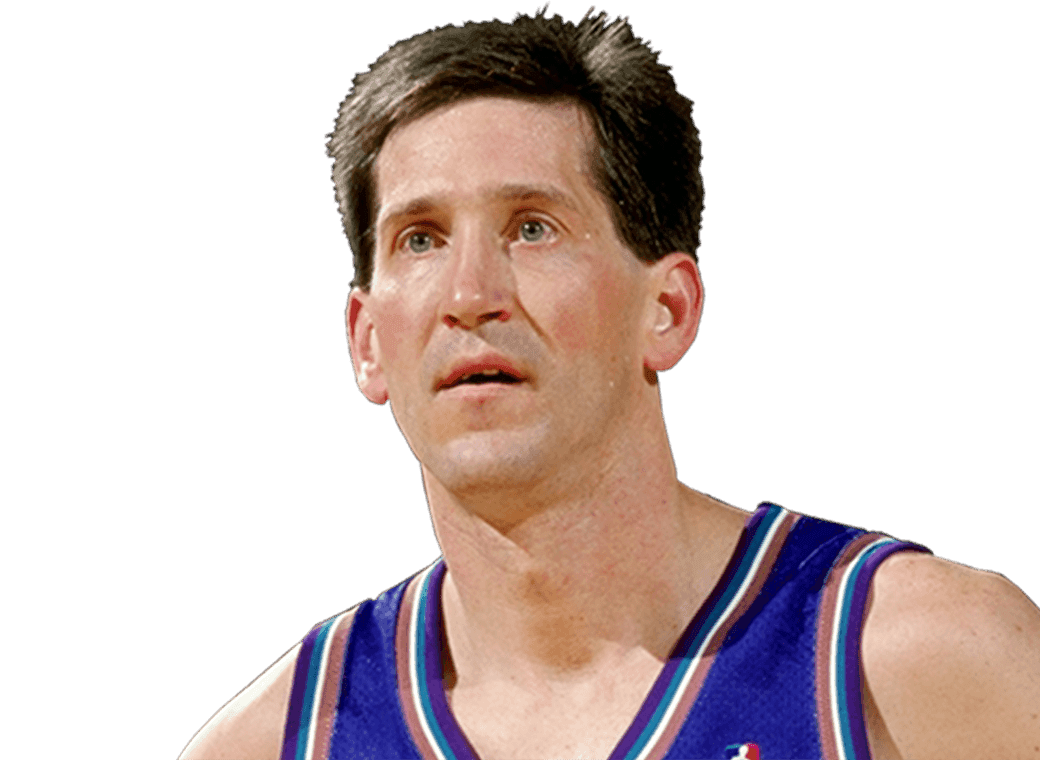
Jeff Hornacek went undrafted, shot 43.5% from three, and was the indispensable third piece of the Stockton-Malone era Jazz. Here is why #14 belongs in the rafters.
Ang artikulong ito ay awtomatikong isinalin mula sa Ingles.View original
Diosh Lequiron
··7 min basahin·
M
Share
Ang pahinang ito ay naglalaman ng mga affiliate link. Maaari kaming kumita ng komisyon kung bibili ka sa pamamagitan ng mga link na ito, nang walang dagdag na gastos sa iyo. As an Amazon Associate I earn from qualifying purchases.
The Utah Jazz retired Jeff Hornacek's #14 to honor a kind of excellence that does not demand attention but produces results. Hornacek went undrafted in 1986 — the fact that explains everything after it, because what followed was extraordinary: three All-Star selections and a 43.5% career mark from three-point range when most shooting guards barely respected the line. After seven seasons developing into a reliable two-way guard in Phoenix, he was traded to Utah in 1994 for Jeff Malone and others. Across six seasons in Salt Lake City he was the third option who made everything else work — the shooter who forced defenses off Stockton and Malone, the defender who competed every possession. He shot 87.5% from the free throw line for his career, his three-dribble, cheek-touch routine a wave to his children. He was indispensable to Utah's back-to-back 1997 and 1998 Finals runs, and later coached in the NBA, surprising no one who watched him play.
From Phoenix to Salt Lake City
Hornacek spent seven seasons with the Phoenix Suns, developing into one of the most reliable two-way guards in the Western Conference. In 1994, the Jazz acquired him in a trade that sent Jeff Malone and others to Phoenix, and what followed was six seasons of exactly the kind of basketball that wins playoff series: consistent, intelligent, efficient, and almost entirely free of wasted possessions.
Vince Williams Jr Youth Fanatics Black Utah Jazz Fast Break Custom Replica Jersey - Statement Edition
His role in Salt Lake City was not to be the primary star. It was to be the player who made everything else work — the shooter who forced defenses to account for the perimeter when they wanted to load up on Stockton and Malone, the defender who competed every possession, the veteran who understood that the most valuable thing a third option can do is be reliably good rather than occasionally great.
Lauri Markkanen Youth Fanatics White Utah Jazz Fast Break Replica Custom Jersey - Association Edition
The Details That Defined Him
Hornacek's pre-free throw routine — three dribbles, a touch of his right cheek — became one of the most recognizable habits in 1990s basketball. He said it was a wave to his three children watching at home. Whether or not you believe that, it is a perfect encapsulation of who he was: a player who could be sentimental and precise at the same time, whose reliability extended from the free throw line to every other aspect of his professional conduct.
Unisex Nike Ace Bailey Purple Utah Jazz Swingman Jersey - Icon Edition
He shot 87.5% from the free throw line for his career. He shot 43.5% from three. He played with the kind of controlled aggression that coaches spend careers trying to teach — knowing exactly when to attack, when to give up the ball, and when to be the one who takes the shot that ends the game. His 1997 and 1998 Finals performances, while the Jazz fell short both times, were among the most quietly excellent contributions on those rosters.
Unisex Nike Lauri Markkanen Purple Utah Jazz Swingman Jersey - Icon Edition
He was also a genuine two-way player in an era that rewarded offensive production far more than defensive commitment. Jazz opponents understood that guarding Hornacek required full attention on the perimeter — he punished every lapse, every moment of overextension on the help side, every defensive mistake that left him momentarily open.
Walker Kessler Youth Fanatics White Utah Jazz Fast Break Replica Custom Jersey - Association Edition
Why #14 Is in the Rafters
The Jazz retired #14 because Jeff Hornacek represented something the organization valued as deeply as star power: the kind of professional excellence that makes everyone around him better. He was not the reason Utah reached back-to-back Finals in 1997 and 1998. But he was indispensable to why they got there — the reliable third leg of a trio whose collective efficiency was greater than the sum of its parts.
Men's Fanatics Keyonte George Black Utah Jazz Fast Break Replica Jersey - Statement Edition
After his playing career, Hornacek went on to coach in the NBA, which surprised no one who had watched him play. His understanding of the game, his attention to detail, and his ability to communicate what good basketball looked like were qualities that translated directly from being a player to developing others. The Jazz keep his number in the rafters as a tribute to the kind of excellence that does not demand attention but produces results every single time it is asked to deliver.
John Konchar Men's Fanatics Black Utah Jazz Fast Break Custom Jersey - Statement Edition
Nagustuhan mo ba ang analysis na ito?
Makakuha ng mas marami pang analysis na tulad nito sa iyong inbox.
Scottie Pippen is the greatest example in basketball history of what it means to be exactly what your team needs. Without Pippen's #33, there is no second three-peat, no dynasty mythology, and arguably no six championships at all.
October 1, 1994: the Bulls retire #23 for the first time. Eighteen months later, Jordan faxed two words and they took it back down. The story of six championships, two three-peats, and the number that bent the gravity of basketball around itself.
Bob Love was the Chicago Bulls' first great offensive player — a jump-shooting artist who averaged 21 points a game and made three All-Star teams. But the story of why the Bulls retired his #10 has as much to do with what happened after basketball as during it.