Ang pahinang ito ay naglalaman ng mga affiliate link. Maaari kaming kumita ng komisyon kung bibili ka sa pamamagitan ng mga link na ito, nang walang dagdag na gastos sa iyo.
Before Michael Jordan played a single professional minute, there was David Thompson — Skywalker — a guard from Shelby, North Carolina, whose 44-inch vertical leap and supernatural scoring made the basketball world reconsider what was possible. At NC State he led the Wolfpack to the 1974 NCAA Championship over an undefeated UCLA team that had won 88 straight games, won the Naismith Award, and was selected first overall by the ABA Denver Nuggets in 1975, averaging 26 points as a rookie. On April 9, 1978, he scored 73 points — including 32 in a single quarter — in a bid for the scoring title, still the fourth-highest single-game total in NBA history. He was a four-time All-Star and averaged 24.0 points across his Denver career. Substance abuse cut his career short; he retired in 1984 at age 30. The Hall of Fame inducted him in 1996, and the Nuggets retired #33 for the extraordinary basketball he gave the franchise.

The Skywalker Arrives
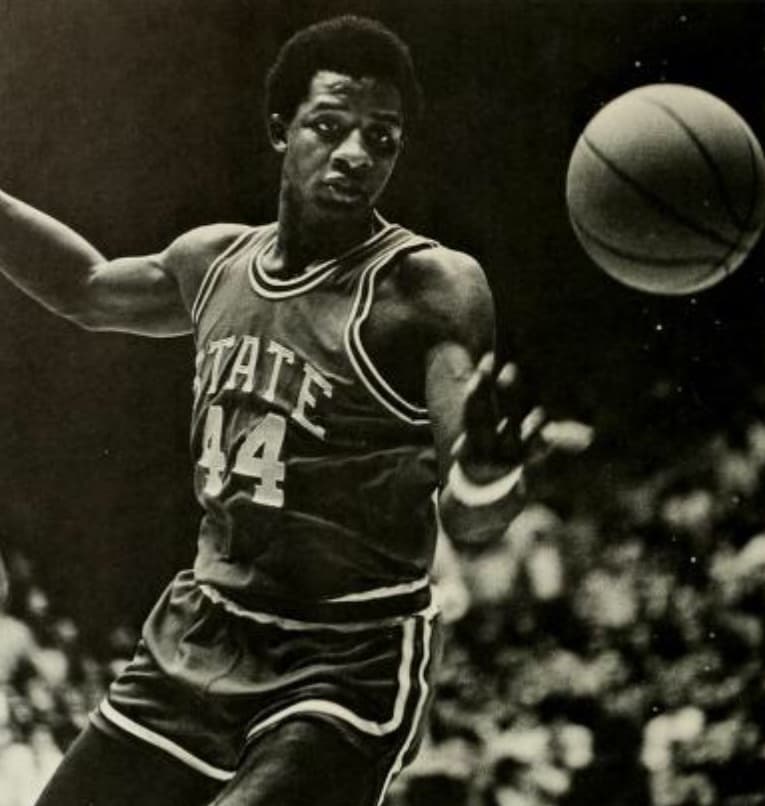
Thompson grew up in Shelby, North Carolina, and announced himself to the national basketball world at NC State, where he led the Wolfpack to the 1974 NCAA National Championship over an undefeated UCLA team that had won 88 consecutive games. To this day, that upset is considered one of the defining moments in college basketball history. The Wolfpack were not supposed to be there. Thompson made them impossible to stop.
He won the Naismith Award as the nation's best player and was the consensus top pick in both the NBA and ABA drafts. The Denver Nuggets — then in the ABA — selected him first overall in 1975, and Thompson immediately rewarded the gamble. In his first professional season he averaged 26 points per game and gave the Nuggets a centerpiece player for their transition into the NBA the following year.
His vertical leap was measured at 44 inches — one of the highest ever recorded for a professional basketball player. At 6-foot-4, Thompson could elevate to a release point that was simply unreachable by most defenders. He combined this with a quick first step, an advanced offensive skill set, and a competitive intensity that made him a nightmare to prepare for. In the late 1970s, there was no more electrifying player in professional basketball.
The 73-Point Game
On April 9, 1978, David Thompson played the final regular season game of the year in a deliberate attempt to win the NBA scoring title. He needed a massive performance to overtake George Gervin of the San Antonio Spurs. What he delivered was one of the most extraordinary individual scoring performances in NBA history: 73 points, including 32 points in a single quarter.
The 73-point game remains the fourth-highest single-game scoring total in NBA history. Thompson shot 28-for-38 from the field and 17-for-20 from the free-throw line. He was in another dimension — not just playing well, but operating at a level of scoring precision that the NBA had rarely seen. In the end, Gervin had been told of Thompson's performance and responded with his own historic game to retain the scoring title. But the 73-point performance stands as the most dramatic individual statement of Thompson's peak ability.

Four All-Star Appearances and the Peak Years
Thompson was selected to four NBA All-Star Games — in 1977, 1978, 1979, and 1982 — and throughout his peak seasons he was among the most complete offensive guards in the game. His combination of athleticism, skill, and competitive fire gave Denver a franchise player capable of taking over a game in ways that few players of any era could replicate.
He averaged 24.0 points per game across his Denver career and was the kind of player who made the people around him better simply by demanding defensive attention. In a Denver Nuggets team that also featured Alex English, Dan Issel, and Kiki Vandeweghe at various times, Thompson was the talent that elevated the franchise's ceiling from very good to genuinely dangerous.
The Tragic Decline
The story of David Thompson cannot be told honestly without acknowledging the substance abuse issues that cut his career short. Beginning in the early 1980s, Thompson's effectiveness diminished as personal struggles took hold. He retired in 1984 at age 30 — an age when most elite players are in the middle of their prime years. The basketball world was left to wonder what a full career of David Thompson would have produced.
The tragedy is not just what was lost in terms of statistics or championships. It is the knowledge that a player widely considered the most gifted of his generation — a player who, by multiple accounts, had capabilities beyond what the box scores captured — never got to show the world the complete version of himself. The ceiling was immense, and it was never reached.

Why the Nuggets Retired #33
The Naismith Memorial Basketball Hall of Fame inducted David Thompson in 1996, giving him the permanent recognition his talent always warranted. The Denver Nuggets retired #33 in acknowledgment of the same truth: that what Thompson showed during his years in a Nuggets uniform was among the most extraordinary basketball the franchise had ever hosted.
The retirement of #33 is also a recognition of what the Nuggets meant to Thompson and what he meant to them. He was the first great player to wear a Denver uniform in the NBA, the first to give the city a reason to believe professional basketball could matter here. That foundation — laid by a man from Shelby, North Carolina, who could jump higher than almost anyone who had ever played the game — is part of why Ball Arena exists as a championship venue today.

Skywalker flew for too short a time. But while he was airborne, there was nothing quite like it. #33 stays in the rafters forever.