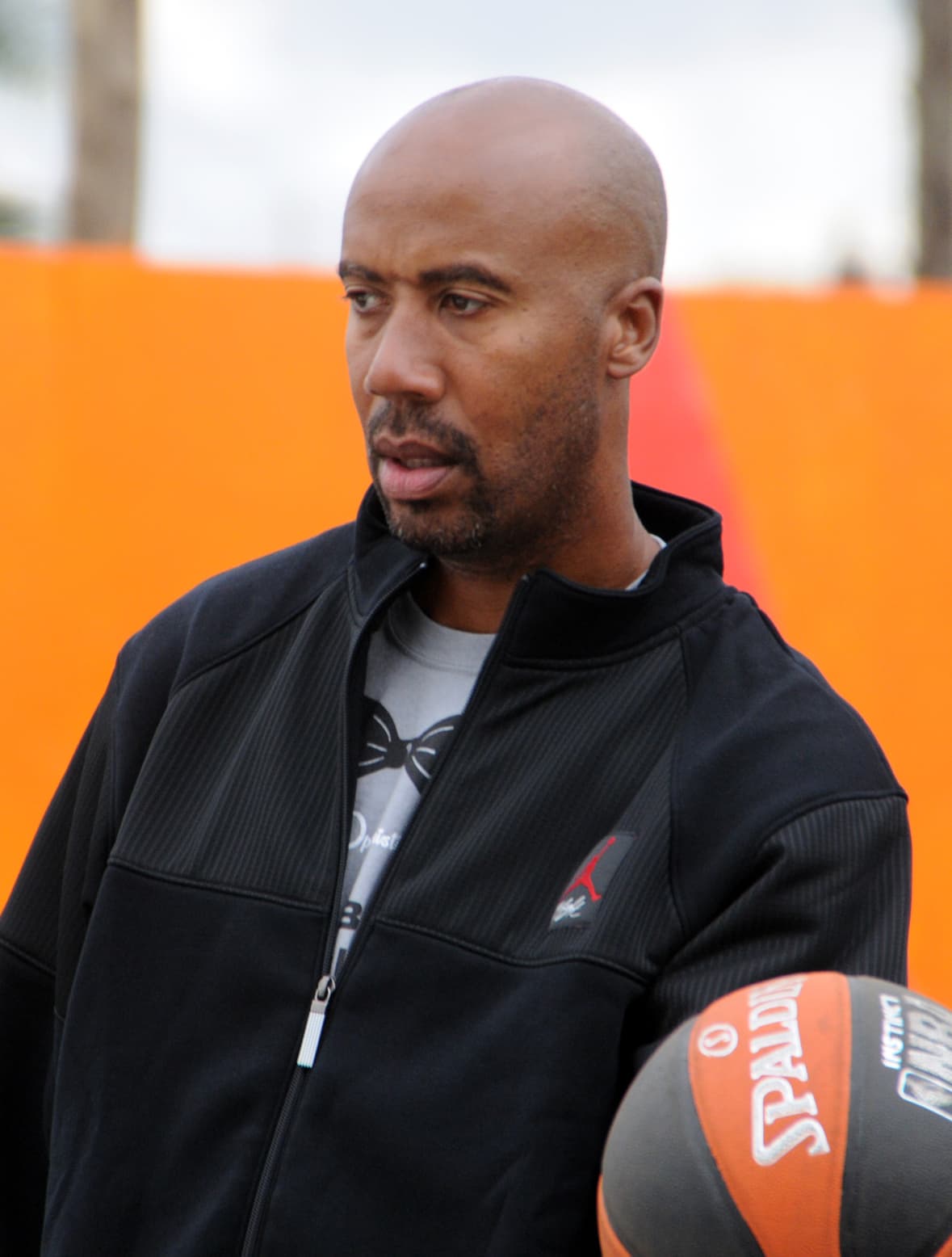
Three championships. Zero All-Star appearances. That statistic tells you everything about how the NBA rewards scorers and systematically undervalues defenders. Bruce Bowen never averaged more than 8.9 points per game in a single season. He never made an All-Star team. He was never going to win a scoring title or an MVP. He was, however, one of the three or four best defenders in the world for the better part of a decade — and on a team built around Tim Duncan's interior dominance, Bowen was the piece that made the perimeter work.
Bowen's path to the Spurs was not straightforward. He went undrafted in 1993, bounced through the CBA, played in France, spent time on several NBA rosters without finding stability, and was nearly thirty years old when San Antonio gave him a real opportunity. What he did with that opportunity — five consecutive All-Defensive First Team selections and three championship rings — is one of the great late-bloomer stories in professional basketball.
From Undrafted to Defensive Ace
Bowen's basketball education came the hard way. Without a guaranteed contract or a reputation to protect, he learned to compete on the margins — using angles, physicality, and anticipation to compensate for the fact that he was not going to beat anybody in a straight footrace or a highlight-reel moment. He developed a defensive philosophy built on positioning: staying in front of his man, contesting every shot, and doing the unglamorous work that wins games.
When the Spurs signed him in 2001, Gregg Popovich recognized something valuable: Bowen was not just a defender in general — he was a specialist capable of guarding the opponent's best perimeter player night after night without breaking down. In an era of explosive wings and three-point shooting, that kind of assignment defender was essential. Bowen became the Spurs' designated stopper for players like Kobe Bryant, Vince Carter, Tracy McGrady, and Ray Allen — the most difficult assignments in the Western Conference.
Five Consecutive All-Defensive First Team Honors
From 2003 to 2007, Bowen made the All-Defensive First Team every single season. That five-year streak placed him among the elite perimeter defenders in NBA history during a period when the Western Conference featured extraordinary offensive talent. He was physical without being dirty in a technical sense — his reputation for sliding his feet under shooters was controversial, but his defensive fundamentals were impeccable.
His three-point shooting complemented his defensive value perfectly. Bowen developed into a reliable corner three shooter over his career, giving the Spurs a floor-spacing threat who could knock down open looks created by Duncan's post presence. It was not a high volume — he rarely took more than four or five attempts per game — but it was a high percentage, and it forced defenses to account for him at all times. An undrafted player who could guard anyone on the perimeter and hit corner threes was precisely what the Spurs needed.
Three Championships as the Defensive Cornerstone
The 2003, 2005, and 2007 championships were built on defense, and Bowen was the defensive identity on the perimeter. While Duncan controlled the paint, Bowen controlled the three-point line — the increasingly critical zone in NBA offense. In the 2005 Finals against the Detroit Pistons, one of the most defensive series in recent memory, Bowen was matched against Richard Hamilton for long stretches and neutralized one of the most creative off-ball movers in the game.
What Bowen provided was not just individual stops. He provided the defensive culture that Popovich demanded. Practice habits, attention to detail, the willingness to do the work that does not show up on a stat sheet — Bowen embodied all of it, every day, for nine seasons. Younger Spurs players learned what professional defensive effort looked like by watching how Bowen prepared and competed. His influence on the franchise's defensive identity extended far beyond his individual assignments.
Why the Spurs Retired #12
The Spurs retired Bruce Bowen's #12 in 2012, a decision that recognized not just what he accomplished but what he represented. Bowen is the argument for why defense — real, sustained, assignment-based defensive excellence — deserves the same recognition as scoring. His five All-Defensive First Team selections are as impressive as most offensive milestones, and he earned them the hardest possible way: by outworking opponents who were more naturally gifted.
Championship basketball is built on players like Bruce Bowen. Every dynasty needs a Duncan or a Jordan — but it also needs the player who takes the toughest defensive assignment so that the stars can focus on scoring. In San Antonio, that player was Bowen for nearly a decade. #12 belongs in the rafters because Bruce Bowen proved that defensive excellence is its own form of greatness, and that an undrafted player willing to do the unglamorous work can still become essential to a dynasty.
Nagustuhan mo ba ang analysis na ito?
Makakuha ng mas marami pang analysis na tulad nito sa iyong inbox.