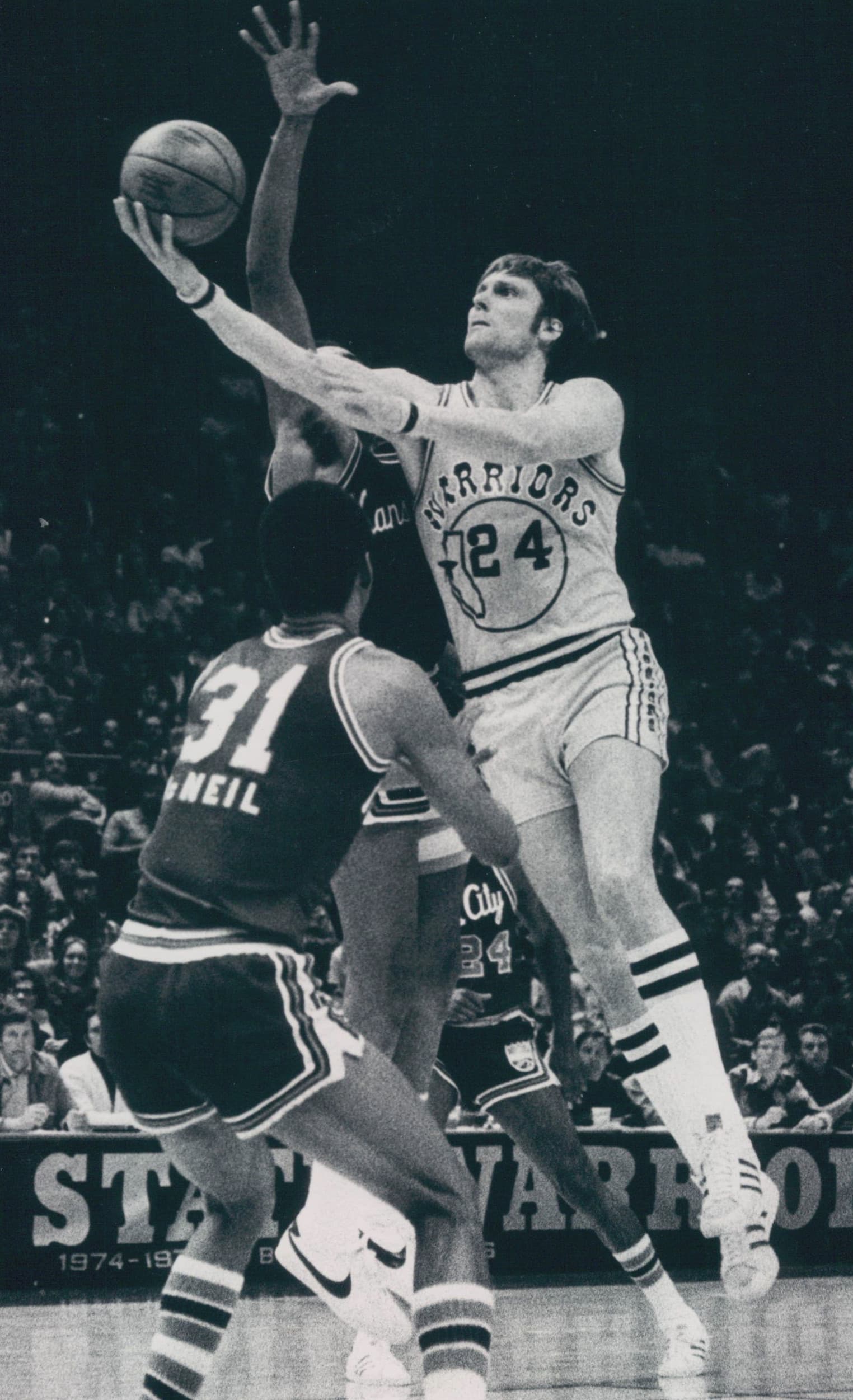
Rick Barry shot his free throws underhanded and made 89.3% of them for his career — a method, taught by his father, that coaches still cite decades later. The Golden State Warriors retired his #24 for what that accuracy accompanied. In the 1975 NBA Finals, an upset for the ages, a 48-34 Warriors team swept the defending Eastern Conference champion Washington Bullets 4-0; Barry averaged 29.5 points, 5.0 rebounds, and 5.0 assists, was named Finals MVP, and was the best player on the floor in every game. It remains the only Finals sweep without home-court advantage. His career carried turbulence — an ABA jump after his 1966-67 rookie season cost him a one-year suspension and four NBA seasons — yet that rookie year produced 35.6 points per game, then the fourth highest in league history. #24 honors the championship, the scoring, and a player remembered for what he accomplished rather than how he made others feel.
The 1975 Championship
The 1975 NBA Finals is one of the great upsets in league history. The Golden State Warriors — a team that had finished the regular season 48-34 and was not considered a serious title contender — swept the Washington Bullets 4-0 in the Finals. The Bullets had Elvin Hayes. They had Wes Unseld. They were the defending Eastern Conference champions. It did not matter.
Rick Barry averaged 29.5 points, 5.0 rebounds, and 5.0 assists per game in that series. He was named Finals MVP. He was the best player on the floor in every game — faster than the Bullets' forwards, smarter than their defenders, and more consistent than anyone Washington had to offer. The sweep remains the only time a team has gone 4-0 in the Finals without home-court advantage and won.
Barry's scoring in the 1975 Finals would be elite by modern standards. In 1975, against the best defense in the Eastern Conference, it was something approaching surgical. He found angles that did not exist, created shots from positions where shots should not be possible, and delivered them at 89% efficiency from the free throw line when games were on the line.
Controversies and Comebacks
Barry's career was not without turbulence. He left the Warriors after his 1966-67 rookie season to play in the ABA — a league jump that resulted in a one-year suspension and four seasons away from the NBA. He returned to the Warriors in 1972 after his ABA contract expired, and the years he lost to legal battles and league politics make his final statistical totals look modest relative to his actual quality of play.
He was not always easy to play with. Teammates have described him as demanding, blunt, and unwilling to accept substandard effort from those around him. Barry has never particularly disputed this characterization. His standards were high and he communicated them directly. Whether this made him difficult or simply honest depends on who you ask.
What is not disputed: he was a genuinely great player in the fullest sense. An elite scorer, a versatile defender, a capable passer, and a free throw shooter so accurate that the method he used — the underhanded release his father taught him as a child — has become part of basketball's ongoing conversation about mechanics, pride, and the willingness to be correct.
Why the Warriors Retired #24
The Warriors retired Rick Barry's #24 for the 1975 championship, for 35.6 points per game in the 1966-67 season (fourth highest in league history at the time), for 89.3% career free throw shooting, and for representing the Warriors at the absolute peak of what an individual player can contribute to a championship run.
But there is something else the number represents: the particular kind of player who is right more often than he is popular, who chooses effectiveness over convention, and who is remembered not for how he made others feel but for what he actually accomplished. That is Rick Barry. And that is worth a number in the rafters.
Nagustuhan mo ba ang analysis na ito?
Makakuha ng mas marami pang analysis na tulad nito sa iyong inbox.