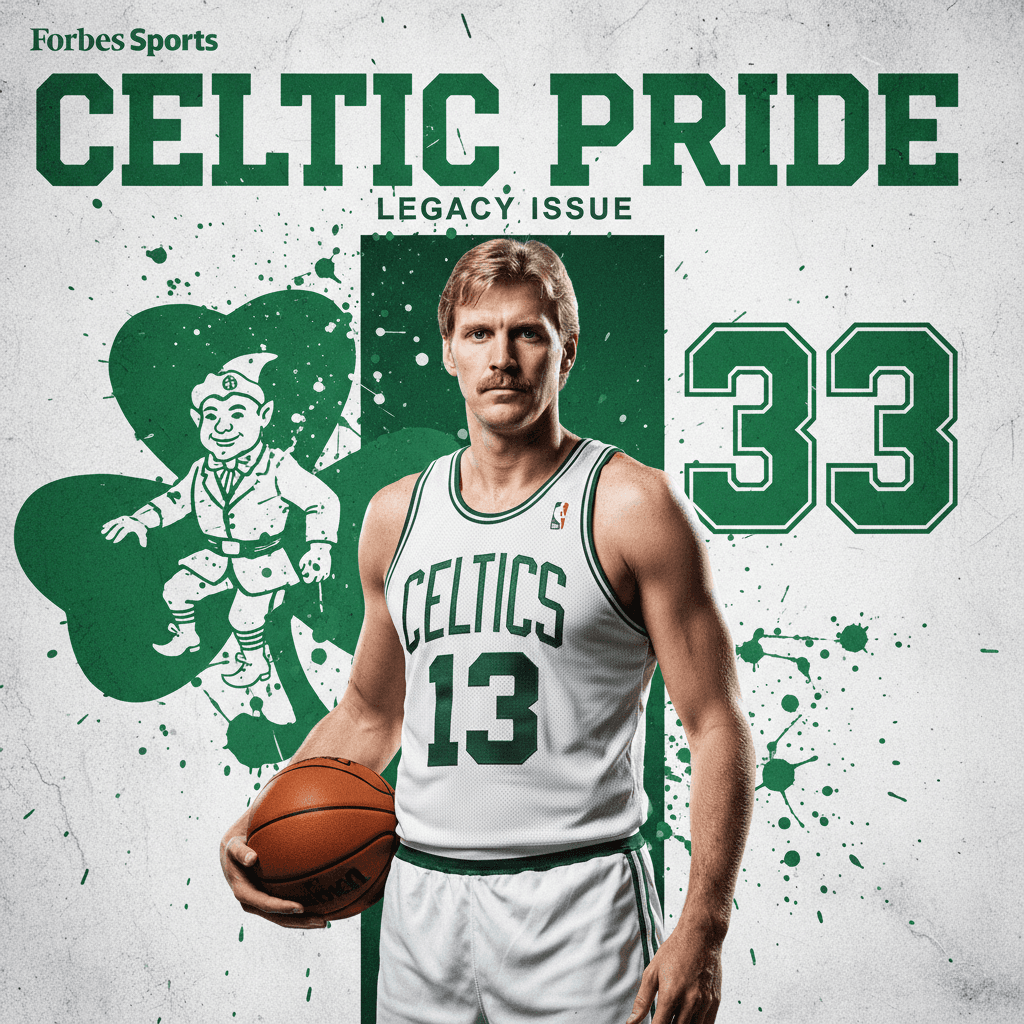
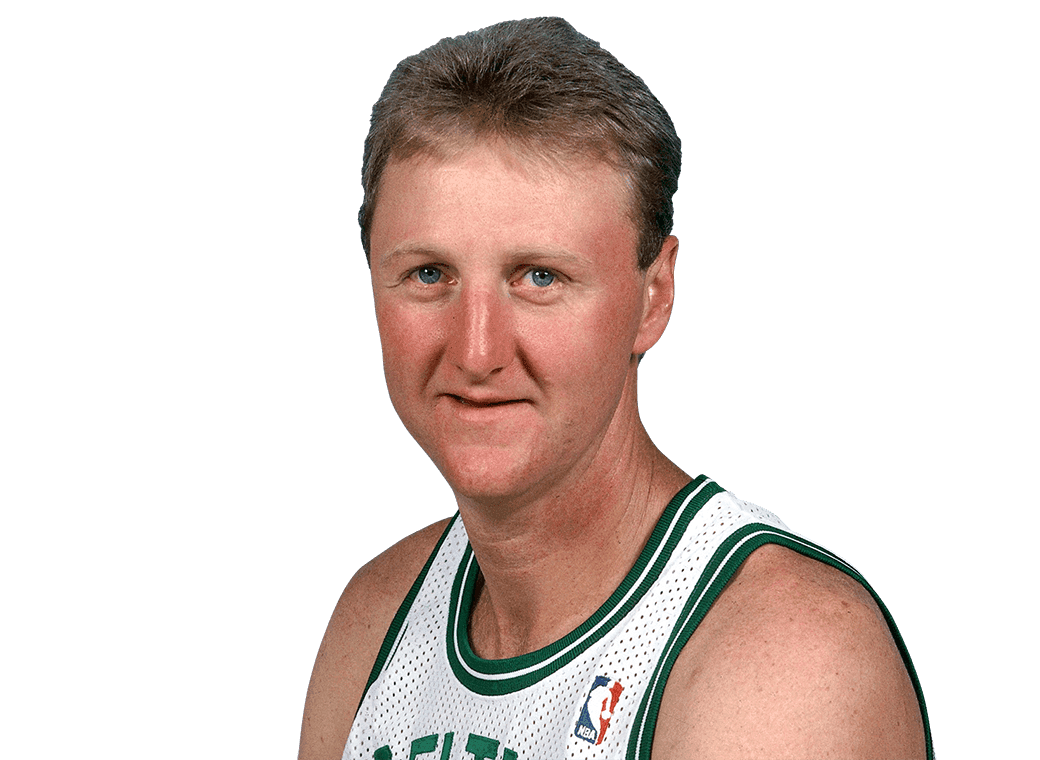
Why the Celtics Retired Larry Bird's #33: Three Championships, Three MVPs, and Basketball Genius in Human Form
February 4, 1993: #33 climbs into the Garden rafters. Three titles, three straight MVPs, and the most famous trash talk in basketball — Larry Bird was too slow to be this good, and was this good anyway.
本页面包含联盟链接。如您通过这些链接购买,我们可能获得佣金,对您无额外费用。 As an Amazon Associate I earn from qualifying purchases.
February 4, 1993. The Boston Garden lowers the lights, and a green-and-white #33 begins its slow climb into the rafters, into the company of Russell and Cousy and Havlicek and Cowens. Larry Bird sits courtside in a suit, twenty-five months removed from the last competitive game his back would ever allow him to play, and the building does the one thing the old Garden never did quietly — it holds its breath. Bird had spent thirteen seasons telling everyone in every arena exactly what he was about to do to them, and then doing it. Now there was nothing left to narrate. The man who talked more trash than anyone who ever played the game had run out of things to say, and so had the city. The banner reached the ceiling. The number stopped moving. And the rafters of the most decorated franchise in basketball history made room for a kid from French Lick, Indiana, who was, by his own honest accounting, too slow to be this good.
He was this good anyway. The story of #33 is the story of how a player with average legs and an unaverage mind dragged the Boston Celtics out of irrelevance and, in the process, helped drag professional basketball back from the edge of cultural extinction.
The Hick From French Lick
Boston drafted Larry Bird sixth overall in 1978, a year before he was eligible to play for them. Red Auerbach, who had built six decades of Celtics mythology on the willingness to be smarter than the rest of the league, saw that Bird had a year of college eligibility left and took him anyway, gambling a high pick on a player who would not suit up for twelve months. It was the kind of patient, ruthless bet that defined Auerbach's tenure, and it was the best one he ever made.
Larry Bird Boston Celtics Autographed smALL-STARS Minis White Chase Variant 6" Figurine
Bird stayed at Indiana State for his senior year and carried a program with no business being there all the way to the 1979 NCAA championship game. Waiting for him in that final was a Michigan State team led by a six-foot-nine point guard named Earvin Johnson, whom everyone called Magic. Michigan State won. Bird shot poorly, was hounded by a defense built entirely to stop him, and walked off the floor a runner-up. The game drew the highest television rating in the history of college basketball, a number that still stands. Nobody watching understood yet that they were not seeing the end of something. They were seeing the opening scene of the rivalry that would save the NBA.
The Savior Arrives
The Celtics that Larry Bird joined in 1979 were not the Celtics of legend. They had missed the playoffs twice in three years. The Garden, which had once been the loudest building in the sport, was playing host to a team in decline, trading on a history its current roster could not honor. Bird changed that in a single season. Boston, which had won 29 games the year before he arrived, won 61 the year he showed up — a 32-game swing, the largest single-season turnaround in league history to that point. He was named Rookie of the Year. The franchise had its best record in the Eastern Conference. The savior had, on schedule, arrived.
Youth Mitchell & Ness Larry Bird Kelly Green Boston Celtics Maxxed Out 2.0 Fashion Hockey Jersey
What he brought was not athleticism. Bird said it himself, flatly, without false modesty, for his entire career: he was too slow, he couldn't jump, he was a step behind the men he guarded. What he brought instead was an understanding of basketball as a system of cause and effect — of spacing, positioning, defensive habit, and momentum — that he could read three or four plays before they happened. He knew where the ball was going. He knew where the defender would be standing when it arrived. He threw passes to spots his teammates had not yet reached and trusted them to be there on time, and they were, because Bird was almost never wrong about where the game was about to go.
The Mouth That Backed It Up
That certainty expressed itself as confidence, and the confidence expressed itself as the most famous trash talk in the history of the sport. Bird did not insult opponents to rattle them. He narrated. He told a defender precisely which move he was about to make, made it, and scored while the man was still processing the sentence. Before the first three-point contest at All-Star Weekend in 1986, he reportedly walked into the locker room, looked around at the field of shooters assembled to beat him, and asked which of them was planning on finishing second. Then he won it. Then he won it again the next year, and the year after that.
Larry Bird Boston Celtics Autographed Green Mitchell & Ness 1985-1986 Authentic Jersey with Multiple Inscriptions - Limited Edition of 33
This was not arrogance in the way the word is usually meant. It was a demonstration of knowledge. Bird had done the work — the thousands of hours, the obsessive film study, the pre-game ritual of arriving early to shoot until his hands bled — and the talk was simply him reporting the result of that work out loud before the evidence arrived. He was telling the truth in advance. The maddening thing, for everyone who lined up across from him, was that the truth kept coming true.
Three Titles, Three MVPs
By his third season Boston was champion. The 1981 title came against the Houston Rockets, and it announced that the Celtics were not merely relevant again but dominant, the rebuild complete in record time. The 1984 championship was the one Bird wanted most, because it came against Magic Johnson's Los Angeles Lakers — the first time the college rivalry was settled on the professional sport's biggest stage. Bird was named Finals MVP. He averaged a line across that series that read like a stat sheet from three different positions at once, and he willed a physical, brutal seven-game war to its conclusion in the Boston Garden heat.
Larry Bird Boston Celtics Framed 14" x 20" Player Caricature Art
Between 1984 and 1986, Larry Bird won three consecutive regular-season MVP awards. Only two men in the history of the league had done that before him: Wilt Chamberlain and Bill Russell. It remains a distinction shared by almost no one. The third of those seasons produced what many who watched it still consider the greatest single Celtics team since the Russell dynasty itself. The 1986 Celtics — Bird flanked by Kevin McHale and Robert Parish up front, with Dennis Johnson and Danny Ainge in the backcourt — went 67-15 and lost a total of four playoff games the entire postseason. Bird won his second Finals MVP, averaging roughly 24 points, 10 rebounds, and 10 assists across the championship round. The frontcourt of Bird, McHale, and Parish is, by broad agreement, the finest the sport has ever assembled, and Bird was its sun.
"I think he's God disguised as Michael Jordan." — Larry Bird, after Jordan dropped 63 points on his Celtics in a 1986 playoff game, paying the rarest compliment in his vocabulary to a man trying to beat him
Larry Bird, Robert Parish & Kevin McHale Boston Celtics Autographed Larry Bird Mitchell & Ness Authentic 1985 Green Jersey with Multiple Inscriptions
The Rivalry That Saved the Game
When Bird and Magic Johnson entered the NBA in 1979, professional basketball was in genuine trouble. Finals games were broadcast on tape delay, after the local news, because the networks did not believe the live product could hold an audience. The league carried a reputation — unfair, racially coded, but commercially real — that it could not shake. Then two rookies who had already played the most-watched college game ever brought their feud into the league, and everything changed.
For a decade they were opposing poles the entire sport organized itself around. Bird's Celtics and Magic's Lakers met in three Finals. The contrast — East and West, white and Black, the blue-collar grinder and the showtime maestro, the Garden's cramped parquet and the Forum's Hollywood gloss — gave casual America a story it could follow even if it did not yet love the game. Television ratings climbed. The Finals returned to live primetime. By the time the two of them stood together on the 1992 Olympic Dream Team, the league they had inherited on life support had become the most globally ascendant sport on earth. They did not save the NBA by being friendly. They saved it by needing, more than anything, to beat each other, and by making the whole world want to watch them try.
Youth Mitchell & Ness Larry Bird Kelly Green Boston Celtics Hardwood Classics Swingman Throwback Jersey
What Trying Looks Like
The body gave out before the mind did. Bird had spent his adolescence doing hard manual labor — among other jobs, working on a road crew in Indiana — and the years of physical wear arrived early and stayed. By the late 1980s his back was deteriorating. He played through it the only way he knew how, which was to keep playing. He lay flat on the floor near the bench during timeouts to relieve the pressure on his spine, then stood up and checked back in. He underwent surgeries. He lost most of the 1988-89 season to heel injuries and another long stretch to his back, and still he came back, because stopping was not a thing his temperament could process.
In the summer of 1992, after his final NBA season, he played for the United States at the Barcelona Olympics, taking the floor alongside Magic Johnson and Michael Jordan on the Dream Team — three men who had, in their different ways, each remade the sport. He could barely move by then. He played anyway, and won gold, and retired weeks later. The #33 that climbed into the Garden rafters represents thirteen seasons of a man competing at the absolute outer limit of his physical gifts, propelled the entire way by an intelligence and a will that refused to acknowledge the limit existed.
Men's Mitchell & Ness Larry Bird Kelly Green Boston Celtics Big & Tall NBA Hockey Jersey
3 consecutive regular-season MVP awards (1984, 1985, 1986) — a feat shared only with Wilt Chamberlain and Bill Russell
12× NBA All-Star
Rookie of the Year in 1980, after authoring the largest single-season win turnaround the league had seen
9× All-NBA First Team — named to the league's top five at his position nearly every healthy year he played
3× three-point contest champion at All-Star Weekend, the first three years the event existed
1992 Olympic gold medalist as a member of the original Dream Team
Inducted into the Naismith Memorial Basketball Hall of Fame in 1998
The only person in NBA history to be named regular-season MVP, Coach of the Year, and Executive of the Year
That final line is the one that sets Bird apart even among the immortals. After his playing career ended, he coached the Indiana Pacers to the best record in the conference and was named Coach of the Year. He later ran the franchise's front office and was named Executive of the Year. No one else in the history of the sport has won all three of those awards — the player's award, the coach's award, and the builder's award. The same intelligence that let him read three plays ahead on the floor let him read a roster, a game plan, and a franchise. The basketball mind that defined #33 never had an off switch.
Why #33 Hangs Forever
The Celtics retired Larry Bird's #33 on February 4, 1993, and no Boston player has worn it since. In a franchise that has retired more numbers than any other in the sport — a ceiling so crowded with banners and digits that the Garden rafters read like a roll call of basketball's founding scripture — Bird's number occupies a specific place. It belongs to the man who proved the dynasty was not finished, that the parquet could host greatness again, that the ghosts in the rafters could be honored not by nostalgia but by a player willing to add a new chapter worthy of the old ones.
Men's Mitchell & Ness Larry Bird Kelly Green Boston Celtics 1985/86 Hardwood Classics Authentic Jersey
It hangs near the numbers of the men who built the modern Celtics with him — Kevin McHale's #32 and Robert Parish's #00, the other two-thirds of the greatest frontcourt the game has produced — and in the longer view it hangs in conversation with the franchise's founding giants, Bill Russell's #6 and John Havlicek's #17. None of those numbers is the franchise by itself. Together they are its spine, each one a different answer to the question of what a Celtic is supposed to be.
#33 is the answer that says: intelligence and will, applied without ceasing, can outrun talent. Bird was too slow. He couldn't jump. He told everyone so, every season, and then he beat them anyway — with his eyes, his hands, his mouth, and a competitive fire that thirteen years of physical breakdown could not put out. The number hangs forever in Boston because it is the proof, raised to the rafters, that trying at the very highest level is its own kind of genius. The Garden has never needed it explained. It only needed to watch.
Scottie Pippen is the greatest example in basketball history of what it means to be exactly what your team needs. Without Pippen's #33, there is no second three-peat, no dynasty mythology, and arguably no six championships at all.
October 1, 1994: the Bulls retire #23 for the first time. Eighteen months later, Jordan faxed two words and they took it back down. The story of six championships, two three-peats, and the number that bent the gravity of basketball around itself.
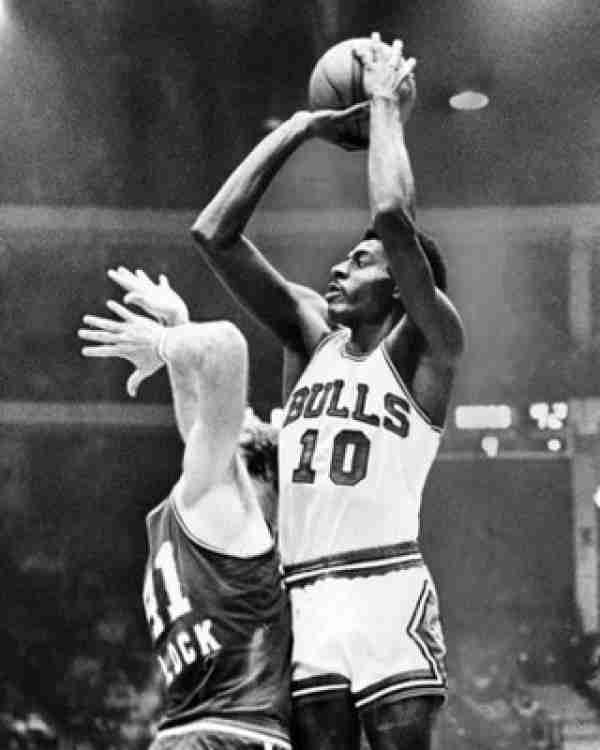
Bob Love was the Chicago Bulls' first great offensive player — a jump-shooting artist who averaged 21 points a game and made three All-Star teams. But the story of why the Bulls retired his #10 has as much to do with what happened after basketball as during it.