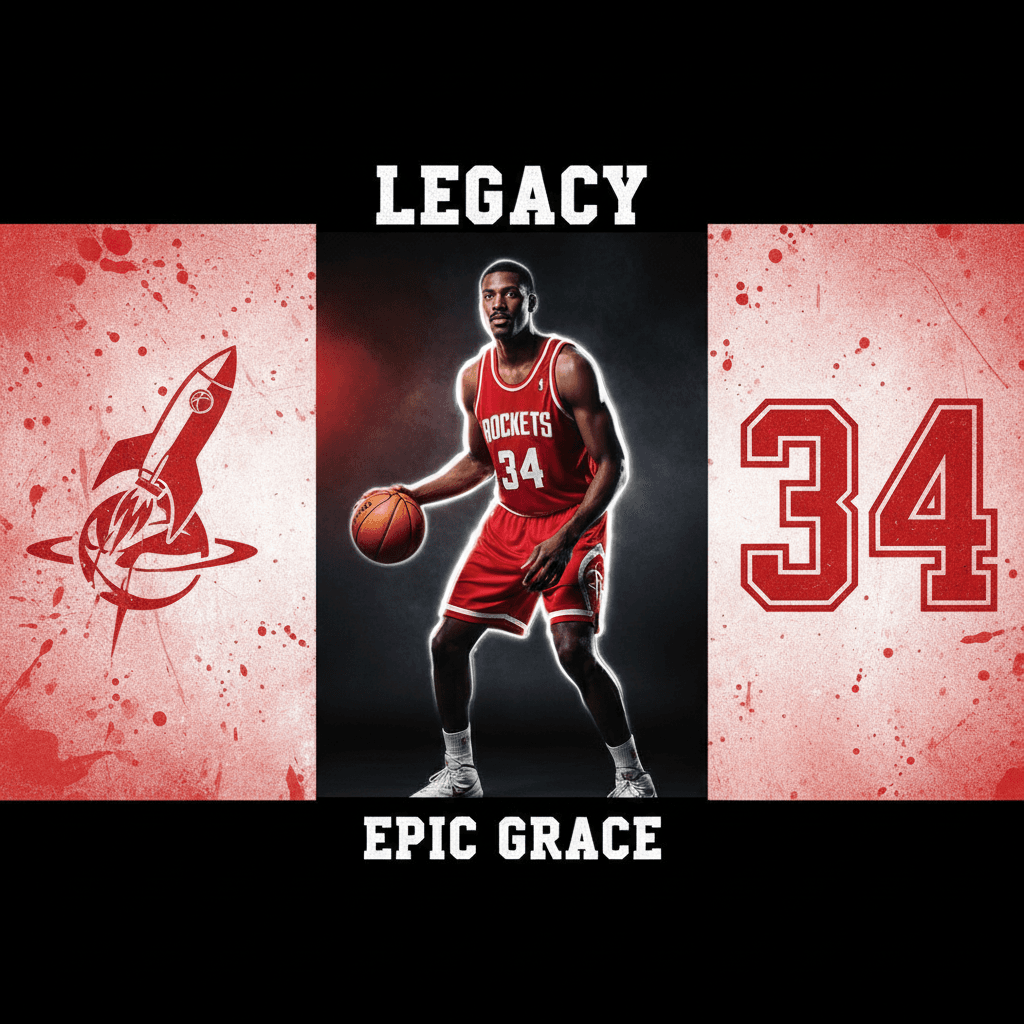
Why the Rockets Retired Hakeem Olajuwon's Jersey #34
The Dream Shake, back-to-back titles, and the only MVP + DPOY + Finals MVP season ever. Why the Rockets retired Hakeem Olajuwon's #34 — basketball's most graceful giant.
Dieser Artikel wurde automatisch aus dem Englischen übersetzt.View original
Diosh Lequiron
··10 Min. Lesezeit·
M
Share
Diese Seite enthält Affiliate-Links. Wir erhalten möglicherweise eine Provision, wenn Sie über diese Links kaufen, ohne zusätzliche Kosten für Sie. As an Amazon Associate I earn from qualifying purchases.
November 9, 2002. Hakeem Olajuwon, thirty-nine years old and one season removed from a final, quiet year in Toronto, signed a one-day contract so that he could retire as a Houston Rocket. There was no farewell tour, no fadeaway at the buzzer to close the book. Just a man in a suit, standing where The Summit's hardwood used to be, ending the career of the most complete center the sport has ever produced. He had arrived in this city in 1984 from Lagos, Nigeria, by way of the University of Houston, a soccer goalkeeper who had not touched a basketball until he was seventeen. He left it as the franchise's all-time leader in points, rebounds, blocks, and games played — the NBA's career leader in blocked shots, and the only man in league history to win Most Valuable Player, Defensive Player of the Year, and Finals MVP in a single season. The Houston Rockets raised #34 to the rafters because anything less would have been a failure of memory.
They did not retire the number because they had to. They retired it because the alternative — letting another player pull that jersey over his head — was unthinkable in a way that needs no argument in Houston.
The Goalkeeper From Lagos
Hakeem Abdul Olajuwon was born on January 21, 1963, in Lagos, the son of working-class parents who ran a cement business. Basketball was not part of his childhood. He played soccer, where he was a goalkeeper, and team handball, two sports built on angles, timing, and footwork — on reading a body and reacting before it commits. He did not pick up a basketball until he was seventeen years old. The detail sounds like trivia until you watch the footwork that came out of it. The pivots, the up-and-under, the way he could feel a defender's weight shift through his back and counter before the defender knew he had committed — none of that was taught on a basketball court. It was imported from a soccer pitch and a handball court half a world away, and it is the reason the rest of the league spent a decade unable to copy him.
Hakeem Olajuwon Houston Rockets Autographed WWE Legacy Title Belt
The University of Houston recruited the raw seven-footer in 1980. Within three seasons he was the engine of the Phi Slama Jama teams — the most electric college program of the era, a dunking, fast-breaking fraternity that turned the Cougars into appointment television. His college teammate and running mate on those teams was a high-flying guard named Clyde Drexler, a partnership that would matter again, in the most improbable way, a decade later. By the time he left school, the kid who had been a goalkeeper four years earlier was the most coveted big man in basketball.
The 1984 Draft and the First Pick
In 1984, the Rockets held the first overall pick in what has since been canonized as the greatest draft class the league has ever assembled. Michael Jordan came off the board third. Charles Barkley went fifth. John Stockton, a future all-time assists leader, lasted until sixteenth. Houston, holding the top selection, took Olajuwon — and history has never second-guessed the choice. To draft first ahead of Jordan and have the pick age into wisdom rather than infamy is its own kind of distinction. The Rockets did not get lucky. They identified the most unguardable interior force of his generation and built two championships around him.
Hakeem Olajuwon Houston Rockets Autographed 16" x 20" Shot vs. Patrick Ewing 1994 NBA Finals Photograph with "94 Finals MVP" Inscription
He did not arrive as a finished product. The early Houston teams reached the 1986 Finals behind the "Twin Towers" pairing of Olajuwon and Ralph Sampson, then spent years stuck in the brutal middle of the Western Conference — good enough to scare anyone, not yet built to finish. The polish came season by season, until the raw athlete had become something far more dangerous: a craftsman.
The Dream Shake
They called him "The Dream," and the move that bears the nickname — the Dream Shake — is less a single maneuver than an entire vocabulary. He would catch the ball on the block, feel the defender, and begin a sequence of shoulder fakes, pivots, and changes of pace that left even elite centers leaning the wrong way. A shake of the shoulders, a half-spin, a freeze, and then the shot — a jump hook with either hand, a fadeaway off the glass, a turnaround from the elbow. He held position in the post like territory he owned, and once he had it, the best defenders in the world were reduced to spectators of their own embarrassment.
What made it lethal was that it worked against everyone. Patrick Ewing, David Robinson, a young Shaquille O'Neal — future Hall of Famers, all of them, and all of them solved by Hakeem Olajuwon in the moments that decided series. He was generous with the move in retirement, too. Kobe Bryant spent a summer in Houston learning the footwork from its source, and so did a generation of bigs after him; the Dream Shake became something close to a finishing school for anyone serious about scoring from the post.
Hakeem Olajuwon Houston Rockets Autographed 16" x 20" Jumping Photograph
And his genius was never confined to offense. Olajuwon retired as the NBA's all-time leader in blocked shots, with 3,830 of them — a record that still stands, and one that flatters him only partly, because the blocks history can count do not include the shots that were never attempted out of fear. His lateral quickness let him switch onto guards in the pick-and-roll and stay in front of them, a skill that sounds invented for a seven-footer playing in the trench warfare of the 1990s. He could anchor a defense and erase a possession from the weak side in the same breath.
1994: The Season No One Has Matched
The 1993–94 season was the most complete year any Rocket has ever played, and one of the most complete any center ever has. Olajuwon led Houston to the title while averaging better than 27 points, nearly 12 rebounds, and close to four blocks a game. He won the regular-season MVP. He won Defensive Player of the Year. He won Finals MVP. No player before him or since has claimed all three in a single season. The math of that is worth sitting with: the league's best offensive player, its best defensive player, and the most valuable player in its championship round were, for one full season, the same man.
Hakeem Olajuwon Houston Rockets Autographed 11" x 14" Jump Shot Over Shaquille O'Neal Spotlight Photograph with "HOF 08" Inscription
The 1994 championship came against Patrick Ewing's New York Knicks in a defensive war that went the full seven games. The series was grinding, physical, and decided by inches — the Rockets closing it out at home in a Game 7 that came down to a single possession. Olajuwon was immovable at the center of it, the one constant Houston could lean on when every shot was contested and every point was paid for in contact.
"I have never seen a center play the position the way Hakeem played it." The footwork, the defense, the will — for one season, Olajuwon held all three of the league's individual crowns at once.
Hakeem Olajuwon & Clyde Drexler Houston Rockets Autograph 16" x 20" Photograph with "Clutch City" Inscription
1995: The Murderer's Row
The skeptics had an explanation ready for the first title. Jordan had retired the previous fall to play baseball, and the doubters wanted to file Houston's championship under absence rather than achievement. The 1995 run was Olajuwon's answer, and it was emphatic enough to end the argument permanently.
Houston limped into the playoffs as a sixth seed and then walked through the most decorated collection of centers ever stacked in a single postseason. Olajuwon outdueled David Robinson — that year's regular-season MVP — in the Western Conference Finals, a head-to-head so one-sided that the award felt like an insult he answered in person. He beat Shaquille O'Neal, the supposed heir to the position, in the Finals, sweeping the Orlando Magic in four straight. Across that run he also went through the heart of the league's elite frontlines, and he did it averaging better than 30 points a game in the Finals while playing the toughest defensive assignment on the floor.
That second title also carried a reunion that basketball could not have scripted. Midway through the season Houston traded for Clyde Drexler — Olajuwon's old Phi Slama Jama teammate from the University of Houston. The two college running mates, who had chased a national championship together in the early 1980s and come up short, won an NBA title together in their thirties. The 1995 banner is not a lesser ring won in a vacuum. It is the one where Olajuwon beat a row of MVP centers, with his oldest teammate finally beside him.
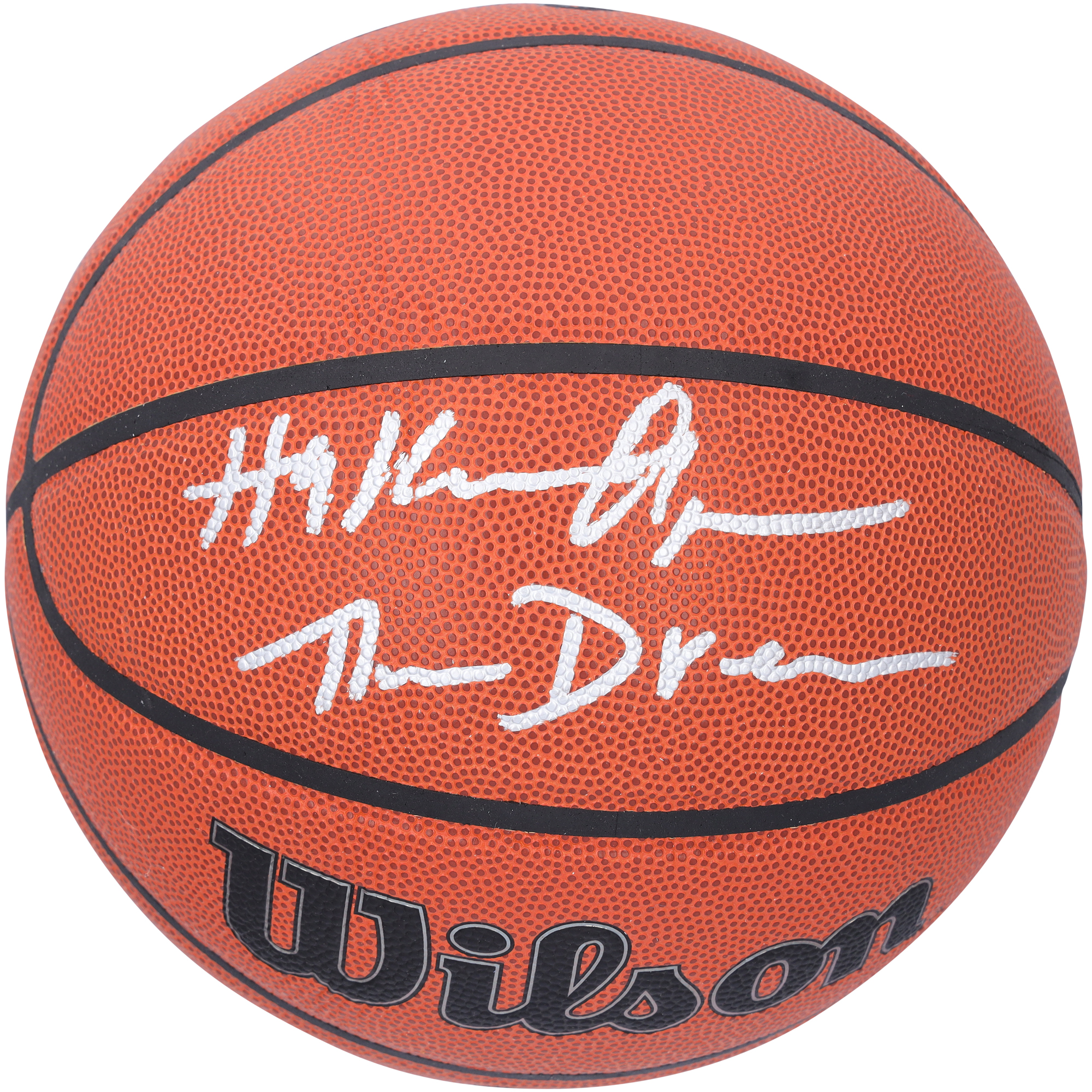
Hakeem Olajuwon Houston Rockets Autographed Wilson Authentic Series Indoor/Outdoor Basketball with "The Dream" Inscription
The Man Behind the Number
Olajuwon became a United States citizen in 1993, a Nigerian-American who carried both identities without diluting either. He was openly, unhesitatingly devout — a practicing Muslim who spoke about his faith in an era when few stars in any American sport did. He fasted during Ramadan while playing full NBA seasons, going entire game days without food or water, and routinely posted some of his finest performances during the fast, which he credited to the mental clarity and discipline it demanded. The league eventually honored that discipline with a Player of the Month award won in the middle of Ramadan.
After his playing days he stayed in Houston, became a fixture in the city's Muslim community, and opened his hands to the next generation. The big men who flew in to learn the Dream Shake found a teacher with no ego about the gift — a man who treated his own genius as something to be passed down rather than guarded. He was a goalkeeper from Lagos who became the standard, and he spent his retirement making sure the standard kept moving forward.
Unisex Nike Red Houston Rockets Swingman Custom Jersey - Icon Edition
The Numbers Behind the Number
2 NBA championships (1994, 1995) — back-to-back, the only titles in franchise history
2× NBA Finals MVP (1994, 1995)
1994 NBA Most Valuable Player
1994 Defensive Player of the Year — the only player ever to win MVP, DPOY, and Finals MVP in the same season
The NBA's all-time leader in blocked shots, with 3,830 career rejections — a record that still stands
12× NBA All-Star
First overall pick of the 1984 draft — chosen ahead of Michael Jordan and Charles Barkley
Houston's franchise leader in points (26,511), rebounds (13,382), blocks, and games played
2× Defensive Player of the Year (1993, 1994)
Naismith Memorial Basketball Hall of Fame, Class of 2008
The numbers describe the résumé without capturing the influence. Olajuwon redrew what a center could be — a rim protector who could also chase a guard out to the three-point line, a back-to-the-basket scorer with a footwork library that coaches still teach frame by frame off old film. He proved, two decades before the sport became truly global, that the best player in the world could be a soccer goalkeeper from Lagos who learned the game at seventeen. Every international big who has followed — every kid abroad told he started too late — has Olajuwon as the counterexample that ends the conversation.
Why #34 Hangs Forever
The Rockets retired Hakeem Olajuwon's #34 in 2002, the year he signed his one-day contract to leave the game as a Houston player. No one has worn it since, and no serious person in the organization has ever suggested they should. The decision is not complicated. Some numbers honor a good player. This one acknowledges that something happened inside the franchise that will not happen again.
Youth Fanatics Reed Sheppard Red Houston Rockets 2024 NBA Draft Fast Break Player Jersey - Icon Edition
#34 witnessed all of it. The raw goalkeeper learning the game in a season at the University of Houston. The Twin Towers reaching the Finals too early. The Dream Shake dismantling every Hall of Fame center the West could send at him. The 1994 sweep of every individual honor the league offers. The murderer's row of 1995, with Drexler finally beside him. The blocked shots no one has surpassed. For a stretch in the mid-1990s, the most unguardable and the most unscoreable-upon player in basketball were the same seven-footer, wearing this number, in this city.
It hangs alongside the other pillars of the franchise — Clyde Drexler's #22, the running mate; Moses Malone's #24, the MVP center who came before him; Rudy Tomjanovich's #45, the player turned coach who led those championship teams from the bench; and the future the franchise built next, Yao Ming's #11. Each of those numbers tells its own story about what a Houston Rocket is supposed to be. None of them, alone, is the franchise. But #34 is the number the rest were measured against — the one that turned the Rockets from a good team into a thing that mattered, and made a goalkeeper from Lagos the gold standard every center is still chasing.
Gefällt Ihnen diese Analyse?
Erhalten Sie weitere Analysen wie diese direkt in Ihr Postfach.
Scottie Pippen is the greatest example in basketball history of what it means to be exactly what your team needs. Without Pippen's #33, there is no second three-peat, no dynasty mythology, and arguably no six championships at all.
October 1, 1994: the Bulls retire #23 for the first time. Eighteen months later, Jordan faxed two words and they took it back down. The story of six championships, two three-peats, and the number that bent the gravity of basketball around itself.
Bob Love was the Chicago Bulls' first great offensive player — a jump-shooting artist who averaged 21 points a game and made three All-Star teams. But the story of why the Bulls retired his #10 has as much to do with what happened after basketball as during it.