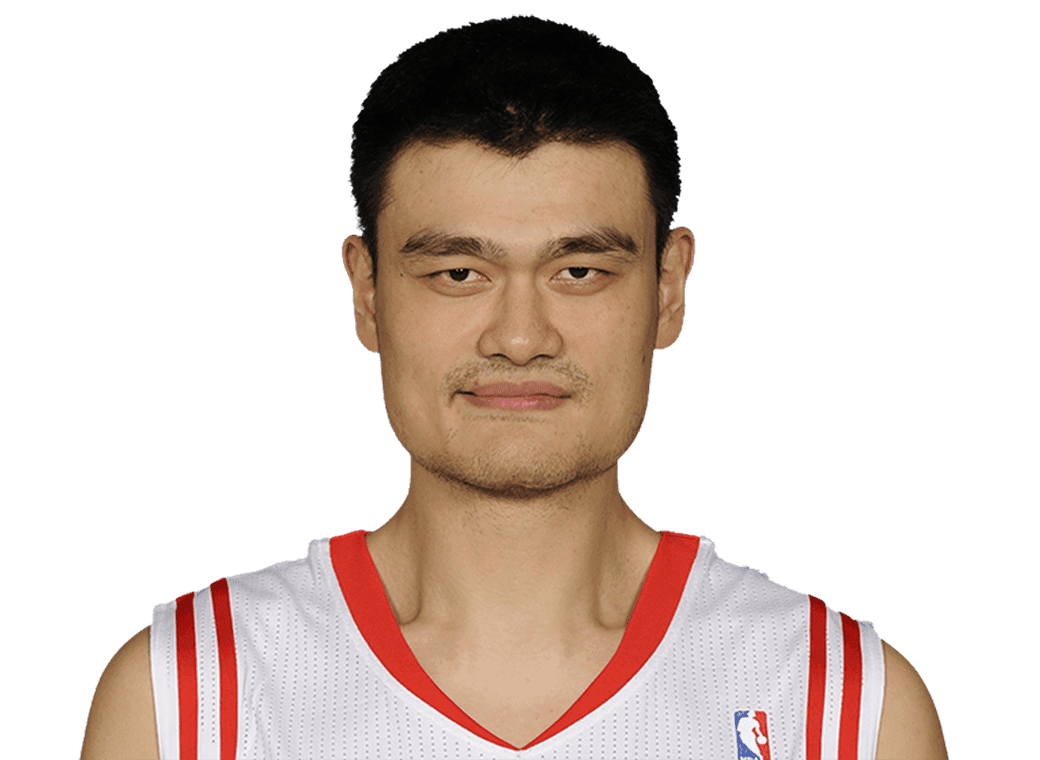
The Houston Rockets retired Yao Ming's jersey #11 on February 3, 2017, the same night they retired Calvin Murphy's #23. Selected first overall in the 2002 NBA Draft after leading the Shanghai Sharks to a CBA championship, the 7-foot-6 center spent eight seasons in Houston, where he made eight All-Star Game appearances, scored 9,247 points, and pulled down 4,494 rebounds. He averaged 19.0 points and 9.2 rebounds across his career and was named All-NBA twice, despite foot and ankle injuries that cost him large portions of five of his eight seasons before forcing his retirement in July 2011 at age 30. But the number honors more than statistics. No single player in NBA history did more to globalize the league: Yao opened the NBA's largest international market, drove a sustained surge in Chinese viewership, and made Houston's large Chinese-American community feel seen by the team that represented their city. His #11 hangs for what he was and what he continues to represent.
The Giant from Shanghai
Yao Ming was born on September 12, 1980 in Shanghai, China. His father Yao Zhiyuan stood 6'7" and his mother Fang Fengdi was 6'3" — both former professional basketball players. Basketball was not just a career for Yao; it was a family inheritance. He began playing professionally for the Shanghai Sharks at age 17 and led them to a CBA championship before the Houston Rockets selected him first overall in the 2002 NBA Draft.
His arrival in Houston was a logistical and cultural event unlike anything the league had experienced. Every Rockets home game featuring Yao broadcast live in China drew audiences that dwarfed the entire American viewership. He was playing basketball for 1.4 billion people.
More Than Size — The Skill Set
The easiest mistake to make about Yao Ming is to remember him only for his size. He was 7'6", yes — but he was also one of the most technically skilled centers the NBA had ever seen. His footwork in the post was precise. His touch around the basket was feathery for a man of his dimensions. He averaged 19.0 points and 9.2 rebounds per game across his career, earned All-Star selections in each of his last seven seasons, and was named to the All-NBA team twice.
Yao had a shooting range that extended to the mid-range, a passing instinct that made him a legitimate facilitator, and a defensive presence that altered every shot within 10 feet of the basket. Tracy McGrady arrived in Houston in 2004, and the Yao–McGrady partnership briefly made the Rockets one of the most dangerous teams in the Western Conference.
The Injuries That Stole a Legacy
Yao's story cannot be told without acknowledging the tragedy of his body's betrayal. Foot and ankle injuries — stress fractures, a broken foot, a torn plantar fascia — interrupted his career repeatedly starting in 2005. He missed large portions of five of his eight NBA seasons. Each time, he rehabilitated, returned, and produced at an All-Star level. Each time, the injuries came back worse.
The 2008–09 season was Yao's best: 19.7 points, 9.9 rebounds, 55.9% from the field, and Rockets home crowds that were some of the loudest in the league. He was finally healthy, finally dominant, and the Rockets were thriving. Then he broke his left foot again in February 2009. He played only five games in 2009–10 before the damage became permanent. He retired in July 2011 at age 30, robbed of what should have been the prime years of his career.
Beyond the Court: What Yao Meant
No single player in NBA history has done more to globalize the league than Yao Ming. His presence in Houston drove a sustained surge in Chinese viewership, merchandise sales, and youth basketball participation that reshaped the NBA's international business. The league opened offices in China, negotiated television deals worth hundreds of millions of dollars, and developed grassroots programs — all accelerated by the Yao effect.
After retirement, Yao became president of the Chinese Basketball Association, led China's national team programs, and was inducted into the Naismith Memorial Basketball Hall of Fame in 2016. He remains one of the most respected figures in global basketball.
Why the Rockets Retired #11
The Rockets retired Yao Ming's jersey #11 on February 3, 2017 — the same night they retired Calvin Murphy's #23. In his eight seasons in Houston, Yao made eight All-Star Game appearances, scored 9,247 points, and pulled down 4,494 rebounds. Those numbers don't capture what he actually meant to the franchise and to the city.
Houston is one of the most diverse cities in the United States, home to the largest Chinese-American community in Texas. Yao Ming made that community feel seen by the team that represented their city. His jersey doesn't hang in those rafters just because of what he did on the court. It hangs there because of what he was, who he was, and what he continues to represent for millions of people who came to love basketball because of him.
Gefällt Ihnen diese Analyse?
Erhalten Sie weitere Analysen wie diese direkt in Ihr Postfach.