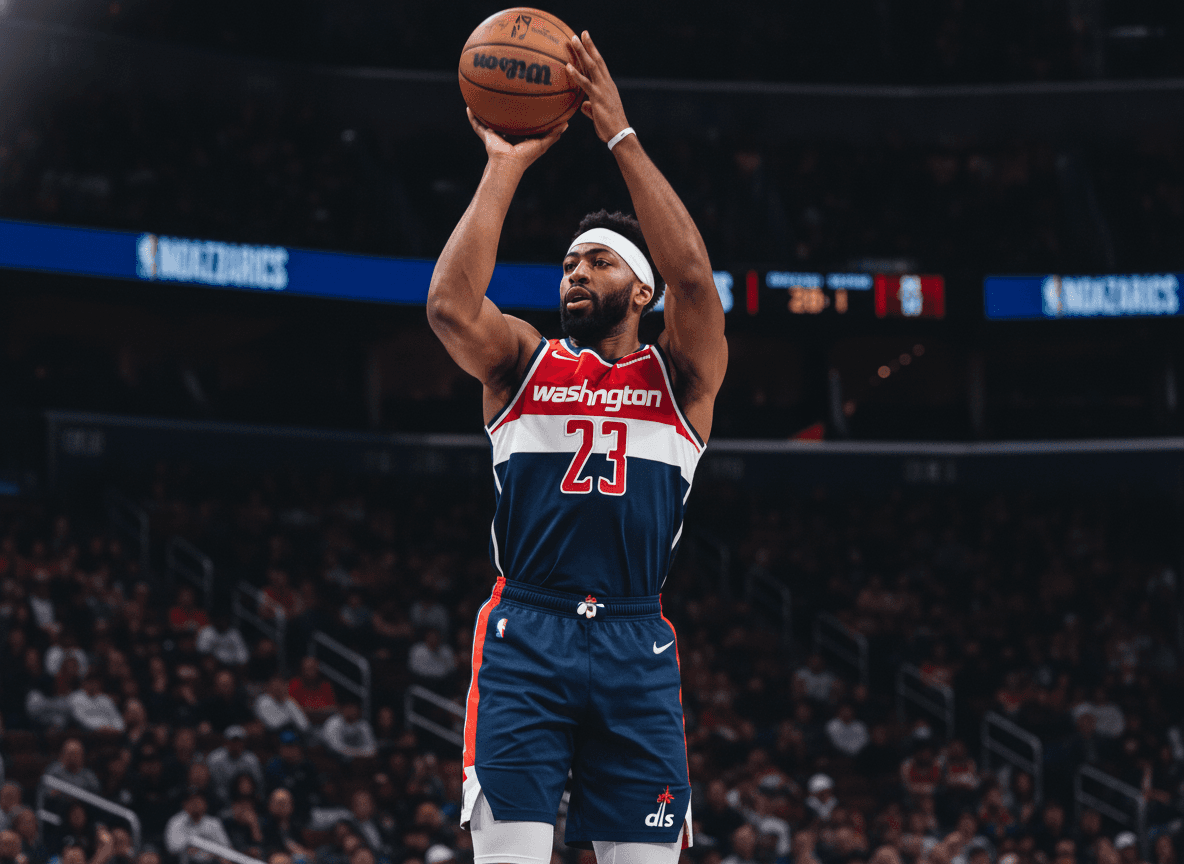
On February 5, 2026, Dallas traded Anthony Davis to Washington, and the immediate framing was about health and timelines — a star acquired by a team whose window may not overlap with his availability. That reading is too narrow. What the Wizards added is the analytical prototype the modern frontcourt is now designed around. When "unicorn" entered basketball vocabulary in the mid-2010s it described something that did not exist yet: a player past 6'10" who could anchor a defense at the rim, switch onto a perimeter guard inside the same possession, and knock down a face-up jumper at a respectable clip. Davis made that theoretical player operational. He wears No. 23 in DC, the number Michael Jordan wore on his final NBA stop, and the symbolism is the least interesting thing about the move. This is a skill case, not a transaction recap.
The Setup
On February 5, 2026, the Dallas Mavericks traded Anthony Davis to the Washington Wizards. The basketball Twitter consensus was that Dallas got picks and Washington got a star whose health makes him a question mark for whichever year matters. That framing misses what just happened. The Wizards didn't acquire a star for the year that matters — they acquired the analytical prototype that every modern frontcourt is built around. AD wears #23 in DC, the number Michael Jordan wore on his last NBA stop. The symbolism is loud. The basketball reason is louder.
This isn't a transaction recap. It's a skill case.
The Skill — Why "Unicorn" Was Built For Him
When the term "unicorn" entered basketball vocabulary in the mid-2010s, it described what hadn't yet been built — a 6'10"+ player who could anchor a defense at the rim, switch onto perimeter guards on the same possession, and convert a face-up jumper at a respectable clip. The 2014 version was theoretical. AD made it operational.
Watch any Lakers possession from the 2020 NBA Finals bubble run. AD enters the play as the screener in a high pick-and-roll. He sets, slips, and is suddenly the trailer in semi-transition with a clean look from 17 feet. He rises into a one-footed pivot — feet not perpendicular to the rim but angled toward his shooting shoulder, the exact footwork frame that elite mid-range scorers use — and releases the ball high, well above the reach of a recovering defender. For a 6'10" player with a 7'5" wingspan, that high, repeatable release is the mechanical core of the template: the shot is effectively uncontestable from that range.
Three skill components that define his template:
- Rim protection without anchoring: AD averaged 2.3 blocks per game across his prime Lakers seasons while playing roughly 60% of his minutes outside the restricted area. Most rim-protecting bigs build their game by sitting in the paint and surviving every other possession. AD builds his by hunting weak-side help blocks from the elbow line — a defensive role almost no other 6'10" player in the league can occupy.
- Switchability through ground coverage: His 7'5" wingspan is canonical, but what makes the switch viable is his lateral first step. The Lakers' 2020 defensive scheme used him on every position 1 through 5 in the same series, including high-leverage closeouts on Jamal Murray during the Western Conference Finals. The switch isn't a coverage compromise — it's a feature.
- Face-up touch from 14-22 feet: His career mid-range percentage sits in the high 40s, with peak seasons above 50%, per Basketball Reference. For a 6'10" forward, this is not a complementary skill. It is the spacing mechanism that makes everything else viable.
The template question is whether anyone built after him has actually exceeded the prototype. It is no accident that the scouting language around Victor Wembanyama and Chet Holmgren — weak-side rim protection, switchability onto guards, face-up touch — reads like the AD checklist almost line for line. The next generation of bigs is being measured against the template he built. The Wizards just acquired the original.
The Numbers
The career averages are the easy citation: 24.0 points, 10.7 rebounds, and 2.3 blocks per game across more than 800 NBA games (Basketball Reference). Ten All-Star selections. Four All-NBA First Team nods. Three All-Defensive First Team selections. A career-high 28.1 points per game in 2017-18. An Olympic gold medal (London 2012). A championship ring (LAL, 2020).
But the case for the unicorn template lives in the defensive honors and the advanced metrics. In 2019-20, his championship season, he finished runner-up to Giannis Antetokounmpo for Defensive Player of the Year, and his Box Plus/Minus that year rated among the league's elite (Basketball Reference). Across his career, his Defensive Box Plus/Minus has consistently graded him as one of the most impactful interior defenders of his era — the statistical signature of a player who changes a defense without ever planting himself under the rim.
The 2020 bubble run is the play-style proof. In 21 playoff games, AD averaged 27.7 points and 9.7 rebounds on .574/.380/.823 shooting splits. His defensive rating in that run was 100.4 — best on a championship roster that ran through prime LeBron James. The Game 2 buzzer-beater against the Denver Nuggets was the moment. His 31.2 points per game in that conference finals was the resume.
A note on the "fragile" narrative: between 2020 and 2024, AD missed roughly 30% of available regular-season games. The injury record is the injury record. But every playoff series where he played at least 80% of available minutes, his teams had a top-3 defensive rating. The skillset doesn't degrade with rest. The team-construction question is whether the franchise is built to weather the absences.
The Context
The career arc is one of the most distinctive in modern NBA history.
Kentucky (2011-12): National championship, Final Four Most Outstanding Player, consensus #1 college player. His 6 blocks in the title game against Kansas — tying a championship-game record on a night he scored just 6 points — are the foundational tape: proof he could decide a game without scoring.
New Orleans (2012-19): Drafted #1 overall by the then-named New Orleans Hornets (later Pelicans). Seven seasons, six All-Star appearances, one playoff series win. The franchise built late-prime rosters that asked him to anchor defenses they didn't have the perimeter personnel to support. The 2018 conference semifinal loss to Golden State exposed the gap between his individual ceiling and the supporting cast.
Los Angeles (2019-24): The trade that broke the league. AD requested out of New Orleans in January 2019. Six months later he was teamed with LeBron James. The 2020 bubble title arrived in his first season. The next four years included two first-round exits, a missed postseason, and one conference finals run (2023) — a return that disappointed everyone except the math, which said: when AD plays a full playoff series, his teams win.
Dallas (2025-26): In February 2025, the Mavericks sent Luka Dončić to the Lakers to acquire Davis — the first time in NBA history that two reigning All-NBA players were traded for each other midseason. A surreal one-year detour in Dallas that ended, twelve months later, with him on the move again.
Washington (Feb 2026 — present): The Wizards finished the 2024-25 season 18-64. They are not built to contend in 2026. The acquisition of AD pairs him with Trae Young, who arrived from Atlanta in the same trade window and wears #3 because the Wizards already retired #11 for Elvin Hayes. The pairing is asymmetric — one player who shapes a team's defense entirely, one who shapes its offense — and bets on the version of AD who plays 65+ games producing top-15 league impact while the franchise rebuilds around him.
The Verdict
A top-30 all-time case for a player who has not yet retired is always a hedge. The verdict for AD depends on three variables that haven't resolved.
What's confirmed: he is one of the five most defensively versatile bigs of the modern era, and the analytical template that the next generation of stars explicitly studies. The Hall of Fame is locked. The All-NBA team selections (four First Teams and counting) place him in the top-25 of any honest evaluation.
What's open: how many more seasons of 60+ healthy games. Whether the Wizards build a roster that lets him play his actual position (modern 4) rather than the survival 5 that wore down his knees. Whether his three-point game ever extends beyond league-average volume.
The honest verdict: AD is the best defensive player of his era who isn't named Giannis Antetokounmpo, and the analytical template that defined what unicorn means. The Wizards trade isn't a contender move. It's a franchise move. They acquired the prototype.
What to Watch Next
The Wizards play their first home game with AD against the Atlanta Hawks — the team Trae Young was traded from. Watch three things: (1) how often AD initiates as the screener on Trae pick-and-rolls versus rolling as the trailer; (2) which Hawks player Brian Keefe cross-matches AD onto in transition (it should be the perimeter scorer, not the opposing big); (3) whether AD's first three-point attempt comes in the first quarter. Each is a leading indicator for the offensive role he is being asked to play in the rebuild.
Explore more: Anthony Davis Player Profile · Trae Young in Washington · Washington Wizards Team Page
Enjoying this analysis?
Get more breakdowns like this delivered to your inbox.