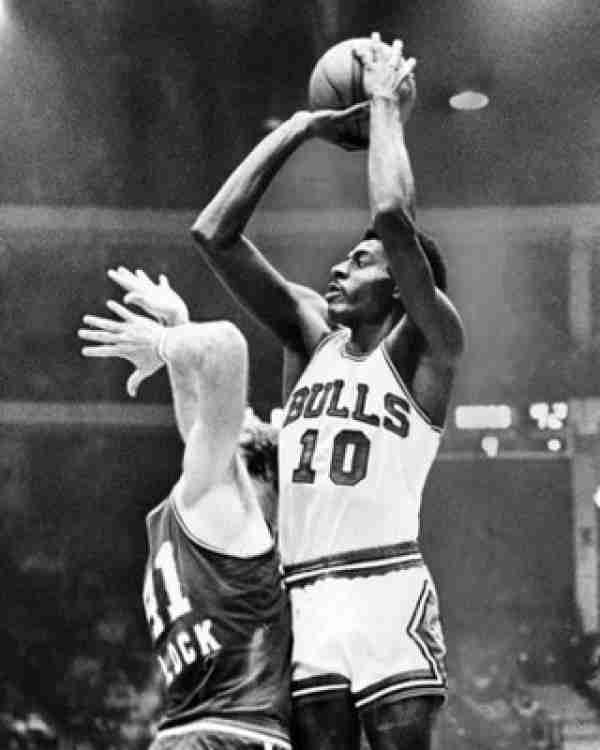
Lou Hudson earned his nickname the honest way. Sweet Lou was not a marketing invention or a media construction — it was the basketball world's attempt to describe what it looked like when Hudson caught the ball and went to work. Fluid where others were mechanical. Effortless where others strained. A scorer who made the extraordinary seem inevitable, possession after possession, season after season, for eleven years in the St. Louis and Atlanta Hawks organization.
His #23 hangs in the State Farm Arena rafters as tribute to a player who gave his prime years to a franchise that has retired only three numbers in its history. Hudson shares that distinction with Bob Pettit and Dominique Wilkins — a group small enough to feel exclusive, prestigious enough to define what the franchise has historically considered worthy of permanent honor.
Greensboro to Atlanta
Born in Greensboro, North Carolina, in 1944, Lou Hudson played college basketball at the University of Minnesota, where he earned All-Big Ten recognition and established himself as one of the premier players in the conference. The St. Louis Hawks selected him fourth overall in the 1966 NBA Draft — a decision that the franchise would benefit from for eleven consecutive seasons.
Hudson arrived in St. Louis just as the championship-era Hawks were transitioning. Bob Pettit was in his final seasons. The franchise was entering a new period that would eventually include relocation to Atlanta. Lou Hudson became the bridge between eras — the player who carried the scoring burden through years that did not produce championships but produced basketball worth watching.
Six Consecutive All-Stars
From 1966 to 1972, Lou Hudson was named to six consecutive NBA All-Star Games. In an era dominated by the Celtics dynasty and the emergence of new powerhouses across the league, Hudson's sustained excellence was a statement about the quality of his game on a team that did not always maximize his abilities.
He averaged 20+ points per game in six different NBA seasons — a mark of consistency that places him among the most reliable scorers in franchise history. His peak was the 1972-73 season, when he averaged 27.1 points per game and established himself as one of the premier offensive players in the league. Those are numbers that demand attention in any era.
Sweet Lou at his best was a player who made the right decision every time — the pull-up when the defender was a step slow, the drive when the spacing was right, the dish when the help arrived. Every move seemed to come from a complete understanding of what was available, filtered through the physical ability to execute whatever the moment required.
The Complete Scorer
What separated Hudson from the pure volume scorers of his era was the quality of his shot selection and the range of his offensive tools. He was not simply a player who shot a lot and converted at a reasonable percentage. He was a player who understood which shots to take, which situations to avoid, and how to create advantages through footwork and positioning rather than raw athleticism alone.
His mid-range game was the foundation — an arsenal of pull-up jumpers from 15-18 feet that defenders could not contest without giving him the driving lane he would take just as readily. Off the dribble or off the catch, Hudson found a way to score from every area of the court and in every defensive configuration the opponents threw at him.
Career Numbers
- 6x NBA All-Star (1966-1972)
- Career 20.2 points per game average
- Six seasons averaging 20+ points per game
- Peak season: 27.1 PPG (1972-73)
- 11 seasons exclusively with St. Louis and Atlanta Hawks
- Hawks franchise all-time scoring leader at the time of his retirement
- 2023 Naismith Memorial Basketball Hall of Fame (Veterans Committee)
The Long-Overdue Hall of Fame
In 2023, the Naismith Memorial Basketball Hall of Fame inducted Lou Hudson through the Veterans Committee — a recognition that had been long overdue and that was received with genuine celebration by the Atlanta basketball community that remembered what he had given the franchise over eleven seasons.
Hudson's career had been undervalued in the decades following his retirement — a product of playing in a market that did not generate the national media attention of New York or Los Angeles, on teams that were competitive without being championship contenders. The Hall of Fame corrected a historical oversight that the Atlanta Hawks organization had already recognized by retiring his number in 1989.
Why #23 Earned Its Place
The Hawks retired Lou Hudson's #23 because he represented something essential about the franchise's identity during a formative era — the kind of player who makes you believe that watching this team is worth your time, night after night, for a decade. He was not the championship hero. Bob Pettit owns that distinction. He was not the national superstar. Dominique Wilkins would claim that mantle. He was the elegant professional who showed up, scored, competed, and elevated the organization through eleven seasons of consistent excellence.
Sweet Lou. Twenty-three. In the rafters, where it belongs.
Menikmati analisis ini?
Dapatkan lebih banyak breakdown seperti ini langsung ke kotak masuk Anda.