Karl-Anthony Towns in New York: How the Knicks Unlocked an Unstoppable Big Man
Towns has always been capable of 25-12 nights. In New York, paired with Jalen Brunson and surrounded by shooters, he's doing it on the most efficient offensive possession rate of his career. A deep dive into how the Knicks built the East's most dangerous frontcourt.
本页面包含联盟链接。如您通过这些链接购买,我们可能获得佣金,对您无额外费用。 As an Amazon Associate I earn from qualifying purchases.
For four seasons in Minnesota, Karl-Anthony Towns was forced into post positions or uncomfortable threes; the article's analytical thesis is that the right offensive architecture, not a different player, unlocked one of the league's most efficient centers. Towns shoots 38.7% from three on 5.8 attempts per game — a volume-and-accuracy profile no center in NBA history has matched at his production level — and pairs it with a 1.06-PPP post-up game that makes the inside-out combination unguardable. His on-court offensive rating of 121.3 versus 108.4 without him is a +12.9 swing per 100 possessions, while 11.4 rebounds (3.1 offensive) convert misses into possessions. Alongside Jalen Brunson, whose pick-and-pop actions force binary defensive choices, the two-man net rating reaches +13.4. In 2025-26 he averages 24.8 points and 11.4 rebounds on a career-high 65.2% true shooting. It matters because that system will be tested when playoff margins disappear.
The Floor-Spacing Revolution
Towns has always been unusual for a center: a consistent three-point shooter who connects at 38.7% in 2025-26 from beyond the arc on 5.8 attempts per game. At his position, that volume and efficiency has no direct precedent in NBA history. No center has ever shot threes at this rate while producing at this level in every other statistical category.
Youth Nike Karl-Anthony Towns Blue New York Knicks Swingman Jersey - Icon Edition
But the three-point shooting only generates its full value in the right offensive structure. In Minnesota, despite surrounding Towns with perimeter players, the offensive system never fully optimized for his floor-spacing potential. The ball got stuck in isolation too frequently, which reduced the number of pick-and-pop actions that create Towns's best looks.
New York's system is different because Jalen Brunson is different. Brunson's pick-and-roll game — among the most sophisticated in the league — generates a binary defensive problem every time he runs an action with Towns: help the roll man or protect the pop-out shooter. When Towns is the pop-out shooter and Brunson is the roller in reverse — or vice versa — this problem becomes acute.
Jalen Brunson & Karl-Anthony Towns New York Knicks Autographed 16" x 20" Photograph
"The thing about KAT on a pick-and-pop is that he's always in a position where the defense has no good option. If they go under the screen, he's an elite three-point shooter — 38% from center range is undefendable from the short side. If they go over, Brunson has the driving lane. You're choosing your poison on every possession." — Eastern Conference defensive coordinator
Inside-Out Scoring: The Combination No Defense Has an Answer For
Towns's three-point shooting gets most of the attention. His post-up game — which he uses selectively and efficiently — is what makes the combination truly unguardable.
Karl-Anthony Towns New York Knicks Autographed Wilson Authentic Series Indoor/Outdoor Basketball with "NY Forever" Inscription
At 7'0" with a face-up game, a jump hook, and enough ball-handling to put it on the floor from the elbow, Towns as a post-up scorer generates 1.06 PPP. That number competes with the best post scorers in the league. But the three-point shooting is what creates the post-up opportunity: defenses that send help to stop his post-up leave shooters open (New York shoots 38.8% from three as a team). Defenses that stay home on shooters give Towns clean looks on his drive or jump hook.
The combination creates a version of Towns that opposing teams prepare for differently from game to game — and that preparation itself creates advantages. If a team over-prepares for his three-point shooting, his post-up work opens. If they focus on his post, the corner three shooters get wide-open looks. The defensive preparation for Towns creates the openings for the Knicks' system.
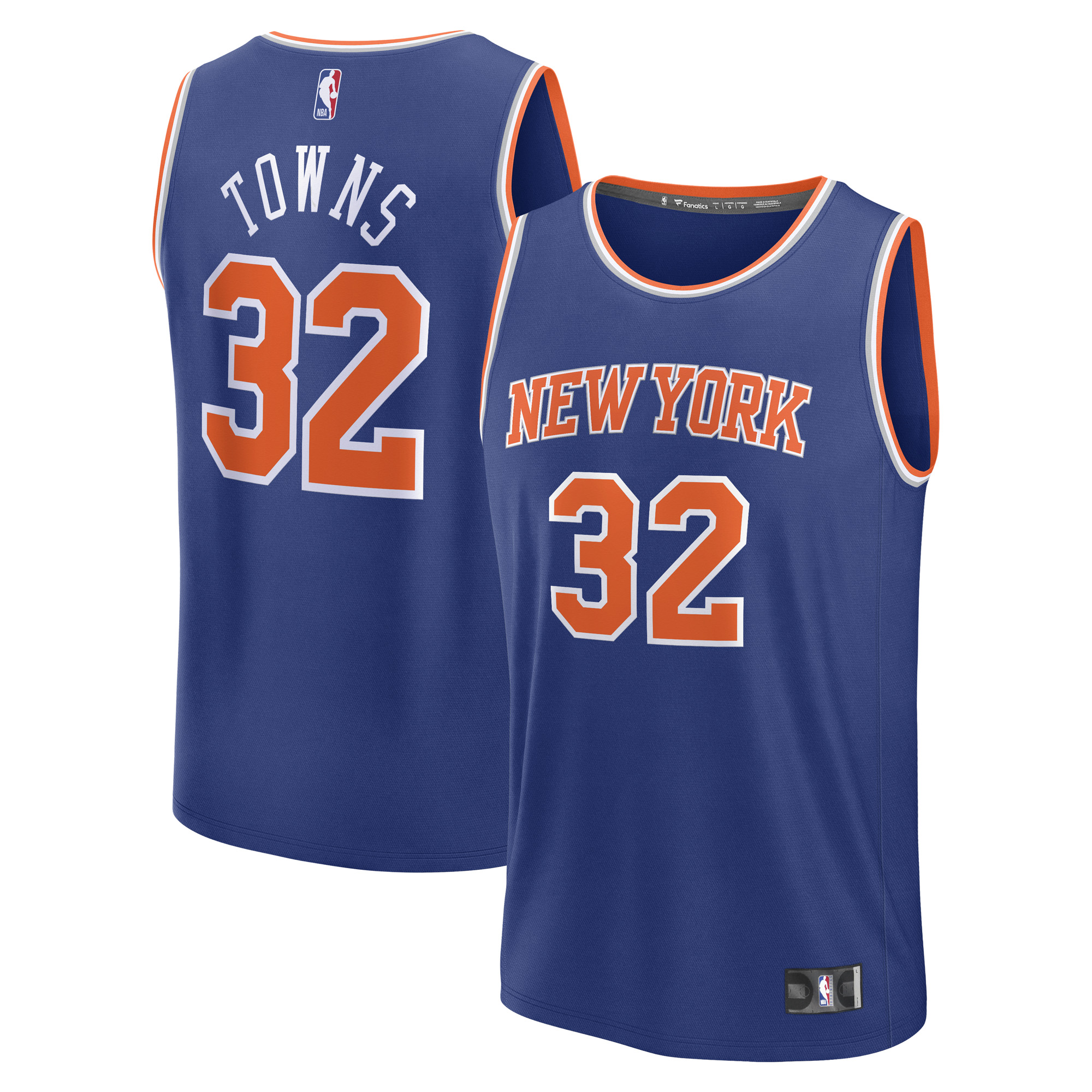
Men's Fanatics Karl-Anthony Towns Blue New York Knicks Fast Break Replica Player Jersey - Icon Edition
Rebounding Dominance: The Understated Contribution
Towns averages 11.4 rebounds per game — the headline number that gets less attention than his scoring. But the rebounding impact extends beyond the raw total in ways that affect New York's competitive standing.
His offensive rebounding — 3.1 per game, top 5 among centers — generates second-chance points at a rate that meaningfully increases New York's offensive efficiency. Teams that design their defense around containing Towns's half-court scoring frequently pay for it with his offensive rebounding, which converts poor shot attempts into additional possessions at the same points-per-possession cost as a made shot.
Karl-Anthony Towns New York Knicks Autographed Cream New Era Autumn 59FIFTY Fitted Hat
His defensive rebounding (8.3 per game) has the secondary effect of creating transition opportunities for Brunson and OG Anunoby — players who produce significantly more efficiently in transition than half-court situations. The statistical chain from Towns defensive rebound to Brunson transition drive is one of the most valuable sequences in New York's offensive playbook.
Offensive rating with Towns on court: 121.3 (top 5 in the NBA)
Offensive rating without Towns: 108.4
Differential: +12.9 per 100 possessions
3P% from center range: 38.7% on 5.8 attempts (no center in NBA history has surpassed 36% at this volume)
The Brunson Partnership: Chemistry Through Complementarity
Jalen Brunson's offensive game and Towns's positioning create a two-man combination that forces defensive compromises on every possession. Their on-court net rating of +13.4 represents one of the best two-man units in the NBA — better than any pairing produced during the championship-caliber Minnesota teams.
Karl-Anthony Towns New York Knicks Autographed Action 16" x 20" Photograph
The chemistry extends beyond statistics to the qualitative: Brunson and Towns have developed a shared language of actions that communicate through movement rather than verbal calls. Towns's step-out from the block signals Brunson's drive window. Brunson's hesitation at the three-point line signals a Towns post-up. These micro-communications happen faster than defensive adjustments can track, giving the pairing an efficiency premium beyond what the individual skill sets predict.
KAT in 2025-26: 24.8 PPG, 11.4 RPG, 4.2 APG, 1.6 BPG. 55.1% FG, 38.7% 3P, 83.4% FT. True shooting: 65.2% (highest of his career). Net rating with Brunson: +13.4. Madison Square Garden is averaging 19,812 fans per game — franchise record.
Karl-Anthony Towns New York Knicks Autographed Game-Used #32 Blue Jersey vs. Toronto Raptors on January 28, 2026 with "GU 1-28-26 vs TOR" Inscription - Size 54+6
The Championship Question
New York has the best player the franchise has had since Patrick Ewing — Brunson — and the most analytically unusual center in the league in Towns. The Eastern Conference path to the Finals runs through Boston, and the Celtics have the defensive infrastructure (Tatum, Brown, their system depth) to present problems that the Knicks haven't faced against softer opponents.
What the Knicks have that makes a deep run plausible: Towns's shooting forces Boston's defense into choices it hasn't faced in recent playoff runs. Brunson's half-court creation is elite in the clutch moments that define series outcomes. OG Anunoby, when healthy, adds a defensive dimension that gives New York's defense teeth at the wing level where Eastern playoff series are usually decided.
Karl-Anthony Towns New York Knicks Facsimile Signature Framed 11" x 14" Spotlight Photograph
The system that unlocked Towns's best basketball will be tested when the margin for error disappears. The outcome will define whether this Knicks team was a great regular-season construction or something more — a genuine championship threat built around one of basketball's most unusual players in one of basketball's most unique situations.
Karl-Anthony Towns New York Knicks Autographed Game-Used #32 Blue Jersey vs. Toronto Raptors on January 28, 2026 with "GU 1-28-26 vs TOR" Inscription - Size 54+6
Boozer and Peterson opened as 2027 NBA Rookie of the Year co-favorites over No. 1 pick AJ Dybantsa. We break down role, usage and the real case for each.
AJ Dybantsa is the presumptive face of the Wizards' rebuild — brought in as the No. 1 overall pick even though Washington already has six NBA wings on the roster. A look at the record-breaking BYU season, the Darryn Peterson decision, and why talent still beats a crowded depth chart.
Dylan Harper arrived as the No. 2 pick and finished his rookie year as an All-Rookie First Team guard starting in the NBA Finals. A film-room look at the Filipino-American lead guard powering San Antonio's next era alongside Victor Wembanyama.