How can you spot a fake NBA jersey?
Check the jock tag first — the small woven label on the lower-left inside hem. Authentic Nike NBA jerseys are made in Thailand, Indonesia, or Honduras; a tag reading "Made in China," a size that doesn't match the jersey, or a blurry style code are the fastest signs a jersey is counterfeit.
- The jock tag on the lower-left hem is the single fastest authentication check.
- Authentic name and number twill is stitched; most fakes are printed or glued.
- The NBA logoman should be embroidered in layered thread, never a flat patch.
- Swingman jerseys run about $120; Authentic run roughly $200–$325.
- Nike edition names — Association, Icon, Statement, City — are real product terms.
If you are buying your first real jersey to match our guide to this season's top players' championship jerseys, the hard part is not choosing a name on the back — it is knowing the one in your cart is genuine. Counterfeit NBA jerseys have gotten good. The screen-printing is cleaner, the fake holograms shinier, and the marketplace photos are lifted straight from official stores. But real jerseys are built to a fixed spec, and fakes cut corners in the same predictable places every time.
This is a hands-on, 7-point checklist you can run in about two minutes — in a store, or the moment a package arrives. We will move from the tell that catches the most fakes (the jock tag) to the details counterfeiters get wrong last: the stitching, the Nike Swoosh and NBA logoman, the tags and holograms, the fabric, the price and seller, and the Nike edition name. Whether you want a Lakers jersey or a throwback, the same seven checks apply.
What is the jock tag, and why is it the fastest way to spot a fake?
The jock tag is the woven or printed label stitched into the lower-left interior hem of the jersey. On an authentic Nike jersey it lists the size and a Nike style/product code, and states the country of manufacture — Thailand, Indonesia, or Honduras. A tag that says "Made in China" is almost always counterfeit.
Beyond the country, three details give fakes away. First, the size on the jock tag must match the size printed elsewhere on the garment — mismatches are common on knockoffs. Second, the printing should be crisp, with a correct Nike sans-serif font and no bleeding or smudging. Third, the style code (a format like AT9793-010) should be legible and consistent. Because the jock tag carries the most data in the smallest space, it is where mass-produced fakes fail most often.
Are the names and numbers stitched or heat-pressed?
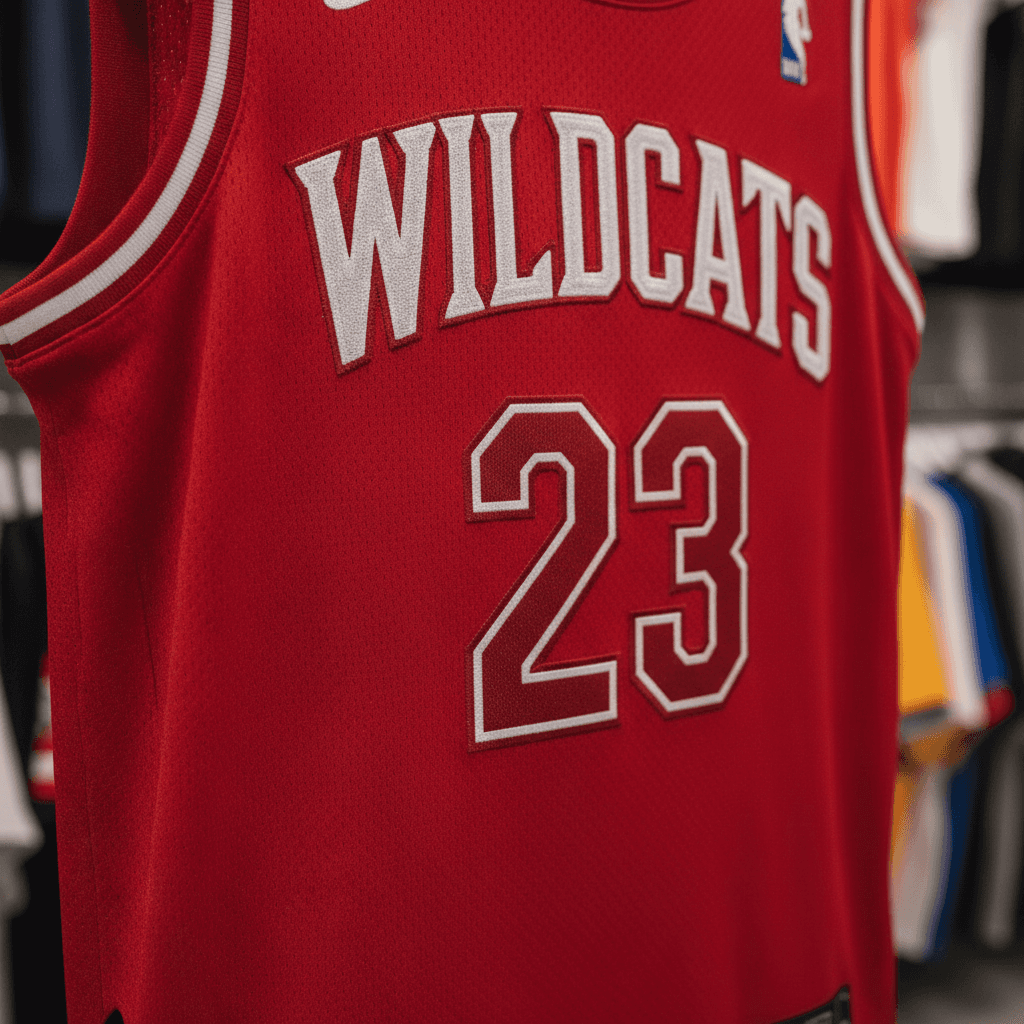
How the name and number are applied depends on the tier. On a Nike Authentic jersey, the letters and numbers are sewn-on twill — thick, layered fabric you can feel with a fingernail. On a Nike Swingman, they are screen-printed or heat-applied and sit flush with the jersey. Neither is fake by itself; the tier sets the expectation.
The counterfeit tell is sloppiness, not method. On real jerseys the thread color is matched so precisely that the stitching nearly disappears; fakes often use an off-shade thread that stands out against the twill. Look for crooked numbers, uneven letter spacing, loose threads, or glue seeping from the edges of a "twill" patch — signs a maker faked the premium look without the construction. If a jersey is sold as Authentic but the number peels or feels printed, the tier claim is false.
How should the Nike Swoosh and NBA logo look?
The two brand marks are hard to fake cleanly. On the upper-right chest, the Nike Swoosh is stitched and embroidered on Authentic jerseys and heat-pressed on Swingman jerseys — but on either tier it should be cleanly applied, centered, and free of loose threads. A crooked or bubbling Swoosh is a warning.
The NBA logoman — the Jerry West silhouette — is the stronger tell. On genuine jerseys it is embroidered with layered, different-colored stitching (red, white, and blue thread). Counterfeits routinely skip that cost and use a flat, sewn-on or heat-applied patch with printed color instead of real thread layers. Run a finger over the logo: if it feels like a smooth sticker rather than raised, multi-color embroidery, treat the whole jersey as suspect.
What do the neck tags, holograms, and QR codes prove?
Interior neck and hem tags should carry consistent branding, clean printing, and matching sizing. Some retail jerseys ship with hangtags that include a hologram or a scannable QR code. When present, an authentic hologram shifts color as you tilt it and shows a clean Nike logo, and a QR or swing tag should scan to an official Nike or NBA verification page.
One honest caveat: a hologram is a signal, not proof. Counterfeiters copy hologram stickers and print fake QR codes that lead nowhere official, so a shiny tag alone should never close the case. We are deliberately not publishing any specific hologram serial or code format, because those details are not something we can verify from an official source — and any "guaranteed code" you see online is exactly the kind of claim scammers exploit. Weigh the tags alongside the jock tag, stitching, and logo, not instead of them.
Does the fabric match the jersey tier you paid for?
Fabric separates the tiers as much as the graphics do. A Nike Swingman jersey uses a smooth, lightweight, slightly stretchy polyester. A Nike Authentic jersey uses Nike's AeroSwift build, with a more textured hand and visible mesh ventilation zones engineered for on-court play. If a listing charges Authentic money for thin, flat, Swingman-weight material, the price and the product do not match.
Feel and weight are your best in-hand test. Real jerseys have substance and a consistent, even weave; many fakes feel papery, overly slick, or unevenly cut. Seams should be flat and straight, side panels aligned, and mesh — where present — uniform. A jersey that feels like a cheap gym pinnie is telling you what it is.
When are the price and the seller the real red flags?
Price is the reality check that catches deals too good to be true. At retail, Nike Swingman NBA jerseys sit around $120 (the official NBA Store lists them near $119.99), while Authentic jerseys run roughly $200–$325. A "current-player Authentic" listed at $45 is not a bargain — it is a counterfeit or a mislabeled replica.
The seller matters as much as the number. Buy from the official NBA Store, Nike, Fanatics, or established team shops. On open marketplaces, watch for stock photos only (no real product shots), sellers shipping directly from overseas, brand-new accounts, no returns, and prices that undercut every legitimate store at once. If the seller cannot show the jock tag and logoman up close, ask — and walk if they dodge.
Which Nike jersey edition are you buying — and why the name matters?
Since Nike took over the NBA uniform contract in 2017, jerseys are sold under four named editions, and knowing them stops you from overpaying or being misled. Association is the classic home white; Icon is the team's primary color; Statement is the bold alternate; and City is the special annual design that tells a story about the team's city.
Fakes often mix these up — pairing a "City Edition" label with last year's artwork, or calling a plain design "Statement" to justify a markup. Cross-check the edition name against the actual colorway on the official NBA Store before you buy. For 2025-26, Nike launched the new City Edition collection on November 11, 2025, so any "2025-26 City" jersey should match those released designs. Retro numbers like a retired Michael Jordan No. 23 fall under Mitchell & Ness hardwood-classics lines, which follow their own stitched construction rules.
Real vs. fake NBA jersey: the 7-point comparison
Here is the full checklist in one view. Run every row — a jersey can pass one or two checks by luck, but authentic jerseys pass all seven.
Frequently Asked Questions
Can an NBA jersey be real if it says "Made in China"?
For current Nike NBA jerseys, no. Authentic Nike jerseys are manufactured in Thailand, Indonesia, or Honduras, so a jock tag reading "Made in China" is one of the most reliable counterfeit signals. Older or vintage licensed jerseys from other eras and brands can differ, but for modern Nike stock, treat a China tag as a fail.
What is the difference between a Swingman and an Authentic jersey?
Both can be genuine — they are different Nike tiers. Swingman jerseys (around $120) use lighter fabric with screen-printed or heat-applied names and numbers. Authentic jerseys ($200–$325) use Nike's AeroSwift material with stitched twill lettering and mesh ventilation. The problem is a Swingman sold at Authentic prices, or a fake imitating either.
Do authentic NBA jerseys have a hologram or QR code?
Some retail jerseys ship with hangtags carrying a hologram or scannable QR code, and when present an authentic hologram shifts color and shows a clean Nike logo while the QR links to an official page. But counterfeiters copy holograms, so treat it as one signal among seven — never as standalone proof of authenticity.
Is a cheap NBA jersey always fake?
Not always — clearance, past-season stock, and legitimate Swingman jerseys can be genuinely inexpensive. The warning is a current-player "Authentic" priced far below the roughly $200–$325 retail range, sold by an unknown marketplace seller with stock photos only. If the price undercuts every official store at once, run the full checklist before buying.
How to buy an authentic NBA jersey with confidence
The safest move is to remove the guesswork: buy from the official NBA Store, Nike, Fanatics, or an established team shop, where the tier and edition are stated plainly and returns protect you. On resale marketplaces, the checklist is your defense — start with the jock tag, confirm the country of manufacture and matching size, then work through the stitching, the Swoosh and logoman, the tags, the fabric, and finally the price and seller.
No single check is foolproof, which is why it is a seven-point list and not a single trick. A real jersey passes all seven; a fake trips on at least one, usually the jock tag or the logoman. Learn those two cold and you will catch the large majority of counterfeits before your money leaves your hand — and enjoy a jersey built to last.
Enjoying this analysis?
Get more breakdowns like this delivered to your inbox.