Are indoor and outdoor basketballs actually different?
Yes — and the cover material is the only difference that matters. Indoor basketballs use soft full-grain or microfiber composite leather tuned for hardwood; outdoor balls use rubber or tougher composite that survives asphalt and concrete. Play an indoor leather ball outside and its grip is gone within weeks.
- Cover material — not size, weight, or color — is what separates the two.
- Leather and microfiber balls are built for hardwood; asphalt destroys them fast.
- Rubber balls are game-ready out of the box and shrug off concrete.
- A composite indoor/outdoor ball is the smartest single pick if you play both.
- Match the ball to your surface and it lasts years, not weeks.
Walk into any sporting-goods aisle and the basketballs look identical: same 29.5-inch size 7, same orange, same pebbled grain. The price tags tell a different story — one ball costs $15, the one beside it costs over $100. That gap isn't branding. It's the cover, and choosing the wrong one is the fastest way to waste money on gear. If you already know you play mostly on blacktop, skip ahead to our guide to the best outdoor basketballs for 2026 — but if you want to understand the decision before you spend, this is the breakdown.
We'll cover what physically changes between an indoor and outdoor ball, why an indoor ball fails on concrete, how the three cover materials — full-grain leather, composite, and rubber — actually compare, and which one to buy for your specific setup. The short version: the surface you play on decides the ball, and getting it right is cheaper than getting it wrong twice.
What actually separates an indoor from an outdoor basketball?
The cover material, full stop. Size, weight, and internal bladder are effectively the same across a regulation size 7 ball. What changes is the skin: indoor balls wear leather or microfiber composite for feel; outdoor balls wear rubber or reinforced composite for survival.
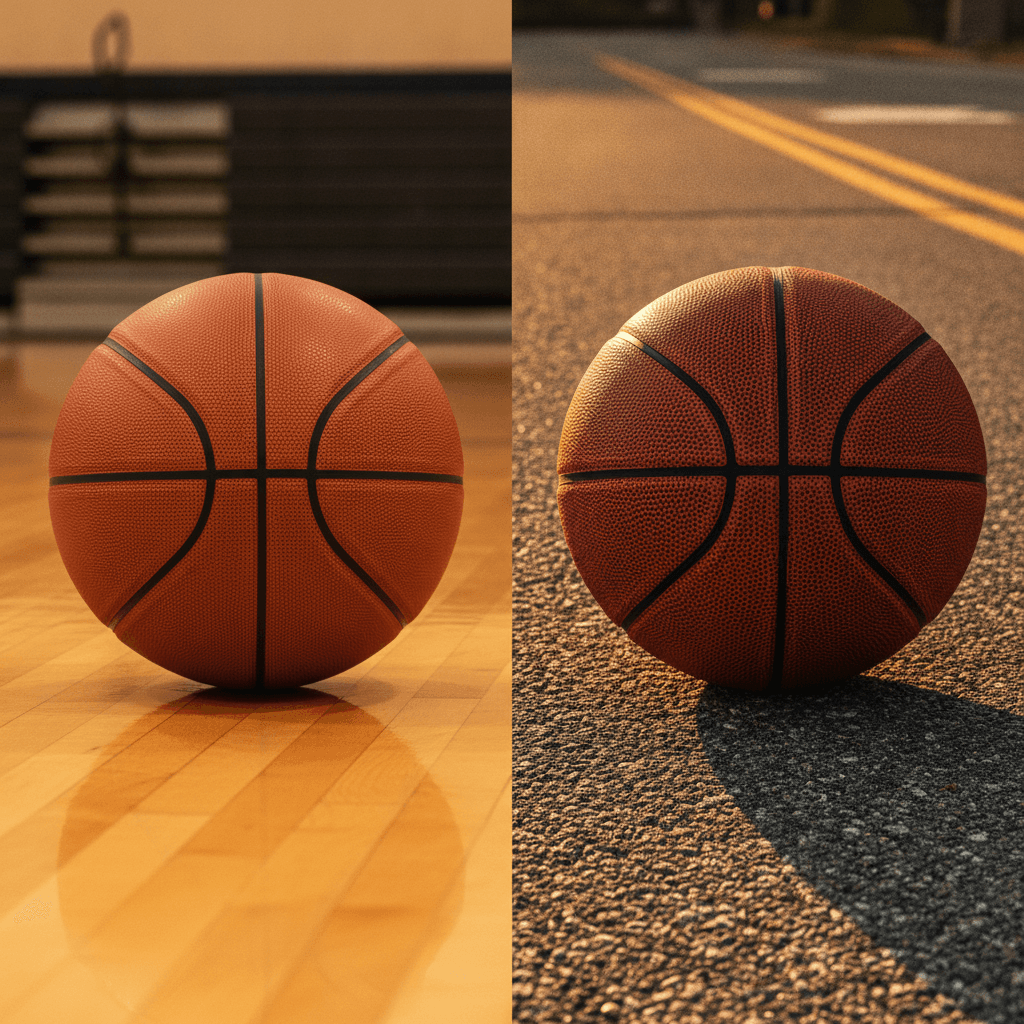
An indoor ball is engineered for a clean, polished hardwood floor. Its cover is soft and tacky so the ball sits in your fingertips and releases cleanly. The Wilson NBA Official Game Ball — the exact ball used in the league — is built from genuine Horween leather in an eight-panel configuration, and Wilson openly notes it "will initially feel slick and rough to the touch" until you break it in. That break-in is the point: leather rewards players who put hours into one ball.
An outdoor ball is engineered for abuse. The Spalding NBA Street, one of the most common park balls in the country, uses a durable rubber cover with deep channels "that stands up to asphalt or concrete," per Spalding's product page. It needs no break-in, tolerates dirt and moisture better, and costs a fraction of a leather ball. The trade is feel — rubber never gets as soft or tacky as leather.
Why does an indoor ball fall apart outside?
Because asphalt is an abrasive, and leather is not built to be sanded. Concrete and blacktop act like coarse sandpaper on every bounce and dribble, grinding down a soft cover far faster than a smooth wood floor ever could.
Leather and microfiber composite covers are designed for a low-friction hardwood surface. Drag them across concrete and the pebbling flattens, the tackiness disappears, and the grip goes with it. As one materials breakdown put it, dragging leather across concrete "even a few times begins to roughen and break down the surface in ways that cannot be reversed." What you're left with is a slick, uneven ball that cost you three figures and lasted a summer.
This is the single most common — and most expensive — mistake players make. A premium indoor ball feels incredible in the store, so people buy it and take it to the park. Within weeks the cover is chewed up. The ball wasn't defective; it was used on the surface it was specifically not designed for. Rubber and outdoor-rated composite covers, by contrast, are formulated to take that abrasion for years.
Indoor vs outdoor basketball: the full comparison
Here's every meaningful difference side by side. Use it to match a ball to where you actually play, not to where you wish you played. Note that "composite" spans both worlds — a quality composite is the true crossover pick.
Which basketball should you buy?
Answer one question first: where do you play the most? Your dominant surface, not your favorite ball, drives the decision. Here's the pick for each of the three common situations.
If you play indoors only: buy a leather or premium microfiber composite ball. For serious gym and league play, genuine leather like the Wilson NBA Official Game Ball delivers the best touch, though it demands break-in and stays indoors permanently. If you want game feel at a lower price and less fuss, a microfiber composite such as the Wilson Evolution — a 100% microfiber composite cover that's NFHS-approved for high-school play — is a genuine gym staple for good reason.
If you play outdoors only: buy a rubber ball and never look back. A durable rubber cover like the Spalding NBA Street is cheap, grippy enough, weatherproof, and disposable in the best sense — when it finally wears out after years of park runs, you replace it for under $25. Pair it with the right footwear too; our roundup of the best outdoor basketball shoes for 2026 covers soles built for the same abrasive surfaces.
If you play both: buy one indoor/outdoor composite ball. This is the sweet spot for most recreational players. A composite cover such as the Wilson NBA Forge line is "made to dominate indoor and outdoor courts," per Wilson, giving you most of leather's soft feel while surviving concrete far better than leather can. You give up a little touch versus true leather and a little lifespan versus pure rubber — but you carry one ball instead of two.
Does the cover material change grip and feel?
Dramatically — grip is the whole reason these materials exist. Feel runs on a spectrum from tackiest (leather) to firmest (rubber), with composite sitting in the middle, and where you land changes how the ball behaves in your hand.
Full-grain leather offers the deepest, softest grip once broken in, which is why the NBA still plays on it. That tackiness helps ball-handling and gives shooters a consistent release — but only on a clean indoor floor, and only after you've logged hours softening the cover. Microfiber composite gets close to that feel right away with far less break-in, which is why it dominates high-school and college gyms. Rubber sits at the firm end: it's more durable and more forgiving of dust and moisture, but it never becomes truly tacky, so precision shooters notice the difference. None of these is "better" in a vacuum — they're optimized for different surfaces, and a ball that grips beautifully indoors can feel dead and slick once its cover is abraded outdoors.
How much should you pay?
Spend to match your surface and your commitment, not to chase a pro logo. There are three honest price tiers, and the most expensive ball is the wrong buy for most people.
Entry rubber balls run roughly $10–$25 and are the correct choice for outdoor and casual play — durable, grippy enough, and cheap to replace. Composite indoor/outdoor balls sit around $30–$70 and are the best value for anyone who plays both surfaces or wants gym-quality feel without leather's price and fragility. Genuine leather game balls start around $100 and climb; they're worth it only if you play indoors regularly and will invest the break-in time. Buying a $100 leather ball for the driveway isn't an upgrade — it's the single worst value in basketball gear, because you're paying a premium for a cover the concrete will destroy. Spend the difference on your shoes instead, where it actually compounds; our 2026 basketball shoe guide breaks down where that money goes furthest.
How do you make your basketball last?
Match the ball to the surface, keep it clean, and hold the right air pressure. Most basketballs die from misuse, not age — and a few habits stretch a ball's life from months to years.
First, never take a leather or microfiber indoor ball onto concrete; that one rule prevents most premature deaths. Second, wipe the cover down after play: Wilson recommends a dry microfiber cloth for leather and mild soap with warm water for rubber and composite, and Spalding's care guidance warns against submerging any indoor ball. Skip alcohol-based disinfectant wipes, which dry out leather and degrade coatings. Third, keep the ball properly inflated — regulation size 7 balls run around 7.5–8.5 PSI, and checking with a gauge protects the seams and bounce. Store it indoors at moderate temperature rather than baking in a car trunk or freezing in a garage.
Frequently Asked Questions
Can I use an indoor basketball outside?
You can, but you shouldn't. Asphalt and concrete act like sandpaper on a soft leather or microfiber cover, grinding away the grip within a few weeks. If you play outside regularly, buy a rubber or outdoor-rated composite ball and keep the indoor ball strictly for the gym.
What basketball works on both indoor and outdoor courts?
A quality indoor/outdoor composite ball, like the Wilson NBA Forge line, is the best all-surface pick. Its composite cover keeps much of leather's soft feel while resisting the abrasion of concrete far better than true leather, so one ball handles the gym and the driveway without falling apart.
Why are leather basketballs so expensive?
Genuine leather covers — like the Horween leather on the Wilson NBA Official Game Ball — are premium materials that deliver the deepest grip and touch, which is why the NBA plays on them. That feel comes at a cost, and it only pays off indoors; on outdoor surfaces the same cover wears out fast.
Do outdoor basketballs need to be broken in?
No. Rubber and outdoor composite balls are game-ready straight out of the box — that firmer, ready-to-play grip is part of the design. Break-in mainly applies to leather indoor balls, whose covers start slick and soften only after hours of play on hardwood.
Does size or color differ between indoor and outdoor balls?
No. A regulation men's ball is size 7 (29.5 inches) and orange regardless of surface. The only meaningful difference is the cover material. Any size or color variation you see is unrelated to whether a ball is built for indoor or outdoor use.
The bottom line: which ball wins?
Neither ball "wins" — the right one is whichever matches your surface. Play indoors on hardwood and a leather or microfiber composite ball gives you the touch the game is built around. Live on the blacktop and a rubber ball delivers durability and grip for the price of a couple of coffees. Split your time and a single indoor/outdoor composite ball is the honest best buy: slightly less feel than leather, far more life than leather outdoors, one ball to carry. Decide where you actually play, buy for that surface, take care of the cover — and the ball will outlast the debate. Ready to shop? Start with our picks in the best outdoor basketballs for 2026.
Enjoying this analysis?
Get more breakdowns like this delivered to your inbox.